
Does the Toyota RAV4 Have Lane Assist?
Last updated: September 19, 2026. Current U.S. Toyota RAV4 models include lane-assistance features, but the exact functions and controls depend on model year. The 2026 RAV4 uses Toyota Safety Sense 4.0 with Lane Departure Alert with Steering Assist (LDA w/SA) and Lane Tracing Assist (LTA).
Quick Answer
Yes. LDA warns when the RAV4 begins to leave a detected lane and can add a small corrective steering input. LTA provides more continuous lane-centering support, but on the 2026 RAV4 Toyota says lane markers must be detected and Dynamic Radar Cruise Control must be on. Neither feature makes the RAV4 self-driving.
Key Takeaways
- Lane Departure Alert and Lane Tracing Assist perform different jobs: one addresses lane departures, while the other supports lane centering.
- On the 2026 RAV4, Lane Tracing Assist requires Dynamic Radar Cruise Control and detected lane markers; it is not an independent self-driving mode.
- Toyota lists Toyota Safety Sense 4.0 as standard on the U.S. 2026 RAV4; earlier model years and other markets should be checked individually.
- Rain, snow, glare, construction zones, faded markings, sharp curves, and a blocked camera can reduce or disable assistance.
Warning: Toyota RAV4 lane assist is driver assistance, not autonomous driving. Keep your hands ready to steer, watch the road, and take control immediately whenever traffic, weather, road markings, or system messages require it.
What Is Lane Tracing Assist in the Toyota RAV4?

Lane Tracing Assist, commonly shortened to LTA, is Toyota’s lane-centering feature. When Dynamic Radar Cruise Control is enabled and the required operating conditions are met, LTA can apply ongoing steering inputs to help keep the RAV4 near the center of its lane.
For Toyota Safety Sense 4.0, Toyota states that lane markers must be detected and Dynamic Radar Cruise Control must be on before LTA can activate. The system uses road lines and can also use information about preceding vehicles as part of its lane-centering assistance. The driver must continue steering and monitoring the road.
Do not apply the Lane Departure Alert speed threshold to LTA. Toyota lists LDA operation above about 30 mph on TSS 4.0 and above about 32 mph on TSS 2.0/2.5-era systems, while LTA has separate requirements tied to Dynamic Radar Cruise Control and lane detection.
How to Tell Whether LTA Is Active
The instrument display shows whether LTA is selected and whether steering support is currently available. The icon design, colors, and messages differ by model year, so the safest check is the display legend in the owner’s manual for that exact RAV4.
- Feature selected: LTA may be enabled but waiting for all operating conditions.
- Steering support active: The display indicates that the system is currently helping with lane centering.
- Limited or unavailable: A message or changed indicator may appear when lane detection, weather, road geometry, or another requirement prevents operation.
Do not rely only on a remembered icon color or symbol from another RAV4 year.
How Lane Tracing Assist Differs From Lane Keeping Assist
Lane-assistance terminology is easy to confuse because manufacturers use different names. The National Highway Traffic Safety Administration separates the functions into warning, departure prevention, and continuous centering:
| Feature type | What it does | RAV4 example |
|---|---|---|
| Lane-departure warning | Provides an audible, visual, or steering-wheel warning when unintended lane drift is detected. | Lane Departure Alert |
| Lane-keeping assistance | Provides a limited corrective input to help prevent an unintended departure. | Steering Assist within LDA |
| Lane-centering assistance | Applies more continuous steering support to help remain near the lane center. | Lane Tracing Assist |
LTA is therefore closer to lane-centering assistance than to a simple lane-departure warning. LDA with Steering Assist, meanwhile, is intended to respond near a detected lane boundary rather than continuously center the RAV4.
Which Toyota RAV4 Years and Trims Have Lane Assist?
For U.S.-market RAV4s, “lane assist” has changed over time. Toyota made Lane Departure Alert with Steering Assist standard across the 2017 RAV4 lineup. The redesigned 2019 RAV4 then introduced Lane Tracing Assist for continuous lane-centering support with Dynamic Radar Cruise Control. For 2026, Toyota lists Toyota Safety Sense 4.0 as standard on the RAV4.
| U.S. model year | Lane-assistance milestone | What to verify |
|---|---|---|
| 2017–2018 | Toyota Safety Sense P with Lane Departure Alert and Steering Assist was standard on U.S. RAV4 grades. | These years have departure warning/correction, not the later LTA lane-centering feature. |
| 2019 | The fifth-generation RAV4 introduced Lane Tracing Assist with Toyota Safety Sense 2.0. | LTA lane centering works with Dynamic Radar Cruise Control; settings and display behavior are model-year specific. |
| 2026 | Toyota Safety Sense 4.0 is standard on the U.S. RAV4 and includes LDA with Steering Assist and LTA. | TSS 4.0 moves driver-support settings to the Audio Multimedia screen. |
For years between these milestones, controls, Toyota Safety Sense generation, and display behavior can differ. A used-vehicle listing is not enough to confirm the exact feature set.
For Toyota’s original descriptions, see the 2017 RAV4 safety announcement, the 2019 RAV4 launch details, and the 2026 RAV4 announcement.
Note: Confirm a specific RAV4 by checking its window sticker, original specification sheet, steering-wheel controls, instrument-display menus, and model-year owner’s manual. Toyota’s manual lookup page is the best starting point.
What Lane Tracing Assist Helps With—and What It Cannot Do
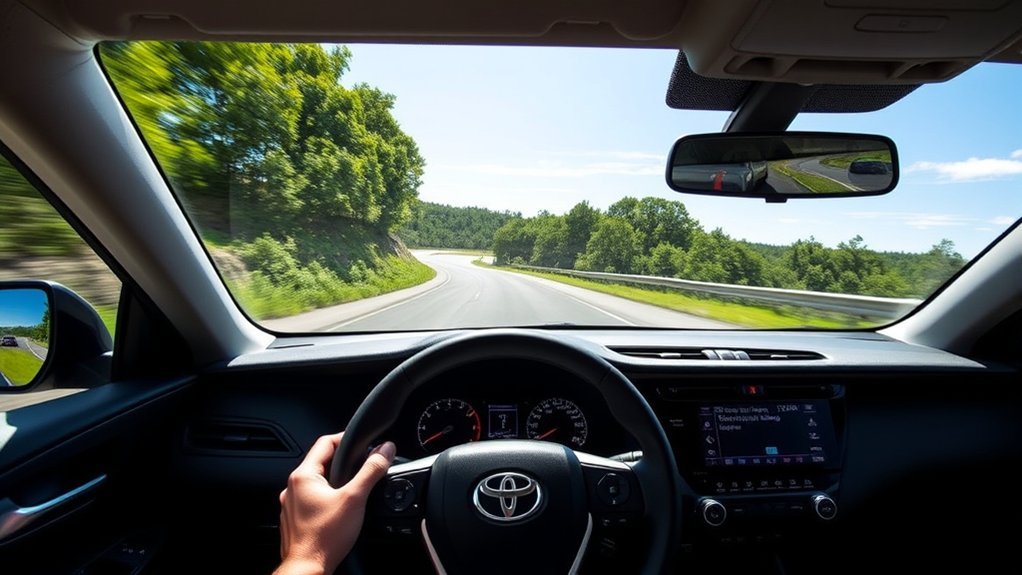
Lane Tracing Assist can reduce the number of small steering corrections needed on a clearly marked highway. That support may make long-distance driving feel less demanding, especially when it is paired with Dynamic Radar Cruise Control.
However, the feature does not guarantee that the vehicle will stay in its lane. The driver remains responsible for road position, speed, braking, obstacle avoidance, and every steering decision.
When Lane Centering Works Best
When lane markings are visible and road geometry is within the system’s capabilities, LTA can provide smoother, more continuous guidance than a feature that responds only as the vehicle approaches a boundary.
| System element | Potential benefit | Important limitation |
|---|---|---|
| Lane detection | Helps estimate the lane center | May fail with faded, covered, confusing, or temporary markings |
| Steering support | Reduces repeated minor corrections | Cannot handle every curve, road edge, merge, or obstacle |
| Driver-adjustable settings | Allows some alerts and assistance behavior to be personalized | Available choices vary by model year and market |
| DRCC integration | Combines speed-and-distance support with lane centering | The driver must still supervise both systems |
How to Use LTA Without Over-Relying on It
Confidence should come from understanding the feature, not overestimating it. A driver who recognizes the system’s status indicators and limitations can respond sooner when assistance weakens or disengages.
- Watch the display: Confirm that the lane-centering indicator shows active operation rather than standby.
- Maintain steering control: Do not release the wheel or wait for a warning before paying attention.
- Expect interruptions: Assistance can change when markings disappear, traffic patterns shift, or the road curves sharply.
- Take breaks when tired: Sway warnings and steering alerts are not substitutes for rest.
Driver rule: Lane assist can support steering, but it cannot replace an alert driver who is ready to take control.
What Is the Role of Lane Departure Alert in the RAV4?
Lane Departure Alert monitors the RAV4’s position relative to visible lane markings or certain road-edge boundaries. If it detects an unintended departure without an appropriate turn-signal input, it can issue visual and audible warnings. Versions equipped with Steering Assist may also apply a small corrective steering force.
The operating threshold depends on the Toyota Safety Sense generation. Toyota lists Lane Departure Alert operation above 32 mph for TSS 2.0-era RAV4 systems and above 30 mph for TSS 4.0. The owner’s manual for the exact vehicle takes precedence because equipment and conditions vary by year and market.
LDA is different from LTA because it is primarily designed to address a developing lane departure. It is not intended to provide continuous lane-centering support throughout a drive.
Customizing Lane Assist Settings for Comfort

The adjustment process differs between RAV4 generations. On Toyota Safety Sense 4.0 vehicles, Toyota moved the safety-system settings to the Audio Multimedia screen. Earlier RAV4 models may use steering-wheel controls and the Multi-Information Display. For a deeper walkthrough of older controls, see our RAV4 lane-keeping assist adjustments guide.
Adjusting a 2026 RAV4 With Toyota Safety Sense 4.0
- Open the Audio Multimedia system’s Settings menu.
- Select Driver support.
- Choose the listed driver-support feature you want to turn on, turn off, or customize.
- Review the on-screen description before changing the available setting.
- Make adjustments while safely parked whenever possible.
Adjusting an Earlier RAV4
Use the steering-wheel controls to open the vehicle-settings or driver-assistance menu in the instrument display. Depending on the model year, the menu may allow you to turn a feature on or off, change an alert method, adjust sensitivity, or change the sway-warning setting.
Pro Tip: Change only one setting at a time, then evaluate it on a familiar, clearly marked road. This makes it easier to identify which adjustment improved or worsened your comfort.
Why RAV4 Lane Assist Can Feel Different From One Road to Another
Lane-centering behavior changes with the quality of the information the system can see. Clear, consistent lane markings on a relatively predictable highway give LTA a better reference than construction lines, lane splits, patched pavement, tight curves, or worn paint.
If steering support feels inconsistent, first check whether the camera’s view through the windshield is clear and whether the road meets the system’s operating conditions. Review the available settings rather than attempting to defeat driver-attention monitoring or modify the vehicle.
A persistent warning, repeated unexpected disengagement, or abnormal steering behavior should be evaluated by a qualified Toyota service facility, especially after windshield replacement, front-end damage, suspension work, or wheel-alignment changes.
When Lane Assist May Not Work Reliably
Toyota states that Safety Sense performance depends on road, weather, lighting, and vehicle conditions. Lane support may become limited or unavailable in situations such as:
- Heavy rain, snow, fog, spray, or direct glare
- Faded, covered, missing, or conflicting lane markings
- Construction zones and temporary traffic patterns
- Sharp curves, steep grades, lane merges, and lane splits
- Shadows, pavement repairs, tire marks, curbs, or road seams that resemble lane lines
- A dirty, fogged, damaged, or obstructed windshield near the forward camera
- A camera that requires inspection or calibration after glass replacement or vehicle damage
When the system cannot determine a reliable lane path, its safest response may be to reduce assistance or disengage. The driver must be prepared for that transition.
How to Troubleshoot Lane Assist Problems
- Read the message: Check the instrument display for a temporary-unavailability notice, camera warning, or master warning light.
- Confirm the correct feature is enabled: LDA can operate separately, but LTA lane centering requires Dynamic Radar Cruise Control.
- Check the road: Look for clear lane markings and avoid testing the feature in construction zones or on sharply curving roads.
- Clean the camera viewing area: Remove dirt, ice, condensation, stickers, mounts, or objects that block the windshield near the forward camera.
- Restart only when safe: If the manual identifies the condition as temporary, park safely, switch the vehicle off, and restart it.
- Review recent work or damage: Windshield replacement, a collision, suspension repairs, or alignment work may justify professional inspection.
- Arrange service for persistent faults: Do not attempt to aim, remove, or recalibrate the camera without the correct Toyota procedures and equipment.
Warning: Do not test a malfunctioning lane-assistance system by intentionally drifting across lane lines in traffic. Use a safe location and follow the diagnostic instructions in the model-specific owner’s manual.
How Does Lane Assist in the RAV4 Compare to Competitors’ Systems?
Compare lane-assistance systems by function, not branding. The useful questions are whether the system only warns, can add a departure correction, provides continuous lane centering, requires adaptive cruise control, permits hands-free use, and what road or speed conditions it needs.
Use the exact model year, trim, package, software version, and market for any competitor comparison. Names such as “lane assist,” “pilot,” or “autosteer” do not describe the same capability across brands.
Toyota’s Lane Assist Features
The RAV4 combines two complementary functions:
- Lane Departure Alert with Steering Assist: Warns about unintended drift and may provide a limited correction near a detected boundary.
- Lane Tracing Assist: Supports more continuous lane centering while Dynamic Radar Cruise Control is engaged.
- Adjustable driver-support settings: Available controls vary by model year, with TSS 4.0 settings located in the multimedia interface.
- Driver-engagement monitoring: The system expects the driver to continue steering and responding to prompts.
Competitor System Comparisons
| Comparison point | Question to ask | RAV4 position |
|---|---|---|
| Lane centering | Is centering continuous, and what other feature must be active? | LTA centers the vehicle while DRCC is in use and detection conditions are met. |
| Departure correction | Does the feature only warn, or can it apply steering? | LDA with Steering Assist can warn and provide a small corrective input. |
| Operating range | What speeds, roads, markings, and traffic conditions are required? | Requirements vary between LDA, LTA, and Toyota Safety Sense generations. |
| Hands-free operation | Is hands-free use explicitly permitted on mapped roads with driver monitoring? | RAV4 LTA is a supervised steering-assistance feature, not a hands-free driving system. |
| Standard equipment | Is it standard on the exact trim or part of a package? | TSS 4.0 is standard on every U.S. 2026 RAV4. |
User Experience Differences
Two systems with similar specifications can feel different because of steering-torque tuning, road curvature, camera performance, driver-monitoring rules, and how smoothly assistance engages or releases.
Before choosing between vehicles, test the exact trims on the same type of road. Evaluate lane-centering stability, warning clarity, steering effort, disengagement behavior, and how easy the settings are to understand. The smoothest system during one short demonstration may not be the most predictable in poor markings or mixed traffic.
Frequently Asked Questions
Can Lane Tracing Assist be turned off completely?
Yes. LTA can be turned off through the applicable driver-support settings. On a 2026 TSS 4.0 RAV4, those settings are in the Audio Multimedia screen. Earlier models may use the Multi-Information Display and steering-wheel controls.
Is Lane Tracing Assist available in all RAV4 trims?
Toyota states that every U.S. 2026 RAV4 includes Toyota Safety Sense 4.0, which includes Lane Tracing Assist. For an earlier model year or a vehicle sold outside the United States, verify the original equipment list and owner’s manual.
Does Lane Tracing Assist work in adverse weather conditions?
Its performance may be reduced or unavailable in heavy rain, snow, fog, road spray, glare, or other conditions that make lane markings and vehicles difficult for the camera to detect. The driver must steer without assistance whenever the system cannot operate reliably.
What year did the Toyota RAV4 get Lane Tracing Assist?
Toyota introduced Lane Tracing Assist on the U.S. 2019 RAV4 with Toyota Safety Sense 2.0. Earlier 2017–2018 RAV4 models had Lane Departure Alert with Steering Assist, but not the later continuous lane-centering LTA function.
Are there maintenance requirements for the lane-assist features?
There is normally no separate routine maintenance interval for LTA or LDA. Keep the windshield and camera viewing area clean, respond to warning messages, and have the system inspected when faults persist or after windshield replacement, collision damage, or work that may affect camera alignment.
How do I turn RAV4 lane assist on or off?
On the 2026 RAV4 with Toyota Safety Sense 4.0, open the Audio Multimedia Settings screen, select Driver support, and choose the feature you want to change. Earlier RAV4s may use an LTA switch and the Multi-Information Display, so check the model-year owner’s manual before changing settings.
Does Lane Tracing Assist drive the RAV4 by itself?
No. It provides limited steering assistance while the driver remains responsible for steering, braking, accelerating, monitoring traffic, and responding to hazards. It is not an autonomous or hands-free driving mode.
Why does Lane Tracing Assist keep turning off?
Common reasons include Dynamic Radar Cruise Control being off, unclear lane markings, a blocked camera, severe weather, a sharp curve, a lane merge, or a driver-attention prompt. Read the instrument-display message and consult the model-specific manual if the problem continues.
Conclusion
The Toyota RAV4 has useful lane-assistance features, but Lane Departure Alert and Lane Tracing Assist should not be treated as interchangeable. LDA warns about unintended lane drift and may provide a limited correction, while LTA supports ongoing lane centering when Dynamic Radar Cruise Control is active and detection conditions are suitable.
The 2026 U.S. RAV4 uses Toyota Safety Sense 4.0 across the lineup, while older vehicles require model-specific verification. Before relying on a feature or changing its settings, check the owner’s manual for your exact year, keep the camera viewing area clear, and remain ready to steer at all times.
Sources
- Toyota USA: 2026 RAV4 announcement — confirms Toyota Safety Sense 4.0, Lane Departure Alert with Steering Assist, and Lane Tracing Assist on the U.S. 2026 RAV4.
- Toyota Safety Sense overview — explains Lane Departure Alert, Steering Assist, Lane Tracing Assist, DRCC requirements, and generation-specific thresholds.
- Toyota Safety Sense 4.0 overview — documents TSS 4.0 controls, the Audio Multimedia settings path, LTA operating requirements, and safety limitations.
- Toyota USA: 2017 RAV4 safety announcement — confirms standard Toyota Safety Sense P with Lane Departure Alert and Steering Assist.
- Toyota USA: 2019 RAV4 launch — confirms the introduction of Lane Tracing Assist on the fifth-generation RAV4.
- Toyota owner’s-manual lookup — provides model-year-specific instructions, warning messages, settings, and limitations.
- NHTSA Driver Assistance Technologies — defines lane-departure warning, lane-keeping assistance, lane-centering assistance, and driver responsibility.

1 thought on “Does the Toyota RAV4 Have Lane Assist? Lane Tracing vs Lane Keep Explained”