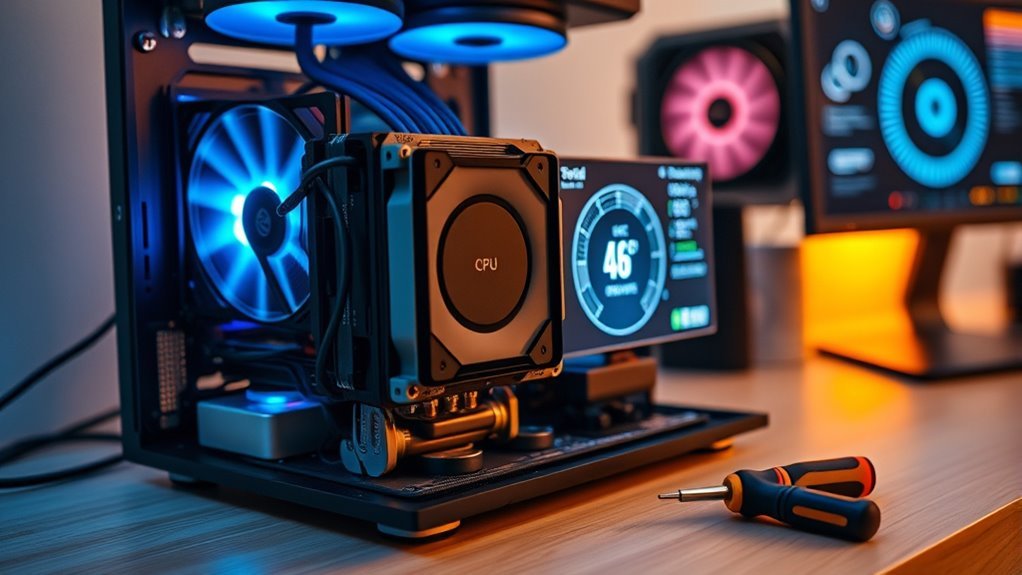
46°C is not hot for a CPU. It sits within the normal idle-to-light-load range of roughly 30°C to 60°C and is considered thermally stable on most systems. Under gaming or heavy workloads, 65°C to 85°C is common, while sustained temperatures above 80°C merit attention. Dust, weak cooling, and old thermal paste can cause spikes. Intel and AMD chips tolerate higher limits, but efficient airflow and proper monitoring keep performance consistent and reveal more.
Key Takeaways
- 46°C is generally a normal, stable CPU temperature, especially at idle or light workloads.
- Typical CPU temperatures range from 30°C to 40°C idle and 40°C to 60°C during regular use.
- Under heavy loads, 65°C to 85°C is common, while sustained temperatures above 80°C deserve attention.
- CPUs start throttling around 90°C, and Intel and AMD maximum limits are usually about 105°C and 95°C, respectively.
- Improve cooling with dust cleaning, better airflow, fresh thermal paste, and quality air or liquid cooling.
Is 46°C Hot for a CPU?
A CPU temperature of 46°C is generally not considered hot under normal operating conditions. In CPU temperature analysis, that reading sits above ideal idle ranges yet remains safely within accepted limits for light use.
For a system under modest load, 40°C to 50°C is typical, so 46°C indicates thermal stability rather than stress. Compared with gaming or heavy workloads, where temperatures often climb to 65°C to 85°C, it is markedly restrained.
For modest loads, 46°C is typical, signaling stability rather than stress and staying well below heavy-workload temperatures.
Such a result usually implies effective cooling solutions and disciplined thermal control, both of which support peak performance and extend component longevity. Regular monitoring remains prudent, since sustained readings above 80°C can signal impending overheating.
From a user-freedom perspective, stable thermals reduce dependence on restrictive intervention and preserve system autonomy.
In practice, 46°C reflects a CPU operating within a safe, efficient envelope, not a condition demanding alarm or immediate remediation.
What Counts as a Normal CPU Temp?
Normal CPU temperatures typically fall between 30°C and 40°C during idle or light use, with readings in the 40°C to 60°C range common during regular operation. This temperature profile reflects a CPU functioning within expected operating temperature limits under modest demand.
In practical terms, a reading near 46°C usually sits squarely inside the normal band, indicating stable thermal behavior rather than constraint. Under heavier workloads, such as gaming or video editing, the CPU may legitimately rise into the 65°C to 85°C range, depending on cooling capacity, ambient conditions, and chassis airflow.
The key measure is not a single number in isolation, but the operating temperature trend over time. Sustained values below 80°C are generally considered safe, while persistent readings above 90°C warrant concern because thermal control mechanisms may intervene.
A well-managed system keeps temperature within these ranges without sacrificing performance or autonomy.
When Is a CPU Too Hot?
When does a CPU become too hot? The threshold is reached when the CPU Temp stays above the safe operating band long enough to threaten stability or longevity. A reading near 46°C remains comfortable, but persistent values above 80°C deserve scrutiny, especially if they appear during ordinary use.
Around 90°C, thermal throttling typically begins, reducing clock speed to shield the chip from damage. This protective response signals that thermal headroom has been exhausted. Continuous exposure to elevated heat can shorten service life, so monitoring should be regular, not reactive.
Around 90°C, thermal throttling begins, reducing clock speed to protect the chip from damage.
If temperatures repeatedly exceed 80°C, the cooling solution should be inspected for dust buildup, degraded thermal paste, or inadequate airflow. In such cases, cleaning, repasting, or upgrading the cooling solution may restore safe margins and preserve performance.
Liberation from overheating begins with measurement, diagnosis, and corrective maintenance.
CPU Temperatures for Gaming and Heavy Loads
During gaming and other heavy workloads, CPU temperatures commonly fall between 65°C and 85°C when cooling is adequate.
Sustained readings above 85°C increase the likelihood of thermal throttling, as the processor reduces performance to control heat.
Although most modern CPUs can tolerate up to 100°C, maintaining temperatures below that level is preferable for stable operation and long-term reliability.
Gaming Temperature Ranges
Gaming and heavy workloads typically push CPU temperatures into the 65°C to 85°C range, which is generally considered safe for sustained performance. Within these gaming temperature ranges, brief spikes are expected, but steady readings above 80°C can trigger thermal throttling and reduce frame consistency.
A capable CPU cooler and clean case airflow can help lower the temperature without sacrificing responsiveness.
- Intel CPUs usually tolerate up to 105°C junction limits.
- AMD Ryzen processors are generally rated safely to 95°C.
- Sustained operation above 90°C increases risk of instability.
- Cooler ambient conditions support liberated, reliable performance.
For users seeking control, the objective is not maximum chill, but disciplined thermal management that preserves speed, protects hardware, and keeps demanding play technically efficient.
Heavy Load Heat Limits
Under heavy load, modern CPUs typically run in the 65°C to 85°C range, which is generally acceptable for gaming and other intensive tasks. At these levels, a safe CPU is usually operating within design expectations, provided thermal cooling is adequate and airflow is unobstructed.
Temperatures above 90°C are a warning sign, often indicating cooling limits have been exceeded and thermal throttling may begin, reducing clock speed to protect silicon. Intel processors may tolerate up to 105°C junction temperature, while many AMD parts peak near 95°C. Yet sustained operation above 80°C can still accelerate wear.
Regular monitoring during heavy load helps preserve performance and the freedom to keep systems responsive. High-quality heatsinks or liquid cooling reduce risk.
Common Reasons CPU Temps Spike
CPU temperature spikes are often linked to dust accumulation and restricted airflow, which reduce the cooling system’s ability to remove heat efficiently.
They also occur when cooling hardware is inadequate or degraded, including failing fans, weak heatsinks, or aging thermal paste that impairs heat transfer.
Under heavy loads or overclocking, the processor generates substantially more heat, increasing the likelihood of elevated temperatures and thermal throttling.
Dust And Airflow Issues
A small buildup of dust can be enough to restrict airflow inside a case, raising CPU temperatures and increasing the risk of thermal spikes. Dust accumulation on heatsinks and fans reduces the cooling system’s ability to transfer heat, even when the layer appears minor.
- Clogged fins trap heat and slow dissipation.
- Poor cable routing blocks airflow paths.
- Weak intake or exhaust fans upset pressure balance.
- Clean filters preserve cooler internal circulation.
Proper case ventilation matters because restricted airflow limits fresh air around the CPU, while dust accumulation can silently erode thermal headroom.
Regular maintenance, precise fan placement, and disciplined cable management restore efficient movement of air. For users seeking control over their hardware, these measures support stable temperatures and reduce avoidable stress on the processor.
Heavy Loads And Overclocking
Even with clean airflow and well-maintained cooling hardware, processor temperatures can rise sharply when workloads intensify. During heavy loads such as gaming or video rendering, a CPU may climb above 70°C, reflecting higher power draw and stress on the cooling stack.
Overclocking increases clock speed beyond manufacturer limits, and without adequate thermal capacity, spikes above 80°C are common. The Intel Core Ultra 9 series, with a 105°C junction ceiling, can approach unsafe territory quickly under sustained demand.
Aging thermal paste reduces heat transfer efficiency, so reapplication every two years is often prudent. Low-quality fans and weak heatsinks further magnify this pressure, risking thermal throttling.
In practical terms, disciplined thermal management preserves performance and autonomy.
How to Check CPU Temperature
To verify CPU temperature, the system can be checked directly through the BIOS by restarting the PC and pressing F2 or Delete during startup, then opening the “PC Status” or “Advanced Setup” menu. This method lets users check CPU temperature without loading the operating system, offering a baseline reading.
- Monitoring software such as Core Temp provides real-time CPU data with minimal configuration.
- Alerts can be set in monitoring software to flag high temperature thresholds promptly.
- An infrared thermometer offers a fast external estimate of surface heat.
- Regular checks help expose overheating trends that can threaten stability and performance.
For most users, software remains the most practical option because it supports continuous observation and historical comparison.
BIOS readings are useful for verification, while external tools can supply supplemental measurements. Together, these methods give users a clearer, more autonomous view of thermal conditions.
How to Cool a CPU Down
If CPU readings are higher than expected, cooling measures should be applied before sustained heat affects stability or component life.
The first step is to remove dust from fans, filters, and heatsinks, because debris restricts airflow and reduces cooling efficiency.
Next, cable routing should be improved so intake and exhaust paths remain unobstructed, allowing cooler air to enter and hot air to exit.
The thermal compound between the processor and cooler should be renewed with a high-quality paste about every two years to preserve efficient heat transfer.
Software should be used to monitor CPU temperatures continuously, with alerts enabled for abnormal spikes, so corrective action can occur early.
For processors with high thermal output, a more capable solution such as liquid cooling may be necessary, since stock coolers can be inadequate under load.
These measures support stable, independent operation and prevent heat from dictating performance.
What Cooling Setup Lowers CPU Temps Most?
Among common cooling options, liquid cooling generally delivers the greatest CPU temperature reduction, with AIO systems often keeping load temperatures roughly 20–30°C lower than air coolers. For systems facing higher heat, this margin can preserve performance headroom and reduce thermal throttling.
High-quality aftermarket air coolers still offer meaningful gains, often cutting temperatures 10–20°C below stock units, especially when paired with good air circulation.
- Use a well-designed case with multiple intake and exhaust fans.
- Apply thermal paste correctly and keep contact surfaces clean.
- Remove dust from heatsinks, radiators, and filters regularly.
- Configure fan curves so cooling responds to load changes.
The most effective setup is rarely one component alone. Liquid cooling, strong chassis airflow, and disciplined maintenance combine to stabilize CPU temperatures and keep thermals under deliberate control.
For users seeking liberation from constraint, the best choice is the system that removes heat fastest and most consistently.
Intel vs. AMD CPU Temp Limits
Cooling hardware can lower temperatures substantially, but safe operating limits still depend on the processor itself. Intel and AMD define different thermal ceilings, so a CPU usually cannot be judged by a single universal threshold.
Intel chips such as the Core Ultra 9 285K permit a maximum junction temperature of 105 degrees celsius, which gives wider thermal headroom before throttling. AMD’s Ryzen 9 9950X3D is rated to 95 degrees celsius, reflecting tighter control demands around its 3D V-Cache layout.
Intel’s Core Ultra 9 285K reaches 105°C, while AMD’s Ryzen 9 9950X3D tops out at 95°C.
Modern processors from both vendors often remain safe near 100 degrees celsius under load, yet sustained exposure can trigger frequency reduction and reduce autonomy over performance. Older AMD parts may peak near 70 degrees celsius, showing that historical generation matters.
Accurate monitoring of the exact model’s limits is consequently essential for preserving stability, preventing damage, and maintaining liberated, efficient operation under demanding workloads.
Frequently Asked Questions
Is 45 C Too Hot for CPU?
45°C is not too hot for a CPU. It usually reflects normal idle or light load conditions; CPU cooling strategies, Thermal paste, and Overclocking effects should be reviewed only if temperatures rise persistently higher.
Is 46 C Too Hot for a GPU?
No, 46°C is not too hot for a GPU; it is normal at idle or light load. GPU cooling remains effective, thermal throttling is unlikely, and performance benchmarks should stay stable and efficient.
At What Temperature Is a CPU Too Hot?
Too hot begins around 80°C, where a CPU starts acting like a drama queen. Above 90°C, damage risk rises. Effective cooling solutions, fresh thermal paste, and performance monitoring preserve temperature and performance.
Is 50 C Too Hot for a CPU?
No—50°C is not too hot for a CPU. It remains within safe operating range for ideal performance. Thermal throttling typically begins much higher; if temperatures rise, improved cooling solutions and airflow should be assessed.
Conclusion
In thermal terms, 46°C is a gentle breeze, not a fire alarm. For most CPUs, it sits comfortably within the normal range at idle or light load, far below danger thresholds. When workloads intensify, temperatures naturally rise, but sustained spikes near the limit can erode performance and longevity. Proper airflow, clean heatsinks, quality paste, and a capable cooler keep the silicon engine running like a well-tuned machine rather than an overheated furnace.
