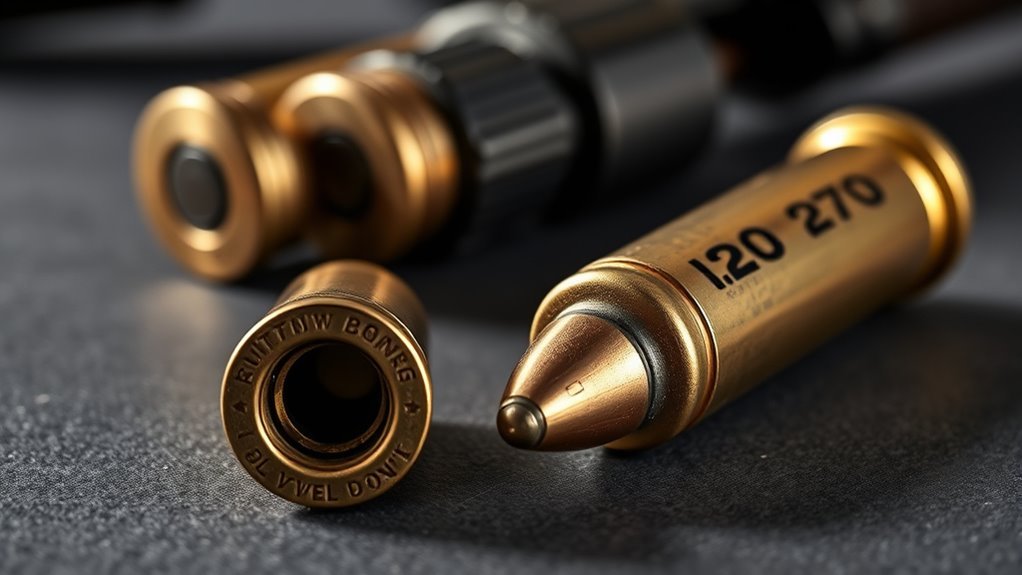
.270 hollow points and .270 full metal jackets serve different roles. Hollow points are designed to expand on impact, increasing diameter, tissue disruption, and energy transfer, which can improve performance on deer-sized game and reduce over-penetration. FMJ loads retain their shape, offering deeper penetration, consistent flight, and lower cost for target work. Choice depends on the task, firearm reliability, and local laws. The details below clarify which load fits each use case.
Key Takeaways
- .270 hollow points expand on impact, creating larger wound channels and greater energy transfer.
- .270 FMJ bullets keep their shape for deep, predictable penetration with minimal expansion.
- Hollow points are generally better for hunting and defensive use; FMJ is better for target shooting.
- Over-penetration risk is lower with hollow points, while FMJ is often preferred for range consistency.
- Always check local laws and test load reliability in your specific .270 rifle.
270 Hollow Point Vs FMJ
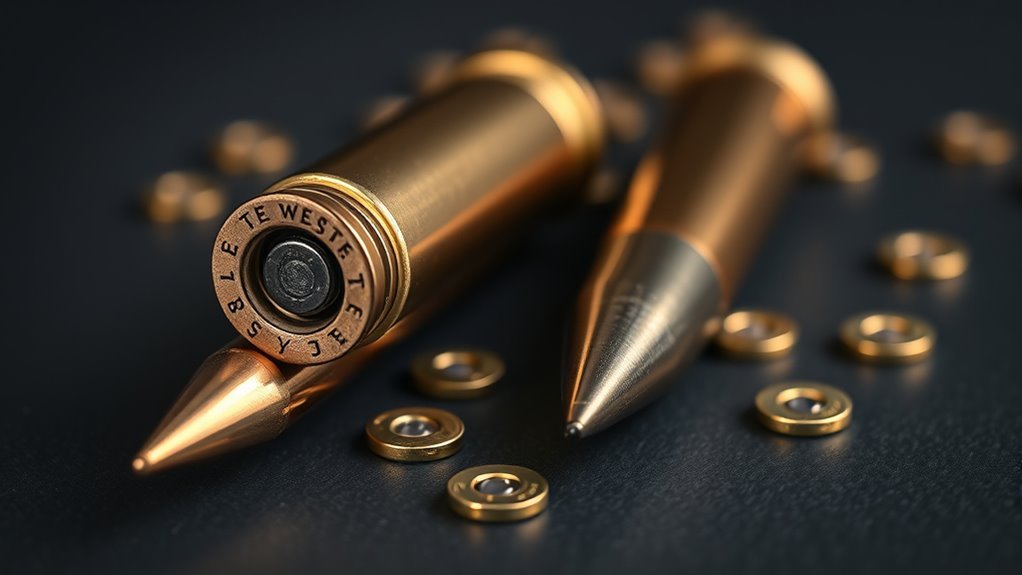
The .270 hollow point and .270 full metal jacket differ chiefly in terminal behavior: the hollow point is engineered to expand on impact, typically to about 1.5 to 2 times its original diameter, while the FMJ is designed to retain its shape and penetrate deeply without expansion.
In technical terms, the Hollow Point increases frontal area, disrupts tissue, and produces a wider wound channel through controlled energy transfer. That profile supports stronger stopping power in self-defense and hunting scenarios, where rapid incapacitation is prioritized.
By contrast, the Full Metal Jacket is built for target shooting and training, offering predictable flight and reduced deformation. Its tendency to over-penetrate makes it less suitable where bystander risk exists.
Selection consequently depends on mission: Hollow Point for defensive or field use, Full Metal Jacket for practice and economy.
For an audience seeking liberation through competent firearm use, understanding these tradeoffs is essential to disciplined ammunition choice.
Key Differences in Performance
Key performance differences between .270 hollow point and .270 full metal jacket ammunition center on terminal effect rather than basic flight characteristics.
Hollow Points are engineered for expansion on impact, increasing diameter, energy transfer, stopping power, and the size of the wound channel. Full Metal Jacket loads preserve shape, favor deeper penetration, and often deliver narrower terminal performance with less immediate disruption.
In self-defense, that contrast matters: controlled expansion can reduce over-penetration and collateral damage, while FMJ projectiles may exit with residual energy. Ammo manufacturers typically position Hollow Points for defensive use and FMJ for practice, consistency, and lower cost.
The distinction is visible in tissue: one round opens like a mechanical bloom, the other threads through with minimal deformation.
One round blooms outward on impact; the other slips through with minimal deformation.
- A Hollow Point striking soft media blossoms outward.
- A Full Metal Jacket passes in a straighter line.
- Energy dispersal appears wider with expansion.
- Penetration appears longer, cleaner, and more narrow.
How .270 Hollow Point Performs on Game
On game animals, .270 hollow point bullets are engineered to expand on impact, producing a larger wound channel and greater energy transfer than non-expanding designs.
This Hollow Point Bullet typically expands to 1.5 to 2 times its original diameter, increasing tissue disruption and stopping power on deer-sized game.
In soft tissue, the Bullet performs efficiently, converting impact energy into rapid damage that supports a quick, humane kill.
The resulting wound channel can accelerate blood loss and reduce tracking distance, which aligns with a hunter’s preference for effective, controlled outcomes.
Penetration should remain within 12 to 18 inches in ballistic gelatin to indicate suitable field performance.
However, heavy bone or thick hide can limit expansion and alter penetration, so shot placement remains critical.
When conditions favor unobstructed soft tissue paths, the .270 Hollow Point offers precise, efficient game performance.
When a .270 FMJ Makes Sense
When cost, consistency, and range utility take priority, a .270 Full Metal Jacket can be the practical choice. The 270 FMJ is well suited to target shooting, where cost-effectiveness supports high-volume practice and reliable performance matters more than terminal expansion.
When cost, consistency, and range utility matter most, .270 FMJ delivers practical, reliable target performance.
Its non-expanding profile preserves shape, helping it track predictably at distance and supporting accuracy for precision shooters in controlled lanes. In shooting competitions that permit it, the load can satisfy rules where expanding ammunition is barred.
- Paper targets punched cleanly at 300 yards
- Steel plates ringing under flat, disciplined flight
- Benchrest shooters measuring tight groups
- Controlled ranges with minimal tissue damage concerns
Because it may over-penetrate, the .270 FMJ is best treated as a range-oriented tool, not a general-purpose hunting solution.
For disciplined marksmen seeking repeatable results and liberated practice sessions, it offers a straightforward balance of economy, precision, and consistency.
How to Choose the Right .270 Load
Selecting the right .270 load depends primarily on the intended application: hollow points are generally favored for hunting because their expansion can increase the wound channel to roughly 1.5 to 2 times bullet diameter, while full metal jackets are better suited to target shooting and practice where cost, consistency, and accuracy matter most.
A hollow point bullet expands upon impact, increasing stopping power and making it suitable for ammunition for self-defense where legal. By contrast, a full metal jacket emphasizes penetration and predictable feeding, often outperforming in shooting targets and extended range sessions.
Ballistic performance should be reviewed in context: hollow point loads may be less reliable through thick clothing, while FMJ loads maintain more uniform behavior. Local laws should always be checked before purchase or use.
Choosing the right .270 load also requires testing in the specific firearm, since compatibility and feeding reliability can vary across rifles and bullet designs.
Frequently Asked Questions
Are Hollow Points Better Than Full Metal Jackets?
Yes—hollow points are usually better where bullet expansion, terminal ballistics, and reduced penetration depth matter, especially for hunting scenarios and self defense use; full metal accuracy, recoil comparison, cost analysis, and ammunition types can favor FMJs.
How Much Does a .270 Drop at 1000 Yards?
A .270 typically drops 250–300 inches at 1,000 yards. A theory suggests bullet design governs the trajectory curve; ballistic coefficient, wind drift, energy retention, and accuracy factors shape terminal ballistics, range estimation, and caliber comparison.
Should You Carry Hollow Points or FMJ?
Hollow points suit carry for Self Defense Considerations; their Hollow Point Advantages, Expansion Characteristics, and controlled Penetration Depth improve Terminal Ballistics Differences. FMJ Performance remains cheaper, aiding Ammunition Costs, Accuracy Comparisons, Recoil Management, and Legal Implications.
Do Cops Use Full Metal Jacket or Hollow Points?
Cops usually use hollow points, not FMJ. Investigation of the theory shows bullet performance, penetration depth, and expansion capability favor law enforcement duty loads, while ammunition types, terminal ballistics, shooting accuracy, self defense needs, legal restrictions, and training requirements vary.
Conclusion
To summarize, the .270 hollow point delivers rapid expansion and greater energy transfer, making it the more effective choice for most hunting applications. The .270 full metal jacket, by contrast, offers deep penetration and controlled deformation, favoring target shooting or specialized use where minimal expansion is desired. Selection should be based on intended purpose, range, and terminal performance. Like a well-tuned sextant guiding a navigator, the right load aligns ballistic behavior with the shooter’s objective.
