
Most professional laptops operate comfortably between 11 and 15 hours of real-world battery life, which generally covers a full workday of mixed productivity tasks. Systems with modern multi-core CPUs, 16GB of RAM, and SSD storage tend to balance endurance with responsive performance. Mobile-focused models should also stay under 3 pounds and include USB-C or HDMI for flexibility. Premium options such as the Dell XPS 14 and Lenovo ThinkPad X1 Carbon illustrate these standards, with further comparisons ahead.
What Battery Life Should Work Laptops Have?
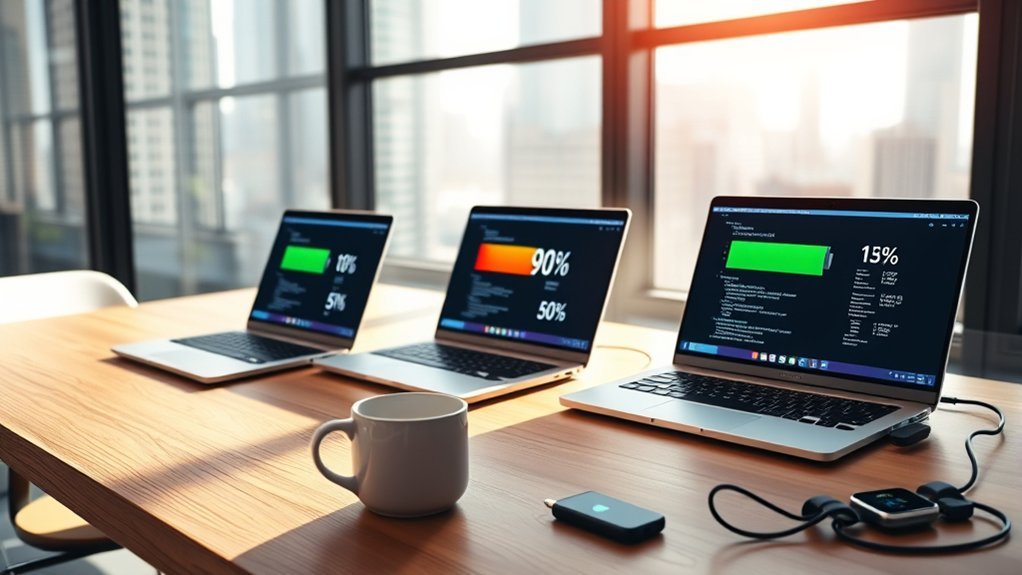
How much battery life is enough for a work laptop depends on workload, but a practical baseline is at least 12 hours to support a full workday without routine recharging. For business laptops, that threshold reduces dependence on outlets and protects continuity during meetings, transit, and remote sessions.
A machine that cannot sustain common productivity tasks without midday charging imposes unnecessary constraints on user autonomy.
Battery life should be evaluated under realistic conditions rather than marketing estimates. Manufacturer claims often reflect light workloads, reduced brightness, or controlled testing, so independent benchmarks are the more reliable measure.
Battery life should be judged by real-world testing, not manufacturer estimates shaped by ideal conditions and unusually light workloads.
Some high-efficiency systems, including models such as the Lenovo ThinkPad X9, can approach 15 hours during light use, indicating strong optimization. Quick charging also matters because it restores operational freedom during short breaks or airport layovers.
The relevant standard is not maximum endurance on paper, but dependable all-day performance that liberates professionals from routine tethering across varied workflows.
Why 11 to 15 Hours Is Ideal
An 11-to-15-hour battery window represents the practical optimum for professional laptops because it aligns with a full workday of mixed productivity use without routine charging dependence. This range gives a laptop sufficient endurance for document creation, web research, video conferencing, and sustained multitasking while preserving operational autonomy.
For professionals seeking freedom from outlet dependency, that balance is materially significant.
From an engineering standpoint, this battery life target reflects efficient system design rather than excess capacity alone. A business laptop in this class typically combines low-power processors, disciplined thermal management, and software optimization to reduce wasteful energy draw without degrading responsiveness.
The result is a machine that remains productive during commutes, flights, client visits, and shared workspaces where power access is uncertain. Models such as Lenovo’s ThinkPad X9 demonstrate the benchmark, approaching 15 hours under lighter workloads.
In practical terms, 11 to 15 hours minimizes interruption while maximizing mobile independence and scheduling control.
Which Work Laptop Features Matter Most?
The evaluation of work laptop priorities typically begins with performance and memory, since multi-core processors and at least 16GB of RAM determine multitasking capacity and application responsiveness.
It then shifts to keyboard and display quality, where key travel, tactile consistency, and Full HD or better panels directly affect sustained productivity and visual accuracy.
Battery endurance and portability remain equally significant, as all-day operation and practical connectivity through ports such as USB-C, HDMI, and USB-A support mobile professional workflows.
Performance And Memory
Prioritize processor, memory, and storage first, since these components determine whether a professional laptop can sustain multitasking workloads without bottlenecks. Strong performance begins with modern multi-core CPUs, typically Intel Core i7 or AMD Ryzen, which execute parallel workloads efficiently and reduce workflow friction. For liberated productivity, 8GB RAM supports baseline business use, while 16GB or more better serves analysts, developers, and creators handling larger applications. Fast RAM and storage also minimize delays when switching tasks or loading datasets. SSDs starting at 256GB improve responsiveness, reliability, and file access speed.
| Component | Practical Baseline |
|---|---|
| Processor | Intel Core i7 or Ryzen |
| Memory/Storage | 16GB RAM, 256GB SSD |
These internals matter more than superficial build quality because they directly govern sustained throughput, stability, and operational autonomy daily.
Keyboard And Display
Ergonomics and visual fidelity directly shape daily productivity once core performance requirements are met. For knowledge workers seeking greater autonomy from friction, a comfortable keyboard remains fundamental.
The phrase keyboard is one useful reminder that input quality can outweigh minor specification differences. Adequate key travel, crisp feedback, and stable keycaps reduce bottoming out, limit fatigue, and improve accuracy across prolonged drafting, coding, and spreadsheet sessions. Backlighting and a precise touchpad further streamline execution.
Display characteristics are equally consequential. A minimum 1920 x 1080 resolution supports clearer text and finer interface detail, while an OLED display can deliver superior contrast for visually dense tasks.
Brightness also matters; at least 300 nits guarantees dependable visibility under typical office lighting, reducing strain and preserving control over sustained work.
Battery And Portability
For many professionals, battery endurance and transport weight determine whether a laptop remains productive beyond the desk. A practical baseline is 12 hours of battery life, sufficient for uninterrupted work across meetings, transit, and remote sessions.
Systems exceeding that threshold, such as the Lenovo ThinkPad X9 at roughly 15 hours under light use, offer greater operational freedom and reduce dependence on chargers.
Portability improves further through lightweight designs. A machine such as the Lenovo Yoga Slim 7i, at 2.15 pounds, minimizes carrying strain and supports consistent mobility.
However, low mass alone is insufficient. Effective portability also depends on broad port availability, especially USB-C and HDMI, which enable peripheral connectivity without adapters.
Together, sustained battery life, lightweight designs, and practical I/O expand autonomy in diverse professional environments daily.
How to Choose a Laptop for Your Workload
Laptop selection should begin with task requirements, with Intel i7 or AMD Ryzen 7 processors, 16GB of RAM, and at least a 256GB SSD serving as a practical baseline for sustained productivity workloads.
Portability should then be assessed through a 14- to 15-inch Full HD display, which balances usable screen space with manageable size for mobile work.
Final evaluation should weigh performance against battery endurance, with approximately 12 hours of runtime supporting reliable operation away from a desk.
Match Tasks First
Start by mapping the workload to the hardware. A disciplined buyer identifies primary tasks first: document preparation, spreadsheet modeling, coding, or graphic design. That classification determines CPU class and memory requirements.
For sustained multitasking or demanding applications, 16GB RAM is the practical baseline, freeing the user from avoidable slowdowns and workflow friction.
Display requirements follow task intensity. Creative work benefits from high-resolution panels such as 2880 x 1800, while general productivity remains effective at 1920 x 1080. Screen size should support visual clarity without excess.
A Laptop for Business also needs strong keyboard comfort, accurate touchpad response, and battery life of at least 12 hours.
Finally, port selection must match peripheral demands, with USB-C, HDMI, and related connectivity enabling an unconstrained, efficient workstation for modern professional autonomy.
Prioritize Portability Needs
Once task requirements are defined, mobility constraints should be evaluated with equal discipline. For professionals seeking operational freedom, portability should be quantified across weight, endurance, footprint, resilience, and connectivity.
- Target systems under 3 pounds; lower mass reduces commuting strain and improves portability.
- Require at least 12 hours of battery life for uninterrupted work away from outlets.
- Prefer 13- to 15-inch displays; this range preserves usability without excessive bulk.
- Specify minimum 1920 x 1080 resolution to maintain document clarity and presentation precision.
- Verify durability and ports: rigid chassis, USB-C/Thunderbolt 4, and HDMI support adaptable workflows.
Examples clarify thresholds: a 2.15-pound Lenovo Yoga Slim 7i Aura Edition maximizes mobility, while the ThinkPad X1 Carbon Gen 14 demonstrates durability through a lightweight aluminum build for demanding daily use.
Balance Power And Battery
Performance must be matched to endurance so the system can sustain real work without creating mobility tradeoffs. For demanding workflows, selection should center on a multi-core processor, ideally Intel Core i7 or AMD Ryzen 9, paired with at least 16GB of RAM. That baseline delivers the power required for multitasking without bottlenecks that restrict autonomy.
Storage also affects responsiveness. An SSD of 256GB or more reduces load times and accelerates file access, enabling faster shifts between applications and tasks.
Equally critical is battery life: a target of 12 hours or more supports uninterrupted productivity beyond fixed desks and charging cycles. Systems using lightweight designs can preserve portability while retaining capable specifications, giving professionals greater freedom to move between workspaces without sacrificing sustained performance or practical usability.
Which Professional Laptops Last All Day?
When all-day endurance is the priority, several professional laptops distinguish themselves through sustained battery efficiency rather than peak performance alone. For business users seeking liberation from chargers, battery life becomes a primary metric when evaluating the best laptops for uninterrupted productivity.
- Dell XPS 14 reaches 20 hours 41 minutes in testing, supporting extended meetings and intensive workdays.
- MacBook Air (M5) delivers up to 18 hours under typical conditions, maintaining dependable full-day operation.
- Lenovo Yoga Slim 7i Aura Edition posts about 16 hours 38 minutes, suiting mobile professionals.
- Lenovo ThinkPad X1 Carbon Gen 14 Aura Edition provides roughly 15 hours on light use.
- Framework Laptop 13 Pro offers strong longevity overall, though results vary with workload and configuration.
Analytically, these systems prioritize efficient silicon, display optimization, and thermal restraint. The result is operational autonomy: fewer charging interruptions, greater scheduling flexibility, and more independent workflows across transit, offices, and client environments daily.
Best Windows Laptops for Battery Life
Among Windows laptops, battery life is best evaluated through sustained runtime under realistic productivity loads rather than vendor estimates alone. This standard frees buyers from marketing distortion and clarifies which systems truly support untethered work.
The Dell XPS 14 ranks among the best options, reaching 20 hours and 41 minutes in battery tests, a result that places it in elite territory for extended professional use.
The Lenovo Yoga Slim 7i Aura Edition delivers 16 hours and 38 minutes, combining strong endurance with a remarkable portable design. HP’s OmniBook Ultra, at 12 hours and 52 minutes, still meets the practical threshold for mobile business reliability.
In this segment, 12 hours should be treated as the minimum acceptable target for users working beyond fixed desks. New Intel Core Ultra and AMD Ryzen AI processors further improve efficiency, helping Windows laptops sustain heavier workflows while preserving battery life under real operational conditions daily.
Best MacBooks for Work and Travel
For professionals balancing mobility, battery efficiency, and application headroom, the strongest MacBook choices for work and travel center on the MacBook Air (M5) and MacBook Pro 14-inch (M5), with the MacBook Neo serving as the budget entry point.
- MacBook Air: 2.7 pounds, 10-core Apple M5, 13.6-inch Liquid Retina display.
- Starts at $1,099 with 512GB storage, positioning it as a best laptop for efficient mobile productivity.
- Delivers up to 18 hours of battery life, supporting autonomous work beyond fixed desks and outlets.
- MacBook Pro 14-inch (M5): 3.4 pounds, 3,024 x 1964 Liquid Retina XDR display for heavier creative or analytical workloads.
- MacBook Neo: $599 entry price, 13-inch Liquid Retina LED display, suited to budget-conscious professionals seeking Apple portability.
Analytically, the MacBook Air offers the strongest value-to-mobility ratio, while the MacBook Pro provides superior display and processing headroom.
The Neo broadens access without matching premium capability.
Best Lightweight Laptops for Business Trips
Business-trip buyers prioritize low carry weight, dependable battery endurance, and input comfort over raw performance alone. The strongest lightweight laptops reduce friction at airports, meetings, and hotel desks by pairing sub-3-pound designs with competent displays and usable keyboards.
The Lenovo Yoga Slim 7i Aura stands out at 2.15 pounds, while its 14-inch 2880 x 1800 touch POLED panel preserves visual precision for documents, dashboards, and presentations.
The Dell XPS 14 remains compelling at 3 pounds, balancing travel portability with a chassis suitable for sustained professional use. The MacBook Neo addresses budget-conscious travelers, starting at $599 and weighing 2.7 pounds; its 13.0-inch Liquid Retina display at 2408 x 1506 supports routine productivity without unnecessary mass.
HP’s OmniBook Ultra is heavier at 3.47 pounds but still viable, offering a 13-inch 2240 x 1400 IPS touch display. Across this category, liberation comes from mobility without operational compromise for modern professionals.
Is Longer Battery Life Worth Paying For?
Why pay more for battery life? For professionals, the premium often converts directly into operational freedom. A system with longer battery life reduces dependence on outlets, adapters, and charging interruptions. That autonomy matters when productivity must continue across offices, airports, and client sites without compromise.
- Dell XPS 14 exceeds 20 hours, supporting true all-day workflows.
- Twelve hours remains a practical minimum for regular professional use.
- Lenovo Yoga Slim 7i reached 16 hours and 38 minutes in testing.
- Higher battery capacity improves portable use during travel and remote work.
- Extra cost is justified when reliability and uninterrupted productivity are critical.
From an analytical perspective, battery longevity is not merely convenience; it is performance continuity. A portable laptop that sustains output without tethering enables more decisive scheduling and fewer operational constraints.
For mobile professionals, paying more for longer battery life often yields measurable returns through reduced downtime, improved workflow stability, and greater control over where work happens.
Frequently Asked Questions
What Is the Best Laptop for Professional Use?
The Lenovo ThinkPad X1 Carbon Gen 14 Aura Edition appears best for professional use, balancing lightweight models, strong performance specs, and practical battery longevity, enabling autonomous productivity through its 2.15-pound chassis and high-resolution OLED display.
What Laptops Do CEOS Use?
CEOs typically use Dell XPS, MacBook Pro, ThinkPad X9, and MacBook Air models, reflecting CEO preferences for premium features, strong performance benchmarks, security, portability, battery endurance, and operational autonomy under demanding executive workflows.
Which Laptop Brand Is Best for Professional Use?
Dell Latitude is often considered best for professional use; right off the bat, it balances business performance, design efficiency, and customer support. ThinkPad, Surface, and EliteBook remain analytically strong alternatives for independent, demanding professional workflows.
Which Laptop Brand Is Most Reliable?
Lenovo is often assessed as most reliable, particularly ThinkPad T, Carbon, and P series, due to strong brand durability, low repair incidence, solid customer support, and competitive warranty options, enabling greater professional autonomy and continuity.
Conclusion
Coincidentally, the battery range that suits most professional laptops—about 11 to 15 hours—also aligns with the duration of a full mobile workday. That overlap is not accidental; it reflects the balance between power efficiency, thermal limits, weight, and performance demands. When evaluated analytically, the best work laptop is rarely the one with the longest endurance, but the one whose battery life precisely matches workload intensity, travel frequency, and essential business features.
