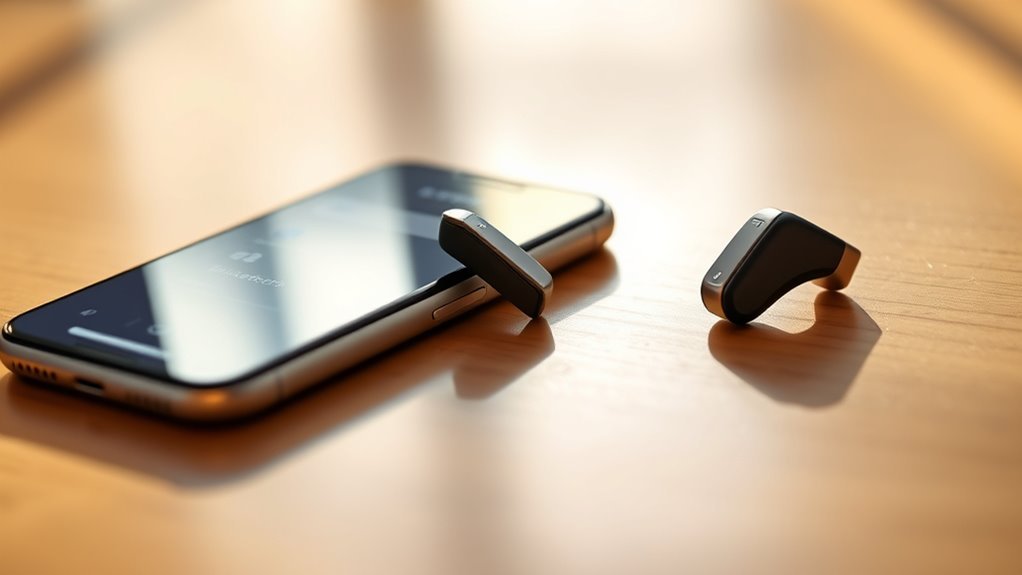
Phonak I90 Sphere hearing aids connect to an iPhone 15 through Bluetooth when both devices are updated, nearby, and in pairing mode. For rechargeable models, placing the aids in the charger for about 10 seconds can activate pairing; battery models use a brief door open-close cycle. Select the aids in iPhone Settings, then wait for the confirmation beep. If connection fails, restart both devices, check firmware, and remove interference. Further steps can improve stability and streaming.
Key Takeaways
- Enable Bluetooth on the iPhone 15, then pair the Phonak I90 Sphere within three minutes of entering pairing mode.
- Restart rechargeable aids in the charger for 10 seconds, or cycle battery doors on replaceable-battery models to activate pairing.
- A confirmation beep or green blinking light indicates successful pairing and readiness for hands-free calls and audio streaming.
- Keep the iPhone and hearing aids close together, with minimal barriers and interference, for the most reliable connection.
- If pairing fails, restart both devices, update firmware and iOS, and reinstall the myPhonak app if needed.
How to Pair Phonak Sphere With iPhone 15
To pair Phonak Sphere hearing aids with an iPhone 15, Bluetooth must first be enabled in the iPhone’s Settings menu. This initial step establishes the wireless environment required for pairing.
The hearing aids should then be prepared according to their power system. Rechargeable models are placed in the charger for at least 10 seconds, removed, and verified in pairing mode by a green blinking indicator. Models with replaceable batteries require the battery doors to be opened and closed for 5 seconds.
The iPhone should then display the hearing aid name in the Bluetooth devices list. Selecting the device initiates pairing. A confirmation beep from the hearing aids indicates successful connection. At that point, wireless calls and audio streaming become available, supporting a more independent daily communication workflow.
Updated firmware on the hearing aids is advisable, as it generally reduces pairing errors and improves device compatibility.
Put Phonak Hearing Aids in Pairing Mode
Phonak hearing aids must be placed in pairing mode before they can connect to an iPhone 15. This step enables direct wireless control and audio access, supporting autonomous use without intermediary accessories.
To put Phonak hearing aids in pairing mode, the method depends on the power system. For replaceable-battery models, the battery doors are opened for 5 seconds, then closed. For rechargeable models, the aids are placed in the charger for at least 10 seconds, then removed; some units can also be restarted by pressing the lower part until the LED blinks red, then green.
- Activate pairing mode on the hearing aids.
- Confirm Bluetooth is enabled on the iPhone.
- Select the aids promptly within 3 minutes.
A limited pairing window applies, so swift action is required. A beep from the aids confirms successful connection for streaming and calls.
Check Before You Pair
Before pairing Phonak I90 Sphere hearing aids with an iPhone 15, the iPhone should be updated to the latest iOS version. Bluetooth must be enabled in Settings, and the hearing aids should be restarted so they enter the 3-minute pairing window.
This check before you pair reduces compatibility faults and supports reliable device discovery. On rechargeable models, battery status should be confirmed first, and the prescribed restart procedure should be followed so detection remains possible.
The Phonak I90 Sphere should also be free of active links to other devices, because prior connections can block a new iPhone 15 from establishing access.
These preparatory steps are not optional; they preserve autonomy by preventing avoidable technical friction. A clean configuration, current software, and an open pairing state create the conditions needed for efficient linking and stable operation.
These preparatory steps are not optional; they prevent friction and enable efficient, stable linking.
Each verification step should be completed before moving forward.
Pair Phonak Sphere in iPhone Bluetooth
With Bluetooth enabled in the iPhone Settings menu, the Phonak I90 Sphere can be placed into pairing mode by briefly using the charger for rechargeable models or cycling the battery doors for battery-powered models.
To pair Phonak Sphere in iPhone Bluetooth, the device list on the iPhone should then be inspected for the hearing aid identifier, typically R-Phonak or L-Phonak. Selection of the correct entry initiates the link without manual code entry. This process preserves user autonomy by establishing a direct wireless pathway.
- Rechargeable models: remain in the charger for 10 seconds, then remove.
- Battery models: open and close the battery doors for 5 seconds.
- iPhone action: tap the Phonak name shown in Bluetooth devices.
A confirmation beep from the hearing aid indicates successful pairing and readiness for liberated communication and audio access.
Confirm Calls and Media Streaming
Successful pairing is confirmed by a hearing-aid beep, indicating that the iPhone 15 is now linked for wireless communication.
At this stage, Phonak hearing aids can receive hands-free calls and media streams directly, removing dependence on separate accessories. Audio from music, podcasts, and telephone conversations is routed into the devices with low friction, supporting a more autonomous listening environment.
The connection permits immediate use after pairing, provided the devices remain within standard Bluetooth range and the iPhone audio output is active. Call audio is delivered binaurally when supported, while media playback follows the same wireless pathway for consistent signal transfer.
For users seeking liberation from environmental barriers, this direct streaming architecture reduces handling demands and preserves mobility.
If performance is inconsistent, firmware currency and system status should be verified, but the confirmed beep itself indicates that the wireless link has been established and ready for practical communication.
Set Up myPhonak Auto-Pairing
Once direct streaming and call audio are confirmed, the next configuration step is myPhonak auto-pairing. The set of hearing aids should first be verified as running the latest firmware and remaining fully compatible with the iPhone 15.
Then the myPhonak app is opened, and the initial setup prompts are followed to establish automatic linkage. Bluetooth must be enabled in iPhone Settings > Bluetooth before initiation.
When the rechargeable devices are removed from the charger, the auto-on function should power them and trigger pairing without manual intervention, supporting user autonomy.
- Confirm firmware and device compatibility.
- Enable Bluetooth and launch myPhonak.
- Remove the aids from the charger and wait for connection.
If pairing does not occur, both the hearing aids and the iPhone 15 should be restarted to refresh the Bluetooth session. This sequence minimizes friction and preserves direct control over listening access.
Why iPhone Notifications Don’t Read Aloud?
Phonak hearing aids generally do not read aloud iPhone text messages or calendar alerts because their iPhone integration is designed to provide sound-based notifications rather than full spoken content.
This design reflects Apple’s MFi framework, which supports reliable connectivity but does not authorize Phonak devices to vocalize the full text of iPhone notifications. As a result, users hear alert tones, not detailed messages, preserving technical simplicity but limiting informational freedom.
Compared with Signia systems, which can announce content, Phonak remains more restrictive. Occasional audible delivery may occur under narrow conditions, yet results are inconsistent and often shaped by app-specific limits.
Google Calendar and similar services are also only partially supported, reducing the scope of accessible alerts.
In practical terms, Phonak iPhone notifications are engineered for awareness, not speech output. This architecture prioritizes stable pairing and discreet signaling over unrestricted message access.
Fix One Phonak Hearing Aid That Won’t Connect
When one Phonak hearing aid fails to connect while the other remains paired, the first step is to confirm that both the aid and the iPhone are powered on and within Bluetooth range. This approach can resolve many connection issues and restores user autonomy without unnecessary intervention.
To fix one Phonak hearing aid that won’t connect, proceed methodically:
- Power cycle the non-connecting aid and verify pairing mode; blinking lights indicate readiness.
- Inspect and replace the wax guard if needed, since obstruction can impair Phonak radio performance.
- Reinstall the myPhonak app, or delete and re-pair the hearing aids to reset stored connection parameters.
If the left aid still fails while the right remains functional, place the device in its charger for one minute, then reinsert it. This hard reboot often clears persistent faults.
Each step targets a distinct failure point, allowing controlled recovery from localized connection issues with minimal disruption.
Fix Phonak Pairing Problems on iPhone 15
Bluetooth pairing failures on an iPhone 15 typically begin with basic connectivity verification: confirm that Bluetooth is enabled in Settings, then restart the Phonak I90 Sphere hearing aids to re-enter pairing mode, with rechargeable units placed in the charger for 10 seconds before removal and green blinking confirmation.
If pairing problems continue, the devices should be kept within close range and the iPhone 15 should be power cycled to clear transient radio faults. Outdated firmware can also suppress discovery, so both the phone and hearing aids should be checked for updates before further attempts.
When the system still does not detect the aids, the existing entry in the Bluetooth list should be deleted and the full pairing sequence repeated from the beginning. This methodical reset restores control to the user, reduces dependency on inconsistent connections, and supports reliable wireless access without unnecessary delay.
Frequently Asked Questions
What Are the Pros and Cons of Audeo Sphere?
Audeo Sphere offers strong speech-in-noise performance, Bluetooth iPhone streaming, and rechargeable convenience. Drawbacks include limited notification-reading features and variable efficacy across hearing profiles. Its clinical design favors autonomy, though personal preference may constrain outcomes.
Which Phonak Model Is Considered the Best?
The Phonak Audeo Paradise, especially the I90 Sphere, is often regarded as best; Model Comparison suggests superior noise handling. A theory of premium performance appears supported by clinical reports, granting users greater auditory autonomy.
What Does Phonak Infino Sphere 90 Do?
Phonak Infinio Sphere 90 provides Hearing Technology that improves speech clarity in noise, suppresses background interference, supports Bluetooth streaming, enables myPhonak customization, and auto-activates from the charger, reducing dependence on manual intervention.
Conclusion
In conclusion, the Phonak i90 Sphere and iPhone 15 generally establish a tidy alliance, provided pairing mode is invoked, Bluetooth permissions are respected, and the myPhonak app is not left to improvise. When notifications remain silent or one aid refuses to cooperate, the fault usually lies in settings, not destiny. A methodical check of battery, firmware, and connection state typically resolves the drama. Technology, fortunately, still rewards patience more reliably than optimism.
