Your Toyota Camry’s catalytic converter reduces harmful exhaust pollutants before they leave the tailpipe. It can last for many years, but engine misfires, an overly rich fuel mixture, oil burning, coolant contamination, impact damage, exhaust leaks, or unresolved sensor problems can shorten its life. Knowing the warning signs—and what does not prove failure—helps you fix the underlying cause before it damages the converter or its replacement.
Quick Answer
A Toyota Camry catalytic converter treats carbon monoxide, unburned hydrocarbons, and nitrogen oxides after combustion. Suspect trouble when the car loses power, stores P0420 or P0430, rattles, fails an emissions test for catalyst-related reasons, or overheats underneath. Diagnose misfires, fuel control, leaks, sensors, oil burning, and coolant intrusion before replacing it.
Key Takeaways
- The catalytic converter treats exhaust gases; it does not control the engine’s air-fuel ratio.
- A P0420 or P0430 code can indicate low catalyst efficiency, but it does not prove the converter is the only faulty part.
- An incomplete readiness monitor can prevent an emissions-test pass, but “not ready” does not mean the converter has failed.
- Misfires, rich operation, oil burning, coolant intrusion, and exhaust leaks must be corrected before installing a new converter.
- Converter quantity and placement vary by Camry model year, engine, hybrid system, and emissions certification.
- Check emissions-warranty coverage and legal replacement requirements before authorizing a paid repair.
Last reviewed for accuracy: July 13, 2026.
Understanding Your Toyota Camry’s Catalytic Converter
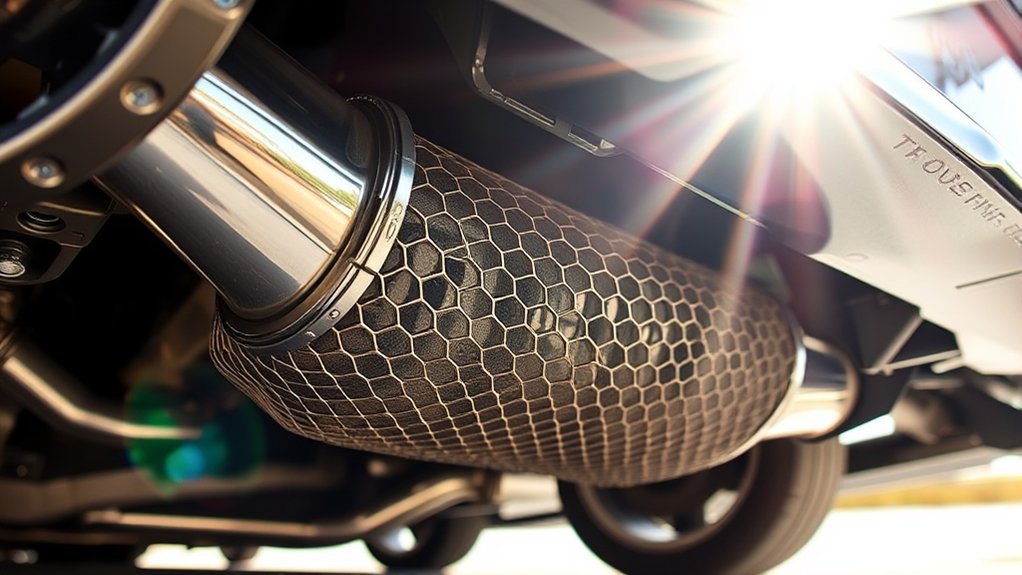
The catalytic converter is part of your Camry’s exhaust and emissions-control system. Exhaust gases pass through a coated internal structure that promotes chemical reactions. These reactions reduce carbon monoxide, unburned hydrocarbons, and nitrogen oxides before the exhaust leaves the vehicle.
Most gasoline-powered Camrys use a three-way catalyst system. Its job is emissions treatment, not fuel-mixture control. The engine control module uses oxygen or air-fuel-ratio sensor information to adjust fuel delivery. The converter then treats the exhaust produced by combustion.
A healthy converter normally creates little noticeable restriction. A melted, collapsed, or heavily contaminated unit can restrict exhaust flow and cause weak acceleration or poor high-speed performance. Replacing a restricted converter may restore lost performance, but it should not be promoted as a horsepower or fuel-economy upgrade.
Note: A catalytic converter reduces several toxic and smog-forming pollutants, but it does not eliminate carbon dioxide. Carbon dioxide remains a greenhouse gas produced during combustion.
How the Catalytic Converter Reduces Harmful Emissions
The U.S. Environmental Protection Agency regulates emissions from passenger vehicles, including harmful exhaust pollutants. A three-way catalytic converter supports compliance by promoting oxidation and reduction reactions inside the exhaust system.
Emission Conversion Process
The converter contains a ceramic or metallic substrate with a large surface area. Catalyst materials such as platinum, palladium, and rhodium help reactions occur without being consumed at the same rate as the exhaust pollutants.
| Reaction | Exhaust pollutant | Main products |
|---|---|---|
| Oxidation | Carbon monoxide | Carbon dioxide |
| Oxidation | Unburned hydrocarbons | Carbon dioxide and water |
| Reduction | Nitrogen oxides | Primarily nitrogen |
The catalyst must warm up before it reaches its most effective operating condition. Short trips may spend a greater share of driving time below that condition. Abnormal overheating, however, can melt or fracture the internal substrate.
Why Air-Fuel Control Matters
The engine-management system must keep combustion within a suitable range for a three-way catalyst to work effectively. A faulty sensor, leaking fuel injector, ignition problem, vacuum leak, or other fuel-control fault can make the mixture too rich or too lean.
A rich mixture can send excess fuel into the exhaust. A severe misfire can do the same. The fuel may burn inside the hot converter and raise its temperature enough to damage the catalyst.
Why Engine Maintenance Protects the Converter
The converter usually has no routine cleaning or replacement interval. The most useful maintenance is preventing upstream engine problems from contaminating or overheating it.
- Replace worn ignition components according to the model-specific maintenance guidance.
- Investigate a flashing check-engine light immediately.
- Repair oil-burning or coolant-loss problems before they contaminate the exhaust.
- Correct fuel-injector and fuel-control faults.
- Use the fuel grade listed in the owner’s manual.
- Inspect exhaust leaks, damaged wiring, and sensor connectors during diagnosis.
For the schedule and specifications that apply to your exact Camry, use Toyota’s official manuals and warranty portal.
Common Causes of Toyota Camry Catalytic Converter Problems
Engine Misfires
A misfire occurs when one or more cylinders fail to burn the air-fuel mixture correctly. Possible causes include:
- Worn or fouled spark plugs
- Faulty ignition coils
- Fuel-injector problems
- Vacuum or intake leaks
- Low compression
- Incorrect fuel pressure
- Wiring or engine-control faults
When unburned fuel reaches the exhaust, it can ignite inside the converter. Continued driving with a severe misfire can overheat and permanently damage the internal catalyst.
Warning: If the check-engine light flashes, the engine shakes severely, you smell raw fuel, or the converter appears red-hot, stop driving as soon as you can do so safely. Turn off the engine and arrange professional inspection or towing. An external fuel leak is also a fire hazard and needs immediate attention.
Rich Fuel Mixture and Leaking Injectors
A leaking injector or another fuel-control problem can deliver more fuel than the engine can burn. This differs from an external fuel-line leak. An external leak may create a fire risk, while an internally leaking injector can contribute to excess fuel entering the exhaust.
Possible clues include hard starting, fuel odor, black exhaust smoke, poor fuel economy, fuel-trim abnormalities, or fuel-fouled spark plugs. These symptoms require diagnosis because several other faults can produce similar results.
Oil or Coolant Contamination
An engine that burns oil can coat the converter with deposits. Coolant entering the combustion chambers through an internal engine fault can also contaminate the catalyst.
Blue exhaust smoke, repeated oil loss, white exhaust after warm-up, unexplained coolant loss, or persistent overheating should be investigated before a converter is replaced. Otherwise, the same contamination can damage the new part.
Physical Damage and Internal Breakup
Road impact, severe vibration, corrosion, or repeated thermal stress can crack the converter housing or break the internal substrate. Loose material may produce a metallic rattle during startup, idle, or acceleration.
A damaged substrate can also shift and restrict exhaust flow. That restriction may cause weak acceleration, reduced power at higher engine speeds, or excessive heat near the converter.
Exhaust Leaks and Sensor Problems
An exhaust leak near an oxygen or air-fuel sensor can alter sensor readings. Damaged wiring, a slow sensor, or another engine-control problem may also produce catalyst-related trouble codes or data that resembles converter failure.
A qualified diagnosis should inspect the complete system instead of replacing the converter solely because a code or symptom appears.
Signs Your Catalytic Converter May Be Failing
No single symptom confirms a failed catalytic converter. However, the following signs justify a diagnostic inspection:
- Check-engine light: The vehicle may store a catalyst-efficiency code or a code related to the underlying engine fault.
- Reduced acceleration: A restricted exhaust can make the Camry feel weak, especially under load or at higher engine speeds.
- Catalyst-related emissions-test failure: Excessive measured emissions or a confirmed catalyst-monitor fault may support further diagnosis. An incomplete readiness monitor by itself does not prove the converter is faulty.
- Rattling noise: A broken internal substrate may rattle during startup, idle, or acceleration.
- Unusual exhaust odor: A sulfur-like or rotten-egg smell can accompany fuel or catalyst problems, but it is not conclusive by itself.
- Dark or abnormal exhaust smoke: This often points to an engine or fuel-control problem that may also damage the converter.
- Excessive heat: Abnormal heat below the vehicle can result from a severe misfire, rich operation, or internal restriction.
- Loud exhaust after theft or impact: A missing, cut, or separated converter can make the exhaust suddenly much louder.
A catalyst-efficiency code is a starting point for diagnosis, not automatic proof that the converter must be replaced.
Catalyst Efficiency Loss vs. Exhaust Restriction
A converter can fail chemically, physically, or in both ways. These failure types do not always produce the same symptoms.
- Low catalyst efficiency: The internal coating no longer treats exhaust as effectively as expected. The Camry may drive normally but store P0420 or P0430 or fail an emissions test.
- Physical restriction: The substrate has melted, collapsed, shifted, or become blocked. The engine may lose power, struggle at higher speeds, run unusually hot, or feel as though it cannot exhale.
- Internal breakup: Pieces of the substrate may rattle and can move into a position that intermittently restricts exhaust flow.
- External damage or theft: Cut pipes, broken flanges, missing sensors, or disconnected wiring may cause a loud exhaust, warning lights, and unsafe exhaust routing.
A catalyst-efficiency code does not automatically mean the exhaust is restricted, and weak acceleration does not automatically mean the catalyst coating has worn out. The diagnostic tests must match the symptom.
Can You Drive With a Suspected Bad Catalytic Converter?
Whether limited driving is reasonable depends on the symptoms. A steady check-engine light with normal engine operation may allow a short trip to a repair facility, but the fault should not be ignored. Continuing to drive can turn an upstream engine problem into converter damage.
Stop driving and arrange towing when you notice any of the following:
- A flashing check-engine light or severe engine shaking
- Raw-fuel odor, visible fuel leakage, or black smoke
- Major power loss that makes merging or maintaining speed unsafe
- A red-hot converter or extreme heat beneath the vehicle
- Overheating, repeated stalling, or signs of an exhaust blockage
- Cut pipes, hanging wiring, sharp metal, or an open exhaust after theft or impact
- Exhaust entering the cabin or any carbon-monoxide concern
Warning: A severely overheated or fuel-soaked converter can create a fire risk. Do not park over dry grass, leaves, paper, or other combustible material when abnormal exhaust heat is suspected.
How a Mechanic Diagnoses a Catalytic Converter Problem
A proper diagnosis should identify both the converter’s condition and the fault that may have damaged it. Depending on the Camry’s model year and symptoms, a technician may:
- Read all diagnostic trouble codes. Misfire, fuel-trim, sensor, temperature, and catalyst codes should be considered together.
- Review freeze-frame and live data. This shows the operating conditions present when a code was stored.
- Check for active misfires. Ignition, injector, compression, and fuel-pressure problems may need testing.
- Inspect the exhaust system. Leaks, impact damage, corrosion, loose shields, cut pipes, and damaged sensor wiring can affect the result.
- Evaluate oxygen or air-fuel sensor data. Sensor performance and wiring should be verified before condemning the catalyst.
- Check for restriction when symptoms support it. Backpressure, vacuum behavior, or other manufacturer-approved tests may help identify a blocked exhaust.
- Look for contamination. Oil burning, coolant intrusion, or rich running can leave evidence that explains repeat failure.
- Confirm the repair after correction. The technician should complete the required monitors and verify that the original condition does not return.
Safe Checks an Owner Can Make
You can collect useful information before the appointment without removing exhaust parts or working beneath the car:
- Record whether the check-engine light is steady or flashing.
- Use a scan tool to record all codes and freeze-frame information, but do not erase them before diagnosis.
- Note when the symptom occurs: cold start, idle, acceleration, highway speed, or after the engine warms.
- Check for unexplained engine-oil or coolant loss.
- Listen for rattling during a cold start while standing beside the vehicle in a ventilated area.
- Look from a safe position for cut pipes, hanging wires, or obvious impact damage after the exhaust has cooled.
- Keep fuel-economy, repair, emissions-test, and warning-light records for the technician.
Note: Do not crawl beneath a vehicle supported only by a jack. Exhaust parts can remain hot long after shutdown, and striking or drilling a converter can release dust and cause additional damage.
What Common Catalyst Tests Can and Cannot Prove
| Test | What it can show | Important limitation |
|---|---|---|
| Trouble codes and freeze-frame data | Which monitor detected a problem and under what conditions | A code identifies a monitored condition, not automatically the failed part |
| Upstream and downstream sensor data | How the control system and catalyst monitor respond during specific operating conditions | Exhaust leaks, wiring faults, sensor age, fuel control, and vehicle calibration can affect the pattern |
| Backpressure or vacuum testing | Whether exhaust flow may be physically restricted | It does not by itself measure the catalyst’s chemical conversion efficiency |
| Inlet and outlet temperature comparison | Whether heat-producing reactions may be occurring under the test conditions | Results vary with engine load, warm-up, mixture, airflow, and measurement location; temperature alone is not conclusive |
| Visual and noise inspection | Impact damage, theft, broken mounts, loose shields, or an internally broken substrate | A converter can lose efficiency without visible external damage or rattling |
What P0420 and P0430 Mean
P0420 generally indicates that the control system detected catalyst efficiency below the expected threshold for Bank 1. P0430 is the corresponding Bank 2 code on engines that monitor a second bank.
These codes can result from a worn converter, but they can also be influenced by exhaust leaks, sensor problems, unresolved misfires, improper fuel control, or contamination. Your Camry’s engine configuration determines which codes and banks apply.
Pro Tip: Before approving a converter replacement, request the complete code list, the identified root cause, the tests performed, the replacement part number, and the part and labor warranty. Correcting the cause first reduces the risk of damaging the new converter.
Readiness Monitors After Repair
Clearing codes or disconnecting the 12-volt battery resets many OBD readiness monitors. The check-engine light may remain off while the monitors are still incomplete. This is why a vehicle can receive a “not ready” emissions-test result even after the original repair.
After repair, follow the model-appropriate verification procedure and allow the required monitors to complete under safe driving conditions. Do not clear codes immediately before an emissions test merely to turn off the warning light. A shop should verify that the catalyst monitor completes and that the original codes and symptoms do not return.
Can a Catalytic Converter Be Cleaned?
A fuel additive or cleaner cannot repair a melted, cracked, collapsed, or chemically worn catalyst. It also cannot correct a misfire, leaking injector, oil-burning engine, coolant leak, damaged sensor, or exhaust leak.
Some products claim to remove light deposits, but results vary and should not replace diagnosis. The EPA explains that its aftermarket evaluation and fuel-additive registration processes do not certify, approve, or endorse a product’s advertised fuel-economy or emissions benefits. Review the EPA’s transportation and fuel-additive guidance, and avoid using an additive that Toyota does not approve for your vehicle or fuel system.
If the converter is restricted or its catalyst efficiency is genuinely below specification, repair of the underlying fault and replacement with a compliant part may be necessary.
Why Regular Maintenance Matters for Your Catalytic Converter
The converter itself normally does not need periodic removal or cleaning. Preventive care focuses on keeping the engine, fuel system, sensors, and exhaust system in proper condition.
- Respond promptly to a flashing or persistent check-engine light.
- Do not continue driving with a severe misfire.
- Monitor engine oil and coolant levels.
- Repair oil consumption, coolant loss, and overheating.
- Follow the correct spark-plug and engine-maintenance schedule.
- Investigate sudden fuel-economy changes instead of assuming the converter is responsible.
- Inspect exhaust damage after striking road debris.
- Keep maintenance and diagnostic records for warranty review.
These steps do not guarantee that the original converter will last for the life of the car, but they reduce avoidable heat and contamination damage.
How Many Catalytic Converters Does a Toyota Camry Have?
There is no single converter count that applies to every Toyota Camry. The system can vary by:
- Model year
- Engine size and layout
- Gasoline or hybrid powertrain
- Federal or California emissions certification
- Whether separate catalyst bricks are counted individually or as part of one exhaust assembly
Some Camrys may use more than one catalyst location or a manifold-integrated unit followed by another underbody unit. Online listings may also count complete assemblies differently from individual catalyst elements.
Engine-bank count is not the same as converter count. An inline-four engine has one cylinder bank, while a V6 has two, which helps explain the Bank 1 and Bank 2 wording used by diagnostic codes. It does not tell you how many individual catalyst elements or exhaust assemblies the vehicle has.
To identify the correct configuration, use the VIN, engine information, under-hood emissions label, converter location, and Toyota’s model-specific parts information. Do not order a converter based only on the words “Toyota Camry.”
Warranty and Legal Replacement Requirements
Note: This section summarizes United States federal and California requirements. Warranty, inspection, and replacement rules differ in Canada and other jurisdictions. Follow the rules where the vehicle is registered and repaired.
Check Emissions-Warranty Coverage
Before paying for a replacement, check the warranty guide for your exact vehicle. According to the EPA’s federal emissions-warranty guidance, the catalytic converter is one of the specified major emissions components covered for eight years or 80,000 miles, whichever occurs first, under applicable federal provisions.
The federal Performance Warranty applies when qualifying conditions involving an approved emissions-test failure are met. The Design and Defect Warranty applies when a covered component fails because of a defect in materials or workmanship. Coverage can be denied when evidence shows that improper use or maintenance caused the failure.
The federal warranties can apply to used vehicles because the coverage period begins with the vehicle’s original sale, not each change of ownership. Additional manufacturer or state coverage may apply. Warranty eligibility depends on the vehicle, age, mileage, failure circumstances, maintenance history, and governing warranty terms.
Toyota states that emissions coverage varies under federal and California regulations. Use Toyota’s manuals and warranties portal to retrieve the Warranty & Maintenance Guide for the exact model year, and have the VIN and mileage available when requesting a coverage check.
Federal Anti-Tampering Rules
The federal Clean Air Act prohibits removing, bypassing, or rendering required emissions-control equipment inoperative on a road vehicle. EPA describes these requirements in its air-enforcement guidance and explains that the anti-tampering provisions apply to vehicle owners as well as commercial parties.
A straight pipe, hollowed converter, electronic defeat device, sensor simulator, or other bypass is not a compliant road-use repair. Temporary removal may be permitted when necessary for a legitimate repair and the emissions-control device is restored to proper operation afterward. State inspection and emissions rules may add further requirements.
California-Approved Replacement Parts
California has specific rules for aftermarket catalytic converters. The replacement must be approved for the exact vehicle application and carry an applicable California Air Resources Board Executive Order when required. CARB advises matching the vehicle’s make, model year, engine size, and test group or engine family. See CARB’s aftermarket catalytic-converter guidance.
Rules outside California vary. Confirm the applicable standard with the vehicle’s emissions label, state inspection authority, or a qualified repair facility before purchasing the part.
Choosing the Correct Replacement
Before installation, the repair order or estimate should confirm:
- The vehicle identification number
- The exact engine and powertrain
- The under-hood test group or engine-family information
- The failed converter’s physical location
- Whether federal or California-compliant certification applies
- The complete replacement part number and compliance markings
- Whether sensors, gaskets, flanges, shields, or adjoining pipes also require repair
- The part and labor warranty
A direct-fit, manifold-integrated, or weld-in replacement must still match the vehicle and governing emissions rules. Price alone does not establish correct fit, durability, or legal compliance.
What Affects Replacement Cost?
Replacement cost can vary widely. Important factors include:
- Camry model year and engine
- Hybrid or non-hybrid configuration
- Converter location and number of assemblies
- Federal or CARB-compliant part requirements
- Original-equipment or approved aftermarket part
- Condition of exhaust pipes, flanges, fasteners, shields, and sensors
- Damage caused by theft
- Diagnostic and labor time
Ask for an itemized written estimate that identifies the part number, compliance markings, labor, additional exhaust repairs, taxes, and warranty.
Steps to Take If Your Catalytic Converter Is Stolen or Damaged
A stolen converter often leaves cut exhaust pipes, hanging wiring, sharp metal, and an extremely loud exhaust. Impact damage may create similar safety concerns.
- Turn off the vehicle. Avoid continued driving when the exhaust is open, parts are hanging, or wiring is damaged.
- Do not crawl beneath an unsupported vehicle. Inspect only from a safe position.
- Photograph visible damage. Take pictures without touching hot, sharp, or unstable components.
- Report a suspected theft. Contact local law enforcement and obtain a report number.
- Contact your insurer. Ask whether comprehensive coverage applies and what documentation is required.
- Arrange towing or professional inspection. A shop should check the exhaust, sensors, wiring, underbody, and nearby components.
- Confirm replacement compliance. The new unit must match the vehicle and applicable federal, state, provincial, or local rules.
- Keep records. Save the report, photographs, invoices, part information, and warranty documents.
Warning: Exhaust gases contain carbon monoxide. Do not idle a vehicle with a damaged or disconnected exhaust in a garage or other enclosed area. Tow the vehicle when its condition, noise, wiring, heat, or exhaust routing makes driving unsafe.
Ways to Discourage Future Theft
No device can guarantee prevention, but several measures may reduce opportunity or make the converter harder to remove or resell:
- Park in a locked garage when available.
- Choose visible, well-lit areas near entrances or cameras.
- Ask whether a model-specific shield or guard can be installed safely.
- Consider identification marking where local programs recommend it.
- Use motion-sensitive lighting or security cameras at home.
- Avoid modifications that interfere with heat shielding, ground clearance, or exhaust movement.
How Millennium Toyota Can Help With Catalytic Converter Issues
If Millennium Toyota is your chosen service center, ask its service department to diagnose the complete engine and exhaust system before recommending a converter. You can use the same checklist when working with another Toyota dealer or qualified diagnostic and exhaust shop.
A complete service visit may include:
- Initial inspection: Confirming the symptoms, stored codes, exhaust condition, and visible damage.
- System diagnosis: Checking misfires, fuel control, sensor operation, leaks, contamination, and exhaust restriction.
- Application verification: Identifying the correct converter for the VIN, engine, emissions family, converter location, and registration requirements.
- Root-cause repair: Correcting the fault that damaged or contaminated the original converter.
- Replacement and verification: Installing a compliant part and confirming that the original symptoms and codes do not return.
- Readiness verification: Confirming that the applicable OBD monitors complete after repair.
- Warranty review: Checking available emissions, parts, and labor coverage before paid work begins.
Request a written diagnosis and itemized estimate. It should identify the proposed part, legal compliance, related repairs, warranty, and total expected charge.
Related Guides
Frequently Asked Questions
How do I know if my Toyota Camry catalytic converter is bad?
Possible signs include reduced acceleration, a catalyst-efficiency code, a catalyst-related emissions-test failure, rattling, unusual exhaust odor, or excessive heat. These signs are not conclusive. A technician should also check for misfires, exhaust leaks, sensor faults, rich operation, oil burning, coolant contamination, physical damage, and exhaust restriction.
What are the three main functions of a three-way catalytic converter?
It oxidizes carbon monoxide into carbon dioxide, oxidizes unburned hydrocarbons into carbon dioxide and water, and reduces nitrogen oxides primarily into nitrogen. These reactions lower several harmful and smog-forming exhaust pollutants.
How many catalytic converters are in a Toyota Camry?
The number and arrangement vary by model year, engine, hybrid configuration, emissions certification, and how catalyst elements are counted within larger assemblies. Use the VIN, engine information, under-hood emissions label, converter location, and model-specific parts catalog for an accurate answer.
Can a Toyota Camry run without a catalytic converter?
The engine may start after the converter is removed or stolen, but the vehicle can be extremely loud, release untreated exhaust, illuminate warning lights, and have unsafe cut pipes or wiring. U.S. federal law prohibits tampering with required emissions equipment. Arrange towing or professional inspection rather than using the vehicle normally.
Does a P0420 or P0430 code always mean the converter is bad?
No. These codes indicate that monitored catalyst efficiency is below the expected threshold, but exhaust leaks, sensor faults, misfires, improper fuel control, or contamination may contribute. The complete system should be tested before replacement.
Is a catalytic converter covered by an emissions warranty?
It may be. EPA guidance identifies the catalytic converter as a specified major emissions component covered for eight years or 80,000 miles under applicable federal warranty provisions. The Performance Warranty and Design and Defect Warranty have different eligibility conditions. Manufacturer or state coverage may differ, so check the exact Toyota Warranty & Maintenance Guide with your VIN and mileage before approving a paid repair.
Can a catalytic-converter cleaner fix a failed converter?
A cleaner cannot repair a melted, cracked, collapsed, or chemically worn catalyst. It also cannot correct a misfire, leaking injector, oil-burning engine, coolant leak, exhaust leak, or sensor fault. Diagnose and repair the actual cause instead of relying on an additive.
Can I drive with a suspected bad catalytic converter?
A short trip for diagnosis may be reasonable when the check-engine light is steady and the engine otherwise runs normally. Stop driving and arrange towing if the light flashes, the engine shakes, power drops severely, you smell raw fuel, the converter glows or overheats, the exhaust is open, or fumes may be entering the cabin.
How long should a Toyota Camry catalytic converter last?
Toyota does not use one universal replacement interval for every Camry catalytic converter. A converter can remain serviceable for many years when the engine and fuel-control systems operate correctly. Misfires, rich running, oil burning, coolant intrusion, corrosion, impact, and repeated overheating can shorten its life.
Why can a new catalytic converter fail or set the same code again?
Repeat failure can occur when the original misfire, rich mixture, oil burning, coolant leak, exhaust leak, sensor fault, or wiring problem was not corrected. An incorrect or noncompliant replacement part can also produce fit or monitoring problems. The root cause and part application should be verified before installation.
Conclusion
Your Toyota Camry’s catalytic converter is an emissions-control component, not a routine tune-up item, cleaning service, or fuel-economy upgrade. Its condition depends heavily on the health of the engine, fuel system, sensors, and exhaust system.
Do not replace the converter based on odor, poor acceleration, one temperature reading, one sensor graph, or a trouble code alone. A complete diagnosis should identify misfires, fuel-control faults, leaks, contamination, sensor problems, physical damage, and possible exhaust restriction. Before paying for replacement, verify warranty eligibility, correct the root cause, and confirm that the proposed part matches your Camry’s exact emissions application.
Sources
- U.S. EPA: Passenger Cars and Trucks Emissions Regulations — supports the discussion of regulated vehicle pollutants and emissions standards.
- U.S. EPA: Transportation, Air Pollution, and Climate Change Frequently Asked Questions — supports federal emissions-warranty, anti-tampering, readiness, and aftermarket-additive guidance.
- U.S. EPA: Air Enforcement — supports federal anti-tampering and defeat-device requirements.
- California Air Resources Board: Aftermarket Catalytic Converters — supports California replacement-part, Executive Order, and application-matching requirements.
- Toyota: Manuals and Warranties — provides model-specific maintenance, warranty, and owner information.
