Your Toyota Camry Hybrid can deliver excellent fuel economy, but its displayed MPG may change from week to week. Cold weather, short trips, traffic, speed, climate-control use, tire condition, recent service work, and the way the dashboard average was reset can all affect the result. A lower number does not always mean something is broken, but a sudden, lasting drop deserves a structured check.
Quick Answer
Your Toyota Camry Hybrid’s MPG can fall because of cold weather, short trips, higher speeds, aggressive acceleration, climate-control use, low tire pressure, replacement tires, extra drag, or a mechanical fault. Confirm the change across two or three comparable fill-ups, then check the tire placard, recent service work, warning lights, hybrid-system behavior, and driving conditions.
Key Takeaways
- Compare your MPG with the correct model-year, trim, drivetrain, and wheel rating—not a universal Camry Hybrid number.
- Cold weather and repeated short trips can cause a large but normal seasonal decline.
- Inflate cold tires to the pressure on the driver-door placard, not to a generic 40–42 PSI target or the sidewall maximum.
- Confirm the trend with hand-calculated MPG over several comparable fill-ups before diagnosing the car from one dashboard reading.
- Review recent tire, wheel, brake, alignment, and oil work when the loss begins immediately after service.
- Get professional help when the decline is sudden, persistent, or paired with warning lights, rough running, pulling, odors, smoke, leaking fuel, or unusual heat from a wheel.
At a Glance
| Time Required | 15–30 minutes for basic checks; two or three fill-ups to confirm a trend |
| Difficulty | Easy for observation and tire checks; professional diagnosis may be needed |
| Tools Needed | Accurate tire gauge, fuel receipts or notes, odometer, calculator, and owner’s manual |
| Cost | Usually $0 for basic checks; diagnostic and repair costs depend on the cause |
Understanding Toyota Camry Hybrid MPG Variability
Start with the correct baseline. EPA estimates vary by model year, trim, drivetrain, and wheel package. For example, Toyota lists the 2026 Camry at up to an EPA-estimated 51 combined MPG. Toyota’s displayed 2026 trim figures also range from 52/49 city/highway MPG for the front-wheel-drive LE to 47/45 for the other listed front-wheel-drive trims, so the maximum figure does not apply to every Camry Hybrid.
The EPA and U.S. Department of Energy explain that fuel-economy estimates come from standardized testing. Your real result can differ because of driving conditions, vehicle condition, fuel, engine break-in, and normal vehicle-to-vehicle variation. Use the rating for your exact configuration as a comparison point, not as a guaranteed result.
A useful MPG comparison controls the variables: the same vehicle, a similar route, similar weather, similar trip length, and several tanks of fuel.
The most common reasons for MPG variation include:
- Trip length: A hybrid spends more of a short trip warming the engine, battery, tires, and cabin, so repeated short trips often produce lower averages.
- Temperature: Cold fluids, denser air, lower tire pressure, cabin heating, and reduced battery performance all increase energy use.
- Traffic and terrain: Stop-and-go traffic, steep grades, headwinds, snow, slush, and wet roads can reduce efficiency.
- Driving style: Rapid acceleration, hard braking, and high speed use more energy. The U.S. Department of Energy says aggressive driving can reduce gas mileage by roughly 15%–30% at highway speeds and 10%–40% in stop-and-go traffic.
- Climate control: Cabin heat can make the gasoline engine run more often in winter. Heavy air-conditioning use can also lower MPG in hot weather.
- Tires and wheels: Low pressure, different tire construction, larger or heavier wheels, alignment problems, and increased rolling resistance can change fuel economy.
- Vehicle load and drag: Extra cargo, roof racks, rooftop boxes, and snow or ice buildup require more energy to move the car.
- Recent resets: Resetting a dashboard average, disconnecting power during service, or viewing a short-trip average can make normal variation look dramatic.
Fuel can play a smaller role. Winter-grade gasoline can contain slightly less energy per gallon than summer-grade fuel. However, you should not assume winter gasoline always contains more ethanol or that fuel alone explains a major MPG loss.
Use the octane grade required by the owner’s manual for your exact model year. The Department of Energy’s octane guidance says that using higher octane than required usually provides little or no benefit under normal driving. Premium fuel is therefore not a reliable fix for falling MPG unless Toyota specifically requires or recommends it for your vehicle.
How to Diagnose a Sudden Drop in MPG
Before replacing parts, confirm that the drop is real. A dashboard average can swing after idling, a cold start, a short trip, a route change, or a display reset. A hand calculation over comparable tanks is more reliable for determining whether the car is actually consuming more fuel.
- Record your baseline: Note the model year, trim, drivetrain, wheel size, usual route, typical seasonal MPG, and whether you are reading a trip average or a long-term average.
- Measure several tanks: Fill the tank, reset the trip meter, drive normally, then divide miles driven by gallons added at the next fill-up. Repeat for two or three tanks.
- Compare similar conditions: Do not compare a warm-weather highway tank with a cold-weather week of short city trips.
- Inspect simple causes first: Check tire pressure, warning lights, cargo, roof accessories, recent tire changes, and recent maintenance.
- Review hybrid-specific clues: Check for hybrid-system messages, unusual engine operation, repeated battery warnings, or a blocked hybrid-battery cooling intake if your model has one.
- Check recalls and campaigns: Use Toyota’s VIN-based safety recall and service-campaign lookup, especially when the car also has a warning message or drivability symptom.
- Escalate when needed: Arrange a diagnosis if the loss continues across comparable tanks or the car shows another symptom.
Hand-Calculate MPG Correctly
For the cleanest comparison, use the same vehicle, similar driving, and a consistent filling method. Fill at the same station and pump when practical, stop at the first automatic shutoff, and do not keep topping off the tank. Small differences in pump shutoff can distort one result, which is why two or three tanks are more useful than one.
Hand-calculated MPG = miles driven ÷ gallons added. For example, 420 miles divided by 9.5 gallons equals about 44.2 MPG.
| What You See | Likely Meaning | Next Step |
|---|---|---|
| Dashboard MPG fell after a reset or short trip | The display may be reacting to a small, unrepresentative sample | Drive normally and compare several full tanks |
| Dashboard MPG fell, but hand-calculated MPG did not | The display average or reset period may explain the change | Continue tracking receipts and odometer readings |
| Both readings fell during colder, shorter trips | A seasonal or route-related decline is likely | Check tires and compare again when conditions are similar |
| Both readings fell suddenly with another symptom | A tire, brake, engine, sensor, or hybrid-system problem may be present | Inspect promptly and arrange diagnosis if the cause is not obvious |
Check Tire Pressure Correctly
Check all tires when they are cold, meaning the car has normally been parked for at least three hours. Use the recommended pressure on the Tire and Loading Information label near the driver’s door or in the owner’s manual. The correct number can vary by model year and configuration, and the front and rear specifications may differ on some vehicles.
The tire-pressure monitoring system is a warning system, not a substitute for monthly checks. It may not alert you until a tire is significantly underinflated. Also inspect the tread for uneven wear, cuts, bulges, embedded objects, and other damage.
Warning: Do not inflate every Camry Hybrid to 40–42 PSI unless your vehicle’s placard specifically calls for that pressure. Do not use the maximum pressure molded into the tire sidewall as your target, and do not bleed warm tires down to the cold placard value. Overinflation can reduce ride comfort and available grip, while underinflation increases heat, wear, and rolling resistance.
Monitor Driving Conditions Closely
Review what changed around the same time as the MPG decline. A different commute, colder mornings, more idling, stronger heat or A/C use, highway driving at higher speeds, hilly roads, stronger headwinds, or added cargo may explain the difference.
Speed matters, but there is no universal “best” speed of 45–65 mph for every vehicle. The Department of Energy states that each vehicle has its own efficient range and that gas mileage usually decreases rapidly above 50 mph. Follow posted speed limits and use a steady pace when traffic and road conditions allow.
Short trips deserve special attention. A five-minute errand can produce a poor displayed average because the engine, battery, tires, and cabin are still warming. Combining nearby errands lets more of the drive occur after the powertrain reaches an efficient temperature.
Assess Recent Maintenance Changes
Look for changes that happened just before the MPG loss. New tires, a different wheel size, incorrect tire pressure, an oil service, brake work, alignment work, or a roof accessory can all affect the result. A change that begins immediately after service should be checked by the shop that performed the work.
| Maintenance Area | What Can Lower MPG | What to Do |
|---|---|---|
| Tires and wheels | Low pressure, higher rolling resistance, larger size, increased weight, uneven wear, or an unapproved overall diameter | Confirm the approved size, load rating, cold placard pressure, balance, and alignment |
| Oil service | Incorrect viscosity, incorrect level, a loose cap, or a leak | Use the oil grade and quantity specified for your exact model year and correct any leak |
| Brakes and alignment | Dragging brake, pulling, or excessive tire scrub | Seek inspection if the car pulls, coasts poorly, vibrates, or one wheel smells or feels unusually hot |
| Warning lights | Engine, emissions, sensor, brake, tire, or hybrid-system faults | Read diagnostic codes and repair the cause rather than simply clearing the light |
| Hybrid-battery cooling | An obstructed cooling intake can interfere with proper battery temperature control on models equipped with an accessible intake | Use Toyota’s manual portal to find the location and approved inspection or cleaning procedure for your exact model year |
| Climate control | Heavy heat, defroster, or A/C use | Use comfortable settings, but never reduce visibility or passenger safety to save fuel |
| Air filter | A severely restricted filter can hurt acceleration and performance | Replace it when required, but do not expect an MPG gain on a modern fuel-injected car |
| Fuel and octane | Contaminated fuel, incorrect fuel, or using an octane below the manufacturer’s requirement | Use the fuel specified in the owner’s manual; do not expect premium fuel to fix MPG when it is not required |
Warning: Stop in a safe place and shut the vehicle off if you see leaking fuel, smoke, signs of fire, a red brake warning, a severe hybrid-system warning, or a wheel that is producing intense heat or smoke. Do not continue driving solely to complete an MPG test.
How Tire Choice Affects Toyota Camry Hybrid Fuel Efficiency
Replacement tires can change MPG, but no responsible estimate can promise a fixed 4–10 MPG loss based only on tire weight, tread depth, or brand. Rolling resistance depends on the tire’s materials, construction, tread design, inflation, size, temperature, load, and operating conditions.
NHTSA advises using the original tire size or another size recommended by the vehicle manufacturer, maintaining the cold placard pressure, and selecting the correct load rating. Those factors affect safety, durability, and fuel consumption, but there is no universal formula that converts one tire specification into a guaranteed MPG change.
When choosing tires, compare:
- Approved size: Use the original size or another size approved by Toyota for your exact car. A non-approved overall diameter can also affect speedometer, odometer, and MPG calculations.
- Load and speed ratings: Meet or exceed the vehicle manufacturer’s requirements.
- Rolling resistance: Look for a tire designed to preserve fuel efficiency without sacrificing the wet, snow, or ice traction you need.
- Wheel diameter and mass: Larger or heavier wheel-and-tire packages can require more energy during acceleration.
- Seasonal needs: Winter tires may reduce MPG compared with low-rolling-resistance all-season tires, but their cold-weather traction can be essential.
- Inflation and alignment: Even an efficient tire performs poorly when underinflated or misaligned.
- Like-for-like comparisons: Compare tires in the same approved size and service category rather than judging them by brand or weight alone.
Pro Tip: After installing new tires, record their size, cold pressure, installation date, and your next three hand-calculated MPG results. This gives you a fair comparison instead of relying on one short trip or one dashboard average.
How Seasons Affect MPG: What to Expect
Seasonal MPG changes are normal, especially for a hybrid. The size of the change depends on temperature, trip length, traffic, tires, precipitation, climate-control use, wind, and whether the car is parked indoors or outdoors.
Cold-Temperature Effects on Efficiency
The Department of Energy reports that hybrid fuel economy typically falls by about 20%–40% in city driving under cold-test conditions and by 25%–45% on short trips. Those are broad research ranges, not Camry-specific promises, but they show why a winter decline can be substantial.
Cold weather reduces MPG because:
- Engine oil and driveline fluids create more friction before warming.
- The gasoline engine must run longer to reach an efficient temperature.
- Cabin heat, defrosters, heated features, and fans use energy.
- Cold air increases aerodynamic drag.
- Tire pressure falls as temperature drops.
- Battery and regenerative-braking performance can be reduced.
- Snow, slush, and winter tires increase rolling resistance.
- Long warm-up idling burns fuel without adding miles.
Winter Fuel Formulations
Winter gasoline is blended to operate in cold temperatures and can have slightly less energy per gallon than summer fuel. That may contribute to a modest seasonal difference. It does not justify assuming every winter blend has higher ethanol content, and it usually does not explain a severe drop by itself.
Hot Weather and Air Conditioning
Warm weather can help the engine reach an efficient temperature faster and can reduce aerodynamic drag. However, heavy A/C use can offset those gains. The Department of Energy reports that A/C can reduce a conventional vehicle’s fuel economy by more than 25% in very hot conditions, particularly on short trips. The percentage effect can be even larger on hybrids, although the result varies by vehicle and conditions.
Vent hot air briefly before using A/C, park in shade when practical, and avoid setting the cabin colder than needed. At highway speeds, open windows increase drag, so A/C may be the more efficient comfort choice. Comfort, visibility, and heat safety remain more important than a small MPG difference.
Easy Maintenance Tips to Improve Your Camry’s MPG
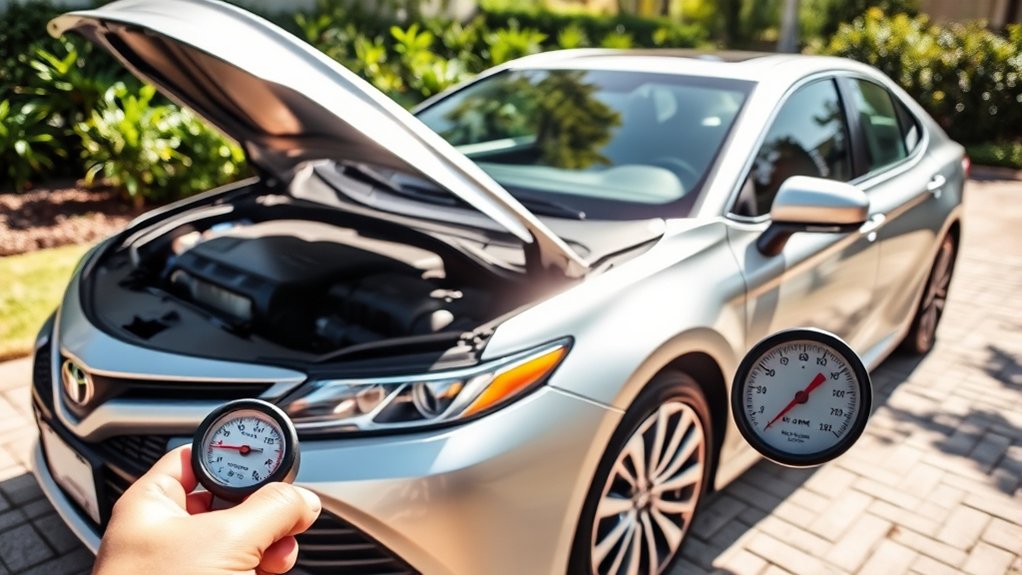
Maintenance protects efficiency, reliability, and safety. Focus on items that can create real resistance, interfere with cooling, or cause the powertrain to operate incorrectly.
- Check cold tire pressure monthly: Use the driver-door placard and inspect tread wear at the same time.
- Use the specified motor oil: Follow the viscosity, quantity, and service interval for your exact model year.
- Respond to warning lights: A check-engine, brake, tire-pressure, or hybrid-system warning can indicate a fault that affects fuel use, emissions, or safety.
- Inspect brakes and alignment: Dragging brakes and poor alignment waste energy and can create safety problems.
- Follow Toyota’s maintenance schedule: Keep fluids, spark plugs, cooling systems, and other service items within specification.
- Replace filters when needed: A clean engine air filter supports performance, but official DOE guidance says replacing a clogged filter on a modern fuel-injected car does not normally improve MPG.
- Keep hybrid cooling areas unobstructed: If your model has an accessible traction-battery cooling intake, keep luggage, pet hair, dust, and other material from blocking it. Follow the exact manual rather than using compressed air or disassembling trim without instructions.
- Remove unnecessary drag and weight: Take off unused roof racks or cargo boxes and clear heavy items you do not need.
- Check recalls and service campaigns: Search by VIN when a warning or unexplained drivability change appears.
Do not chase MPG by overinflating tires, using an unapproved oil, skipping defrosting, blocking needed airflow, or delaying a required repair. Small gains are not worth reducing safety or reliability.
How to Drive for Better MPG
Your driving habits can change fuel economy more than many small maintenance adjustments. The goal is not to drive unusually slowly or obstruct traffic. Instead, reduce unnecessary acceleration, braking, speed changes, and idling.
- Accelerate smoothly: Use moderate throttle and let the hybrid system blend engine and electric power.
- Look ahead: Ease off early when traffic slows so regenerative braking can recover some energy.
- Hold a steady legal speed: Higher highway speeds increase aerodynamic drag and usually reduce MPG.
- Use cruise control selectively: It can help maintain a constant speed on flat highways, but it may add unnecessary throttle changes on rolling terrain.
- Use Eco mode as a tool: If equipped, it can encourage gentler inputs, but it cannot overcome cold weather, low tires, or aggressive driving.
- Combine trips: One longer outing usually uses less fuel than several separate cold starts.
- Avoid prolonged idling: Idling uses fuel without adding miles.
- Brake progressively: Smooth, early deceleration gives the hybrid system more opportunity to recover energy than abrupt last-second braking.
Keep a safe following distance so you can respond gradually. Avoid unsafe “hypermiling” methods, coasting that reduces vehicle control, drafting other vehicles, or driving below a safe traffic speed.
Winter Driving Tips for Better Toyota Camry Hybrid MPG
You cannot remove every cold-weather penalty, but you can reduce avoidable losses without compromising safety:
- Park in a garage when available: A warmer starting temperature shortens the warm-up period.
- Avoid long warm-up idling: Once the windows are clear and it is safe, drive gently so the car warms under light load.
- Combine errands: Finish several nearby stops in one warmed-up trip.
- Check tire pressure more often: Cold temperatures can lower pressure quickly.
- Clear snow and ice: Extra weight and disrupted airflow add resistance.
- Use heat efficiently: Choose a comfortable setting and reduce unnecessary use of heated features after the cabin warms.
- Prioritize traction: Use appropriate winter tires when conditions require them, even if MPG falls slightly.
- Compare winter with winter: Judge improvement against similar temperatures and routes rather than against a summer highway result.
Note: Visibility and traction come first. Use the defroster, heat, lights, and winter tires whenever needed for safe driving. Fuel economy is secondary to vehicle control and clear windows.
When a Drop in MPG Needs Professional Diagnosis
Schedule an inspection when the MPG decline continues across several comparable fill-ups or appears with another symptom. Professional diagnosis is especially important when you notice:
- A check-engine, hybrid-system, ABS, brake, or tire-pressure warning that does not clear after the underlying cause is corrected
- Rough running, hesitation, poor acceleration, unusual engine operation, or repeated battery warnings
- A fuel smell, visible leak, smoke, or unusual exhaust odor
- Pulling, vibration, uneven tire wear, poor coasting, or one wheel becoming unusually hot
- A sudden decline immediately after tire, wheel, brake, alignment, or oil service
- A large loss that remains after weather, route, tire pressure, and trip length return to normal
- Unusually rapid swings in the hybrid battery display combined with reduced assist, warnings, or a major change in engine operation
- A cooling fan or airflow noise that is new, unusually loud, or paired with a hybrid warning
A technician can inspect diagnostic trouble codes, fuel and air sensors, brakes, alignment, tire specifications, engine temperature, cooling systems, and hybrid-system data. The goal is to test the car and identify the cause, not to replace parts from guesswork alone.
What to Tell the Technician
Bring details that make the problem easier to reproduce and diagnose:
- Your model year, trim, drivetrain, mileage, and tire size
- The date the MPG decline began
- Dashboard and hand-calculated MPG before and after the change
- Typical trip length, speed, temperature, and route
- Recent tire, wheel, brake, alignment, battery, or oil work
- Photos or exact wording of warning messages
- Whether the car pulls, vibrates, coasts poorly, smells unusual, or runs the engine more often
- Fuel receipts showing gallons added and miles driven
This information helps distinguish a normal seasonal change from a tire, brake, engine-temperature, sensor, or hybrid-system problem.
Frequently Asked Questions
Why is my Toyota Camry Hybrid MPG going down?
Common causes include colder weather, short trips, stronger heat or A/C use, higher speeds, aggressive driving, low tire pressure, new tires, extra cargo, roof accessories, traffic, and maintenance problems. Confirm the decline with two or three hand-calculated tanks and compare similar driving conditions.
Does a Toyota Camry Hybrid really get 50 MPG?
Some configurations can. Toyota lists the 2026 Camry at up to an EPA-estimated 51 combined MPG, with 52/49 city/highway ratings shown for the front-wheel-drive LE. Your exact rating depends on model year, trim, drivetrain, and wheels, while real-world MPG depends on weather, route, speed, trip length, and vehicle condition.
How can I improve my Camry Hybrid’s MPG?
Use the placard tire pressure, accelerate and brake smoothly, follow legal speeds, combine short trips, limit unnecessary idling, remove unused roof accessories, use the specified oil and fuel, and repair warning-light or brake issues promptly. Track the result over several comparable tanks.
What are the disadvantages of a Toyota Camry Hybrid?
The main trade-offs are a more complex high-voltage system, possible battery-repair expense after applicable warranty coverage ends, and a larger winter MPG decline than some drivers expect. Toyota states that U.S. model-year 2020 and newer hybrid batteries have 10-year or 150,000-mile coverage, whichever comes first, subject to the warranty terms. Older years and other markets can differ, so check the warranty guide for the exact vehicle.
Can low tire pressure cause a noticeable MPG drop?
Yes. Underinflation increases rolling resistance and tire heat. Check pressure monthly with the tires cold and use the driver-door placard value. Do not wait for the TPMS warning because it may illuminate only after pressure is significantly low.
Should I inflate my Camry Hybrid tires to 40–42 PSI for better MPG?
Only if the Toyota tire placard for your exact vehicle specifies that pressure. A generic 40–42 PSI recommendation is not appropriate for every Camry Hybrid. Use the manufacturer’s cold inflation pressure, and never treat the tire’s sidewall maximum as the normal target.
Why did my MPG drop after installing new tires?
The new tires may have different rolling resistance, tread construction, weight, pressure, or overall diameter. Confirm that the size and load rating are approved, check the cold placard pressure and alignment, and compare at least three hand-calculated tanks before assigning a fixed MPG loss to the tires.
Is the dashboard MPG reading accurate?
It is useful for tracking trends, but it can change sharply after a reset, short trip, cold start, or long idle. Verify a suspected decline by dividing miles driven by gallons added over two or three consistent fill-ups.
Will premium gas improve Camry Hybrid MPG?
Not as a general rule. Use the octane specified in the owner’s manual for your model year. When premium is not required, the extra cost usually exceeds any small or inconsistent normal-driving benefit.
How much winter MPG loss is normal for a hybrid?
DOE research indicates that hybrid fuel economy can fall roughly 20%–40% in cold city driving and 25%–45% on short trips under test conditions. Your Camry’s change may be smaller or larger depending on temperature, trip length, tires, snow, wind, and cabin-heating use.
Can a weak hybrid battery lower MPG?
A hybrid-system or battery problem can affect efficiency, but MPG alone cannot diagnose battery health. Seek testing when the decline is persistent and accompanied by warning messages, reduced assist, unusually rapid charge-display swings, changed engine behavior, or a loud battery-cooling fan.
Sources
- Toyota: 2026 Camry — current trim and EPA-estimated MPG information; accessed July 13, 2026.
- U.S. Department of Energy and EPA: Fuel Economy in Cold Weather — cold-weather hybrid losses and winter-driving factors; accessed July 13, 2026.
- U.S. Department of Energy and EPA: Fuel Economy in Hot Weather — air-conditioning and open-window effects; accessed July 13, 2026.
- U.S. Department of Energy and EPA: Driving More Efficiently — speed, aggressive driving, cargo, and idling guidance; accessed July 13, 2026.
- U.S. Department of Energy and EPA: Keeping Your Vehicle in Shape — tire pressure, oil grade, warning lights, and air-filter guidance; accessed July 13, 2026.
- NHTSA TireWise — correct placard pressure, monthly checks, tire sizing, load ratings, and tire maintenance; accessed July 13, 2026.
Conclusion
A falling Toyota Camry Hybrid MPG reading is often caused by weather, short trips, speed, climate-control use, display resets, or tire changes rather than a major failure. Start with the correct rating for your model year and trim, verify the trend across several comparable fill-ups, and check cold tire pressure against the driver-door placard.
If the loss remains after conditions return to normal, review recent service work, check the model-specific hybrid cooling guidance and recall status, and watch for warning lights, pulling, rough operation, odors, smoke, leaks, or unusual wheel heat. A measured diagnosis is more reliable than overinflating tires, buying premium fuel unnecessarily, or replacing parts based on guesses.
