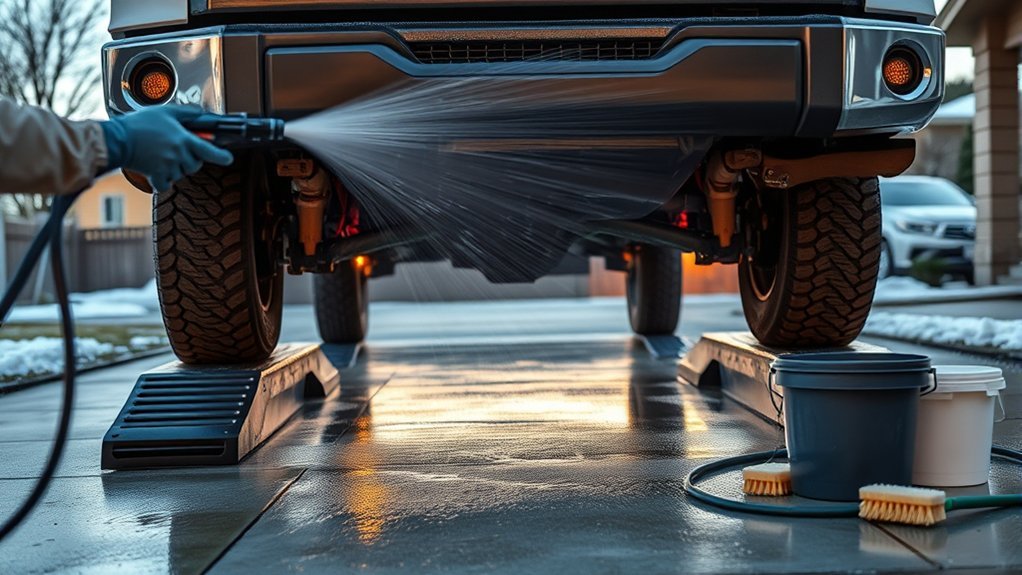
To wash a Toyota Tundra undercarriage after road salt, rinse the underside with plenty of fresh water as soon as practical after exposure. Focus on the wheel wells, frame rails, crossmembers, skid-plate edges, suspension mounts, hitch, spare-tire carrier, and visible drains. Use a hose or low-pressure, wide-fan underbody attachment, keep concentrated spray away from seals, boots, sensors, connectors, vents, brake parts, and loose coatings, then let the truck drain and inspect for rust or damage.
Last updated: September 11, 2026
Quick Answer
Rinse the Tundra’s undercarriage with plenty of fresh water as soon as practical after heavy road-salt exposure. Use a hose or low-pressure, wide-fan underbody attachment, flush the wheel wells and frame areas, clear drain openings, and let the truck dry. Skip vinegar, baking soda, and cooking spray; use only vehicle-safe products.
Key Takeaways
- Fresh water is the main tool for dissolving and flushing road-salt residue from the undercarriage.
- Keep the truck on level ground and use a side-operated underbody wand rather than crawling underneath it.
- Use a wide spray pattern and avoid directing concentrated pressure at seals, boots, vents, connectors, brake parts, or damaged coatings.
- Vinegar and baking soda do not chemically neutralize ordinary sodium chloride and may create compatibility or residue problems.
- Inspect the frame, lines, fasteners, seams, drains, skid plates, hitch, and wheel wells after washing.
At a Glance
| Time Required | Varies with buildup and access; allow additional time for draining and drying |
| Difficulty | Easy, provided the truck remains on the ground |
| Tools Needed | Garden hose or pressure washer with a wide-fan underbody attachment, safety glasses, waterproof gloves, flashlight or inspection mirror, and wheel chocks |
| Cost | Varies by water use or wash-bay fees; attachments, soap, and corrosion treatments cost extra |
Which Cleaning Method Should You Use?
Match the cleaning method to what is actually on the truck. More pressure or stronger chemicals are not automatically better.
| What You See | Best First Step | When to Escalate |
|---|---|---|
| Light white salt film or fresh brine residue | Use a thorough fresh-water rinse from several angles | Repeat the rinse if residue remains in seams, ledges, or wheel wells |
| Packed mud mixed with salt | Pre-soak, loosen accessible deposits gently, and flush until runoff is clear | Use mild automotive soap only if oily grime remains after rinsing |
| Freezing weather or unsafe driveway drainage | Use a commercial wash with an underbody cycle and controlled drainage | Wait for safer conditions if water could freeze around the truck or walking surfaces |
| Peeling coating, active leak, heavy scaling, or perforation | Stop aggressive washing in that area and inspect from a safe position | Arrange professional inspection before applying another coating |
Warning: Do not crawl beneath a Tundra supported only by its emergency jack or a hydraulic floor jack. Keep the truck on the ground and operate the sprayer from the side. If lifting is unavoidable, follow the model-year owner’s manual and use properly rated ramps or jack stands on a solid, level surface.
Why Does Road Salt Damage a Tundra’s Undercarriage?
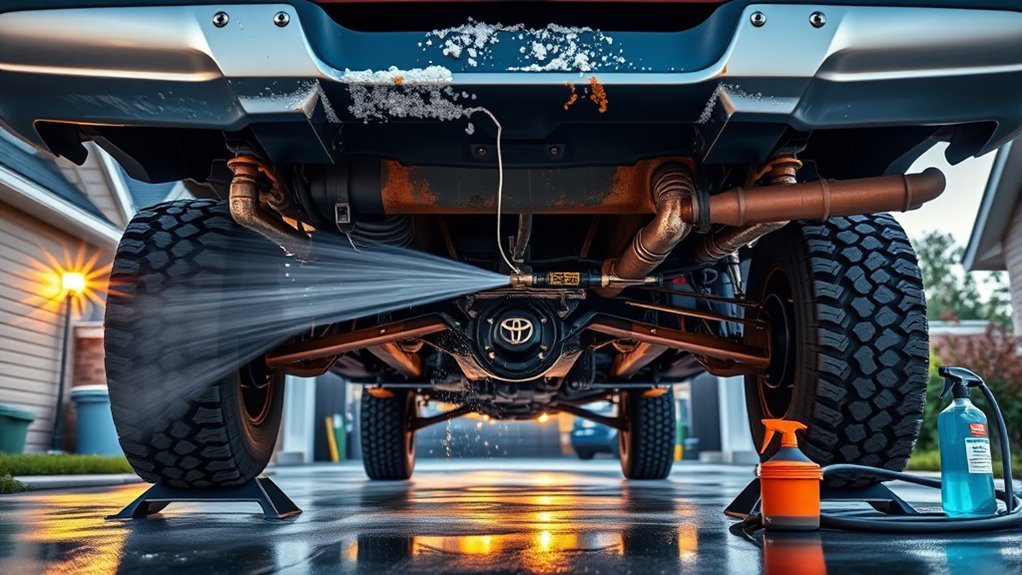
Road departments use sodium chloride, calcium chloride, magnesium chloride, brines, and other deicing materials to improve winter-road safety. These products are effective on ice, but chloride-rich moisture can promote corrosion when it remains in contact with exposed steel, damaged coatings, fasteners, seams, and crevices.
The U.S. Environmental Protection Agency says road salt has corrosive effects on cars, trucks, bridges, and roads and cites about $5 billion in annual U.S. repair costs. Toyota’s corrosion-care guidance also identifies accumulated road salt, dirt, and moisture in hard-to-reach underbody areas as common contributors to corrosion.
Salt residue is especially troublesome where mud and compacted debris hold moisture against the truck. Common collection points include the wheel wells, frame channels, crossmembers, skid-plate edges, suspension mounting points, hitch assembly, spare-tire carrier, seams, and drain openings.
Toyota’s longstanding corrosion-care guidance recommends regular undercarriage rinsing on salted roads and a thorough underside wash when winter ends.
Corrosion develops over time rather than after a single salty drive. Washing cannot reverse deep pitting or restore metal that has already flaked away, but removing salt and debris reduces continued exposure and makes developing problems easier to see.
What Tools Do You Need to Clean a Tundra Undercarriage?
You do not need to lift the truck or buy professional detailing equipment. A strong garden-hose flow is adequate for routine salt removal, while a pressure washer or rolling underbody attachment can improve access when used carefully.
| Tool | Purpose | Important Note |
|---|---|---|
| Garden hose and sprayer | Flushes soluble salt and loose dirt | A long wand makes it easier to reach beneath the truck |
| Pressure washer or rolling underbody attachment | Reaches broad underbody areas and wheel housings | Use low pressure, a wide fan, and enough distance to avoid damage |
| Flashlight or under-vehicle mirror | Checks seams, frame areas, lines, fasteners, and drains | Inspect from beside the vehicle without placing your body underneath |
| Safety glasses and waterproof gloves | Protect against splashback, grit, and dirty water | Wear non-slip footwear and clothing suitable for the temperature |
| Wheel chocks | Helps prevent unintended vehicle movement | Use with the parking brake on a level surface |
| Mild automotive wash soap | Helps loosen oily grime that water alone does not remove | Use only when needed and follow the product’s dilution instructions |
What Safety Checks Should You Do Before Washing?
- Choose a suitable location. Check local rules for outdoor vehicle washing. Keep dirty or soapy runoff away from storm drains, wells, streams, and other surface water.
- Wait for the truck to cool. The engine, exhaust, catalytic components, brakes, and driveline parts may remain hot after driving.
- Park securely. Use a level, stable surface, shift into Park, apply the parking brake, turn off the engine, remove the key, and chock the wheels.
- Check the temperature. Do not create an icy driveway or allow water to freeze around brakes, steps, or suspension components. Use a commercial wash when outdoor conditions are too cold for safe drainage and drying.
- Inspect for obvious damage. Look for hanging panels, loose undercoating, fluid leaks, exposed wiring, severely corroded lines, or damaged components before spraying.
Note: Water dripping from the air-conditioning system can be normal. Oily, colored, strongly scented, or persistent fluid should be identified before washing so a leak is not mistaken for rinse water.
How to Wash a Toyota Tundra Undercarriage After Road Salt
1. Start With a Low-Pressure Pre-Rinse
Position the hose or underbody attachment beside the truck. Begin with a broad, moderate stream to loosen surface salt and grit. A hose often provides enough flow for routine winter maintenance.
Work from the front toward the rear so runoff carries loosened debris away from sections you have already cleaned. Do not place your head, arms, or torso beneath the truck.
2. Flush the Wheel Wells
Turn the front wheels to improve access where practical. Rinse the inner fender liners, mud flaps, suspension mounting areas, and the ledges where the wheel-well liner meets the body.
Avoid holding concentrated pressure against rubber boots, brake hoses, wiring, connectors, wheel-speed sensors, or the edges of a loose liner.
3. Rinse the Frame, Crossmembers, and Skid-Plate Edges
Move the sprayer slowly along both frame rails and across the crossmembers. Direct water around seams, brackets, bolt heads, the transmission-support area, skid-plate edges, and other places that collect slush.
The goal is to carry debris out, not push it farther into a cavity. Change the spray angle and make several passes rather than using a concentrated jet at close range.
4. Clean the Rear Undercarriage
Rinse the rear wheel wells, axle housing exterior, suspension mounts, hitch receiver, spare-tire carrier, bumper supports, and the rear portions of the frame. Do not force water into axle, differential, transmission, transfer-case, or fuel-system vents.
5. Clear Drain Openings
Inspect the lower door, rocker-panel, frame, and body drain areas that are visible from outside the truck. Remove loose mud with gentle water flow or a soft nonmetallic tool. Do not enlarge a hole, probe wiring cavities, or force a rigid object into an unknown opening.
6. Use Automotive Soap Only When Needed
Fresh water removes ordinary salt because the deposit dissolves and washes away. If oily road film or packed grime remains, use a mild automotive detergent mixed according to its label. Avoid household degreasers, harsh solvents, bleach, acidic wheel cleaners, and strongly alkaline cleaners unless the vehicle and product manufacturers specifically approve the application.
7. Perform a Thorough Final Rinse
Rinse until the runoff is clear and visible white residue, foam, and loosened sediment are gone. Make a second pass over wheel wells, seams, skid-plate edges, the hitch, and the rear frame because these areas often retain debris.
8. Let the Truck Drain and Dry
Allow water to drain in a well-ventilated location. A short drive on a clean, dry road can help shed trapped water, but test the brakes gently at low speed first because wet brakes may respond differently for a short time.
Avoid storing a wet, salt-contaminated truck in a damp, poorly ventilated garage. If you intend to apply a corrosion inhibitor, follow that product’s instructions regarding cleaning, drying, surface preparation, and temperature.
Pro Tip: Take a few well-lit photos of the frame, brake and fuel-line routes, hitch, and suspension mounts after the final rinse. Comparing the same areas during future washes makes changes in rust, coating condition, or leaks easier to spot.
Can You Pressure-Wash a Tundra Undercarriage Safely?
Toyota has historically recognized high-pressure water as useful for cleaning the underside and wheel housings. That does not mean maximum pressure or a narrow blasting nozzle is appropriate.
- Use the washer’s vehicle or delicate setting when available.
- Select a wide-fan nozzle rather than a zero-degree or pinpoint jet.
- Begin farther away and move closer only if necessary.
- Keep the nozzle moving instead of concentrating pressure on one spot.
- Spray at an angle that carries dirt out of a cavity.
- Do not aim directly into electrical connectors, vents, seals, rubber boots, damaged coating edges, cameras, sensors, or body openings.
- Do not concentrate the spray on brake calipers, brake hoses, friction surfaces, tire sidewalls, axle seals, or steering and suspension joints.
- Stop if paint, factory coating, rust scale, seam sealer, or a liner begins to lift.
A rolling underbody attachment is often safer and more even than trying to aim a handheld lance under the truck. A commercial wash with an underbody cycle is another practical option, especially during freezing weather.
Which Tundra Undercarriage Areas Need the Most Attention?
- Front and rear wheel wells: Slush is repeatedly thrown into liners, seams, brackets, and suspension areas.
- Frame rails and crossmembers: Mud and salt can remain on ledges, around fasteners, and near openings.
- Skid plates and splash shields: Debris can collect along edges and between panels and adjacent components.
- Rocker panels and drain points: Blocked drains can retain contaminated water.
- Brake and fuel-line routes: Inspect accessible lines and retaining clips for swelling, deep scaling, wetness, or damage.
- Hitch and towing hardware: The receiver, safety-chain loops, wiring-bracket area, and fasteners receive direct road spray.
- Spare-tire carrier: The cable, support, wheel, and nearby frame can hold dirt and moisture.
- Suspension and steering mounts: Rinse around brackets without blasting boots, seals, or sensor wiring. If you find looseness, torn boots, or corrosion around mounting points, see the Toyota Tundra suspension wear-points guide.
Should You Use Vinegar or Baking Soda on Road Salt?

Vinegar and baking soda are often suggested as homemade salt “neutralizers,” but ordinary sodium chloride is not an acid or base that needs this treatment. An aqueous sodium-chloride solution is generally neutral, according to the National Institutes of Health PubChem database.
Water is effective because it dissolves the salt and carries the chloride-containing solution away. Adequate flow, repeated passes, and removal of trapped mud are more important than changing the solution’s pH.
- Skip vinegar: Its acidity may be incompatible with some metals, finishes, sealants, and existing corrosion-control products.
- Skip baking soda: It does not neutralize sodium chloride and may leave alkaline powder or solution in seams and cavities.
- Skip household dish soap when possible: Use a mild automotive soap whose label permits exterior vehicle use.
- Skip cooking spray: Food-grade oil sprays are not tested or labeled as underbody corrosion treatments.
A purpose-made salt-removal product may be used when its manufacturer confirms compatibility with automotive paint, aluminum, steel, rubber, plastics, electrical components, and the truck’s existing undercoating. Follow its dilution and rinsing instructions exactly.
How Often Should You Wash the Undercarriage?
The best interval depends on how often you drive on treated roads, the type of deicer used, mileage, temperatures, storage, and whether the truck collects packed snow or mud.
- After salt exposure: Recent Toyota Tundra owner guidance says to wash the vehicle after driving on salted roads. Rinse the undercarriage as soon as practical when salt or brine is visible.
- During regular winter use: Inspect frequently and rinse whenever buildup develops.
- Older Toyota corrosion guidance: Earlier Tundra manuals advised hosing off the undercarriage at least once a month on salted roads and washing the underside thoroughly when winter ends.
- At winter’s end: Give the underside, wheel housings, drains, hitch, and hidden ledges a thorough cleaning.
- After off-roading: Remove packed mud promptly because it can retain moisture and conceal damage.
Use the Toyota manuals and warranties portal to select your exact model year and check for vehicle-specific washing instructions or limitations.
How Should You Protect the Undercarriage After Cleaning?
Once the undercarriage is clean and adequately dry, inspect the factory coatings before adding another product. Look for chips, peeling material, exposed metal, orange staining, deep scaling, swollen lines, loose fasteners, damaged panels, and clogged drains.
Repair Damage Before Covering It
A corrosion inhibitor can slow exposure, but it does not rebuild weakened metal or permanently repair a detached factory coating. Remove only loose material using an appropriate method and have significant damage evaluated before covering it.
Seek professional inspection when you find the conditions below. For repair-path context, see the Toyota Tundra frame-rust repair options guide.
- Perforation or holes in structural metal
- Thick, layered rust scale that breaks away easily
- Severe corrosion around suspension, steering, body-mount, or hitch attachment points
- Deeply corroded, swollen, wet, or damaged brake and fuel lines
- A fluid leak or damaged wiring near a corroded area
- A large section of detached undercoating that may be trapping moisture
Using Fluid Film or Another Corrosion Inhibitor
A lanolin-based product such as Fluid Film is one optional type of automotive corrosion inhibitor. The manufacturer’s automotive guidance describes underbody use but also warns that the product may soften some existing undercoatings. Its FAQ says caution is needed around non-oil-resistant rubber because swelling may occur.
Warning: Do not spray an oily corrosion inhibitor onto brake pads, rotors, drums, tire tread, accessory belts, pedals, walking surfaces, hot exhaust components, or any part excluded by the product label. Overspray on a friction surface can create a serious safety hazard.
Before applying any coating:
- Confirm that the product is labeled for automotive underbody use.
- Check compatibility with the factory coating, rubber, plastics, paint, wiring, and any prior treatment.
- Follow the required drying time and application temperature.
- Mask or avoid brake, tire, exhaust, belt, and friction surfaces.
- Apply only the specified film thickness.
- Record the application date and inspect the treatment periodically.
Mud flaps can reduce direct spray in some areas, but they do not eliminate the need for washing. Check behind the flap and around its mounting hardware because debris may collect there.
How Do You Clean a Tundra Undercarriage After Off-Roading?
Off-road mud can be more difficult to remove than road salt because it packs into shields, brackets, wheel wells, and frame ledges. Let heavy mud soften with a low-pressure pre-rinse rather than immediately attacking it with a concentrated jet.
- Remove large, loose clumps from accessible areas without crawling beneath the truck.
- Pre-soak the wheel wells and visible underbody surfaces with fresh water.
- Rinse from several angles to move mud out from behind shields and brackets.
- Use mild automotive soap only if oily contamination remains.
- Inspect skid plates, liners, wiring, hoses, steps, and recovery points for impact damage.
- Check for plant material around hot exhaust parts before driving.
- Perform a final rinse and let the truck drain thoroughly.
Do not coat the underside with cooking spray before off-roading. It is not a substitute for an automotive protectant and may attract dirt or reach surfaces where oil is unsafe.
How Do You Fix Common Undercarriage-Washing Problems?
White Residue Remains After Rinsing
Repeat the fresh-water rinse using a different spray angle. Residue often remains where water flow did not reach behind a liner, bracket, skid-plate edge, or frame ledge. Use mild automotive soap only if repeated water rinsing does not remove the film.
Mud Keeps Draining Out
Continue rinsing until the runoff is clear. Toyota’s older corrosion guidance warns that merely wetting mud without removing it can be counterproductive because trapped debris continues to hold moisture.
A Drain Opening Appears Blocked
Use gentle water flow and a soft nonmetallic tool only when the opening’s purpose is clear. Do not drill, enlarge, or probe an unknown cavity. A dealer or body shop can clear inaccessible drains safely.
Factory Coating Begins to Peel
Stop pressure washing that area. Photograph the damage and arrange an inspection. A loose coating can hide corrosion or hold contaminated moisture against the metal.
It Is Too Cold to Wash at Home
Use a commercial facility with an underbody cycle and controlled drainage. Avoid washing where runoff will freeze on pavement or around the truck’s brakes, steps, doors, or suspension.
You Find Heavy Rust
Do not assume that applying oil or undercoating makes the area structurally sound. Have deep scaling, perforation, or corrosion near brake lines, fuel lines, suspension mounts, steering mounts, the hitch, or body mounts evaluated by a qualified technician.
How Should You Manage Undercarriage Wash Water?
Undercarriage runoff can contain salt, sediment, brake and tire particles, oil residue, metals, and detergent. The EPA’s vehicle-washing guidance notes that outdoor wash water may carry pollutants into storm drains.
- Follow municipal rules governing driveway vehicle washing and wastewater discharge.
- Prefer a commercial wash that captures or treats its wastewater when home runoff cannot be managed safely.
- Keep wash water away from storm drains, streams, shorelines, wells, and bare eroding soil.
- Use the minimum amount of detergent needed.
- Collect loose mud and sediment rather than flushing piles into a drain.
- Clean up any visible oil or chemical leak before washing the area.
Frequently Asked Questions
How do you wash salt off a Toyota Tundra undercarriage at home?
Park on a level surface, let the truck cool, apply the parking brake, and chock the wheels. Use a hose or low-pressure underbody attachment from beside the truck. Flush the wheel wells, frame rails, crossmembers, skid-plate edges, hitch, spare-tire carrier, seams, and visible drains, then perform a complete fresh-water rinse.
Does an automatic undercarriage wash remove road salt?
An undercarriage wash can remove a substantial amount of loose salt and road grime when its spray reaches the contaminated surfaces. It may not fully clean packed mud, shielded ledges, frame cavities, or damaged coating edges, so inspect the truck and repeat the rinse when residue remains.
Is a pressure washer safe for a Tundra undercarriage?
It can be safe when used with a low-pressure or vehicle setting, a wide-fan nozzle, adequate distance, and constant movement. Do not direct concentrated pressure at connectors, vents, seals, rubber boots, brake parts, tire sidewalls, sensor wiring, or loose and damaged coatings.
Should you use vinegar or baking soda to neutralize road salt?
No. Ordinary sodium chloride is generally neutral in water, so neither vinegar nor baking soda is needed to neutralize it. Fresh water removes salt by dissolving and carrying it away. Homemade acid or alkaline solutions may also be incompatible with metals, finishes, sealants, or existing coatings.
How often should a Tundra undercarriage be washed during winter?
Rinse after heavy salt or brine exposure and whenever visible buildup develops. Older Toyota guidance advised at least monthly undercarriage rinsing on salted roads and a thorough wash after winter. Check the owner’s manual for your exact Tundra model year.
How do you clean the undercarriage after off-roading?
Soften packed mud with a low-pressure pre-rinse, flush it from several angles, and continue until the runoff is clear. Inspect skid plates, liners, suspension mounts, wiring, hoses, recovery points, and the exhaust area for impact damage, leaks, or trapped vegetation.
Can Fluid Film be applied after washing?
It may be used when the surface preparation and application conditions match the product instructions. Check compatibility first because the manufacturer says it may soften some undercoatings and affect non-oil-resistant rubber. Keep it away from brakes, tires, belts, hot exhaust parts, and other excluded surfaces.
When should underbody rust be professionally inspected?
Arrange an inspection for perforation, thick flaking scale, damaged brake or fuel lines, loose structural brackets, leaking components, or severe corrosion around suspension, steering, body-mount, frame, or hitch attachment points. Washing and coating cannot replace metal already lost to corrosion.
Conclusion
Washing a Toyota Tundra’s undercarriage after road-salt exposure is mainly a matter of using enough fresh water, reaching the areas where residue collects, and avoiding unnecessary chemicals or excessive pressure. Keep the truck safely on the ground, rinse the wheel wells and frame methodically, clear visible drains, and inspect the cleaned surfaces before applying any optional corrosion inhibitor.
Regular washing reduces the time salt and wet debris remain against the truck, but it does not repair advanced corrosion. Address peeling coatings, damaged lines, heavy scaling, structural rust, and leaks promptly rather than hiding them beneath another layer of product.
Sources
- Toyota Tundra Manuals and Warranties — year-specific owner-manual access and vehicle guidance
- Toyota 2002 Tundra Owner’s Manual — corrosion causes, salted-road rinsing, high-pressure cleaning, drains, and end-of-winter washing
- U.S. Environmental Protection Agency: Road Salt — road salt’s corrosive and environmental effects
- EPA Vehicle Maintenance and Washing Guidance — vehicle-wash runoff and stormwater considerations
- NIH PubChem: Sodium Chloride — chemical properties and the generally neutral character of sodium-chloride solution
- Fluid Film Automotive Applications — manufacturer application information and undercoating compatibility warning