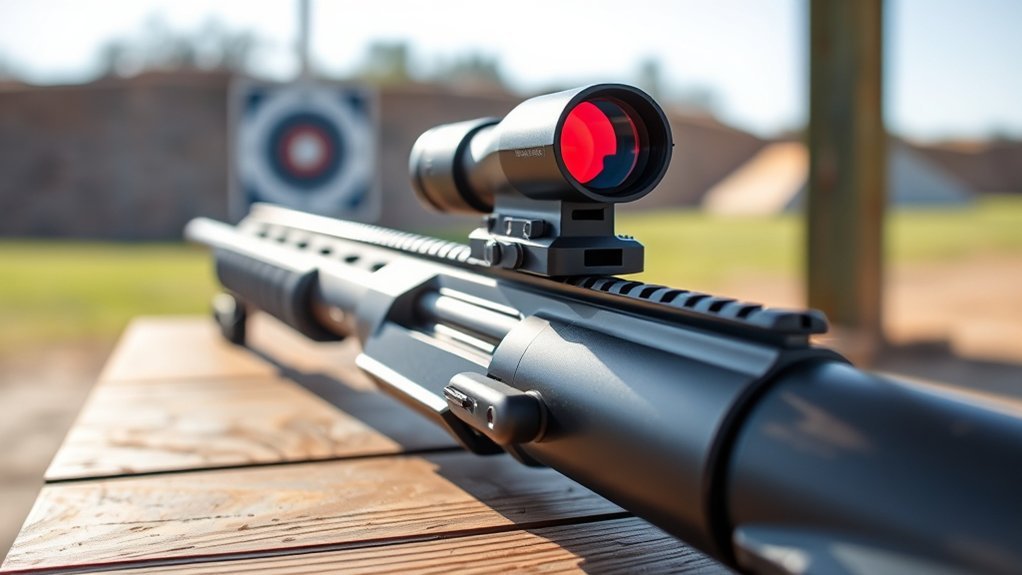
A lower third co-witness sight setup keeps iron sights visible near the bottom of a red dot optic’s viewing window. It offers a less obstructed view while retaining access to backup iron sights. Understanding how this configuration differs from absolute co-witness helps you evaluate sight compatibility, mount height, and viewing comfort.
Quick Answer
A lower third co-witness places the iron sights in the bottom third of a red dot sight’s viewing window. The optic sits higher than it would in an absolute co-witness arrangement, leaving more open space around the reticle. It is commonly used on AR-style rifles, especially those with fixed front sights.
Key Takeaways
- Co-witness describes the relationship between an optical sight and backup iron sights. It does not describe a separate type of red dot technology.
- Lower-third configurations commonly use taller optic mounts than absolute co-witness configurations, but there is no universal mounting height.
- Dot size, optic brightness, mount compatibility, and iron-sight height are separate considerations.
- A clearer sight picture does not automatically improve accuracy. Proper alignment, equipment condition, and safe shooting practices still matter.
What Is a Lower Third Co-Witness Sight?
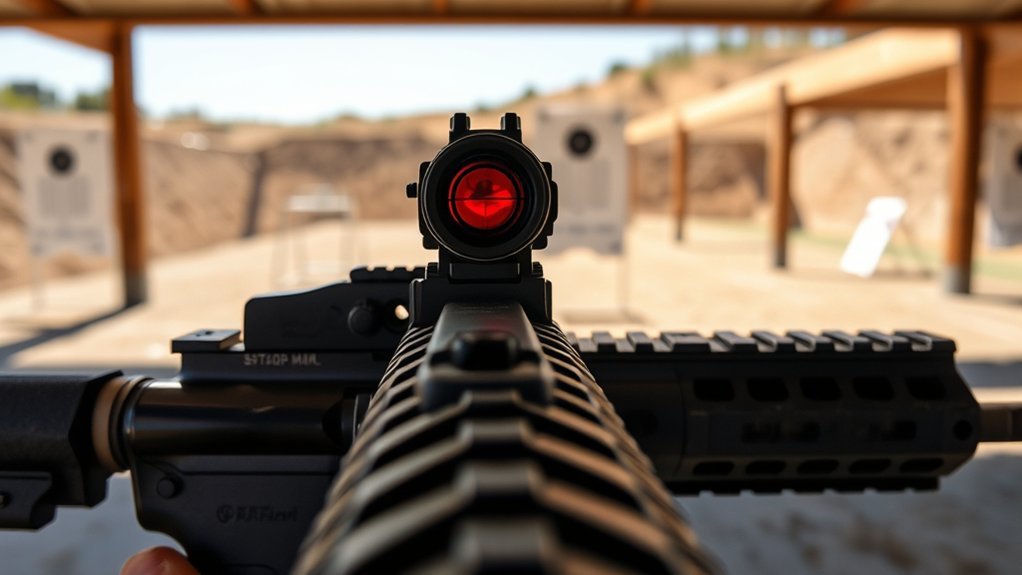
A lower third co-witness sight is a configuration where a red dot optic sits slightly higher than the line of sight through standard iron sights. The iron sights remain visible through the lower portion of the optic’s viewing window.
The term describes the relationship between two sighting systems, not a special type of optical sight.
In an absolute co-witness arrangement, the iron sights appear near the center of the optic window. With lower-third co-witness, they appear closer to the bottom.
This difference is particularly noticeable on rifles with fixed front sights. A fixed sight remains visible even when the red dot is the primary aiming reference.
As explained in the Vortex Optics guide to co-witnessing, both arrangements retain access to compatible iron sights while changing how much of the optic’s window those sights occupy.
The main purpose is to balance a clear sight picture with access to a secondary sighting system.
How Does Lower Third Co-Witnessing Work?
Lower-third co-witnessing works by placing the optic’s centerline above the iron sights’ normal viewing line. The iron sights therefore appear lower in the optic window rather than at its center.
The red dot remains the primary optical reference. The iron sights provide a separate mechanical reference when viewed through the optic.
The SIG Sauer co-witness glossary identifies absolute and lower-third co-witness as two common arrangements.
| Feature | Description |
|---|---|
| Optic Height | Higher than an absolute co-witness configuration; the exact height varies by optic and mount. |
| Field of View | Iron sights occupy the lower portion of the viewing window, leaving more open space near its center. |
| Common Application | AR-style rifles with compatible fixed or folding iron sights. |
| Backup Usability | Compatible iron sights remain visible through the optic when properly configured. |
| Main Trade-Off | A less obstructed optic window, with a different viewing position for the iron sights. |
The optic’s height does not have to match one universal measurement. Manufacturers use different mounting systems, optical housings, and centerline specifications.
What Is the Typical Lower Third Co-Witness Height?
On many AR-style rifle configurations, lower-third co-witness mounts have optical centerlines around 1.57 to 1.66 inches above the top rail. However, those measurements are examples rather than a universal standard.
For reference, the Scalarworks LEAP/01 mounting system identifies the following optical centerline heights:
- 1.42 inches: Absolute co-witness with compatible standard-height backup sights.
- 1.57 inches: Lower-third co-witness with compatible backup sights.
- 1.93 inches: A taller configuration that requires compatible taller iron sights for co-witnessing.
Other manufacturers demonstrate why a single mounting measurement cannot describe every setup.
For example, the Trijicon MRO lower-third mount lists an optical-axis height of 1.663 inches, while a Holosun lower-third mount uses a 1.63-inch height.
The EOTECH EXPS3 HD provides another manufacturer example, using a 1.74-inch centerline for lower-third co-witness.
These are optic-and-mount-specific specifications. A height that works with one combination should not be assumed to work identically with another.
Benefits of Lower Third Co-Witness Sights
The biggest benefit of lower-third co-witness is a less obstructed view through the optic. It keeps compatible iron sights available without placing them in the center of the viewing window.
Several characteristics make this arrangement appealing:
- Clearer central viewing area: Iron sights occupy less of the center of the optic window.
- Reduced visual clutter: A fixed front sight is less prominent around the central red dot.
- Backup sight access: Compatible iron sights remain available when the electronic optic cannot provide its reticle.
- Different viewing posture: A slightly taller optic may offer a more comfortable head position for some users.
- Flexible equipment configurations: The arrangement can work with compatible fixed or folding backup sights.
These advantages relate mainly to visibility, equipment compatibility, and user comfort.
They do not guarantee faster target acquisition, higher precision, or better results for every shooter.
Individual eyesight, optic design, training, and personal preference affect the overall experience.
Lower Third vs. Absolute Co-Witness: Which Is Better?
Neither lower-third nor absolute co-witness is automatically better. The main difference is where the iron sights appear within the optic window.
Lower-third co-witness leaves more open space near the center. Absolute co-witness puts the iron sights closer to the central optical reference.
Visibility Differences
Lower-third co-witness usually provides a less cluttered central sight picture. Absolute co-witness keeps the iron sights more prominently visible.
With absolute co-witness, the iron sights appear near the center of the optic window. Some users prefer this familiar alignment, especially when they regularly use mechanical sights.
With lower-third co-witness, the iron sights occupy the lower part of the window. This reduces their visual presence around the central reticle.
The difference becomes especially clear when a rifle has a fixed front sight. Since that sight cannot fold away, its position within the optic window matters.
Neither arrangement makes the optic’s glass inherently clearer or automatically increases the optical field of view. The principal change is how much of the visible scene the iron sights obstruct.
User Preference Insights
Personal preference often determines which co-witness arrangement feels more comfortable. The right choice depends on the optic, iron sights, and the user’s preferred viewing position.
The following comparison highlights the main trade-offs.
| Feature | Lower-Third vs. Absolute Co-Witness |
|---|---|
| View | Lower-third keeps iron sights near the bottom of the window. Absolute places them closer to the center. |
| Target Acquisition | Lower-third offers less central obstruction. Absolute offers a more directly aligned iron-sight reference. Performance varies by user. |
| Flexibility in Cheek Weld | Lower-third generally uses a slightly higher optic position. Absolute generally permits a lower viewing position. |
For recreational target shooting, either configuration can be suitable when the equipment is compatible and correctly maintained.
Users who dislike seeing a front sight near the center of the optic may prefer lower-third co-witness. Those who prefer a more centered mechanical reference may favor absolute co-witness.
Comfort and visibility are better comparison criteria than assuming one arrangement produces superior accuracy.
Ideal Scenarios for Lower Third Co-Witness Setups
Lower-third co-witness is especially relevant when fixed iron sights remain visible through an electronic optic. It is also useful to understand when comparing red dot mounting options for recreational or competitive target shooting.
The arrangement combines a relatively open optical view with continued visibility of compatible mechanical sights.
Enhanced Target Acquisition
A less obstructed sight picture may make the central red dot easier to distinguish from surrounding equipment. However, that does not necessarily mean every user will acquire targets faster.
The experience depends on several factors:
- Lighting: Reticle brightness and lens characteristics influence visibility in different conditions.
- Fixed front sights: Lower-third positioning keeps the front sight away from the central viewing area.
- Head position: Mount height influences viewing comfort and consistency.
- Vision: Individual eyesight can affect how clearly the illuminated reticle appears.
Red dot performance and co-witness geometry are related but separate issues. A taller optic does not automatically improve the brightness, shape, or clarity of the dot.
Versatile Shooting Environments
Lower-third co-witness can suit a variety of range and sporting environments where users prefer a less obstructed optic window.
For example, recreational shooters using rifles with fixed front sights may appreciate having the central viewing area less occupied by the front sight post.
Competitive shooters may also compare the two arrangements based on comfort and preferred sight picture. Neither arrangement guarantees a competitive advantage.
In bright conditions, visibility depends on factors such as the optic’s brightness settings, lens coatings, and surrounding light.
Mount height alone does not establish better glare reduction or low-light performance.
Likewise, a 2 MOA red dot is not required for lower-third co-witness. MOA, or minute of angle, describes the dot’s angular size. Co-witness instead describes the geometric relationship between the optic and iron sights.
Users should evaluate dot size and reticle design separately from mount height.
Installation Tips for Lower Third Co-Witness Sights
Safe installation begins with confirming equipment compatibility and following the manufacturer’s instructions. Mounting requirements vary between optic models, firearms, and iron-sight configurations.
A lower-third co-witness label does not guarantee that every combination will produce the same visible alignment.
Warning: Before inspecting or installing firearm accessories, unload the firearm, remove ammunition from the work area, and verify that the chamber is empty. Keep the muzzle pointed in a safe direction and your finger away from the trigger. If you are unfamiliar with the equipment, consult a qualified gunsmith.
The National Shooting Sports Foundation’s firearm safety rules explain the essential precautions for handling firearms.
- Confirm compatibility: Check the optic model, mounting interface, rail type, and backup iron-sight specifications against the manufacturer’s documentation.
- Review the stated centerline height: Use the manufacturer’s published optical-axis measurement rather than assuming that every lower-third mount measures 1.6 inches.
- Follow the supplied mounting instructions: Use only the mounting hardware and procedures specified for the particular optic and mount. Seek qualified professional assistance if any requirement is unclear.
- Check the visible arrangement safely: With the firearm confirmed unloaded, verify that the optic and iron sights appear in the intended portions of the viewing window.
- Have alignment and function verified: Follow the manufacturer’s guidance and, where appropriate, use a qualified instructor or gunsmith at an authorized range.
For manufacturer-specific guidance about optical adjustment and verification, refer to the Aimpoint red dot sight support documentation.
Do not assume that visually lining up the red dot and front sight establishes correct zero for both systems. Visual co-witness, secure mounting, and verified sight calibration are distinct considerations.
Important Considerations About Lower Third Co-Witnessing
Lower-third co-witness is a useful sight arrangement, but it has limitations. Understanding those limits can prevent confusion when comparing optics and mounting systems.
Does Lower-Third Co-Witness Require a Particular Red Dot?
No. Lower-third co-witness is not limited to one specific dot size or reticle design.
The relevant factors are the optic’s physical dimensions, mounting interface, optical centerline, and the height of the iron sights.
A smaller dot may appeal to users who prefer a finer aiming reference, but it is not a requirement for co-witness compatibility.
Can Every Red Dot Co-Witness With Standard Iron Sights?
No. Some optical configurations sit too high or too low for standard-height iron sights to remain visible in the intended part of the viewing window.
Others require specific mounting accessories or compatible iron-sight heights.
The presence of a Picatinny rail or an available mounting adapter does not, by itself, guarantee the desired co-witness arrangement.
Does Co-Witnessing Replace Proper Sight Verification?
No. Co-witnessing describes the visible relationship between two sighting systems. It does not establish that the equipment is correctly secured or calibrated.
Mechanical sights and electronic optics still require appropriate inspection and verification according to their manufacturers’ instructions.
For safety and reliability, avoid treating visual alignment as a substitute for professional evaluation when equipment fit or function is uncertain.
Frequently Asked Questions
What Is the Difference Between Full Co-Witness and Lower 1/3 Co-Witness?
Full, or absolute, co-witness places iron sights near the center of the optic window. Lower-third co-witness places them in the bottom third. The main difference is the relative viewing position. Neither configuration guarantees better accuracy because results also depend on equipment condition, user ability, and proper sight verification.
What Is Lower 1/3 Co-Witness Height?
Lower-third co-witness height varies by optic, mount, and iron-sight configuration. Many AR-style arrangements use an optical centerline around 1.57 to 1.66 inches above the rail, but other manufacturer-specific heights exist. The correct reference is the stated compatibility of the exact optic and mounting system.
What Is a Co-Witness Sight?
A co-witness sight setup allows compatible iron sights to remain visible through an optical sight. The arrangement provides two separate sighting references within the same viewing window. Absolute and lower-third co-witness describe where the iron sights appear relative to the optic’s center, rather than different types of red dot technology.
Do You Really Need Co-Witness Sights?
No, co-witness sights are not mandatory for every red dot setup. They are useful when a shooter wants compatible iron sights available as a secondary reference. Whether they are necessary depends on the firearm, optic, intended sporting use, personal preference, and equipment compatibility.
Conclusion
A lower third co-witness sight offers a less obstructed central view while keeping compatible iron sights visible near the bottom of the optic window.
Compared with absolute co-witness, its main advantage is the different sight picture rather than a guaranteed improvement in accuracy.
The best arrangement depends on your optic, mounting system, iron-sight height, and preferred viewing position. Use manufacturer specifications and qualified professional guidance to confirm compatibility and safe operation.
Sources
- Vortex Optics, Everything You Ever Wanted to Know About Co-Witnessing, Part One: Definitions, sight picture, and key differences.
- SIG Sauer, Co-Witness Glossary: Absolute and lower-third co-witness terminology.
- Scalarworks, LEAP/01 Specifications: Optical centerline heights and mount compatibility.
- Trijicon, MRO Lower 1/3 Co-Witness Mount: Manufacturer optical-axis measurement.
- Holosun, 509MNT-1.63-PIC Mount: Manufacturer lower-third height specification.
- EOTECH, EXPS3 HD: Manufacturer centerline height and lower-third co-witness specification.
- Aimpoint, Zeroing Your Red Dot Sight: Manufacturer guidance for optic verification.
- National Shooting Sports Foundation, Firearm Safety Rules: Safe firearm handling and inspection guidance.