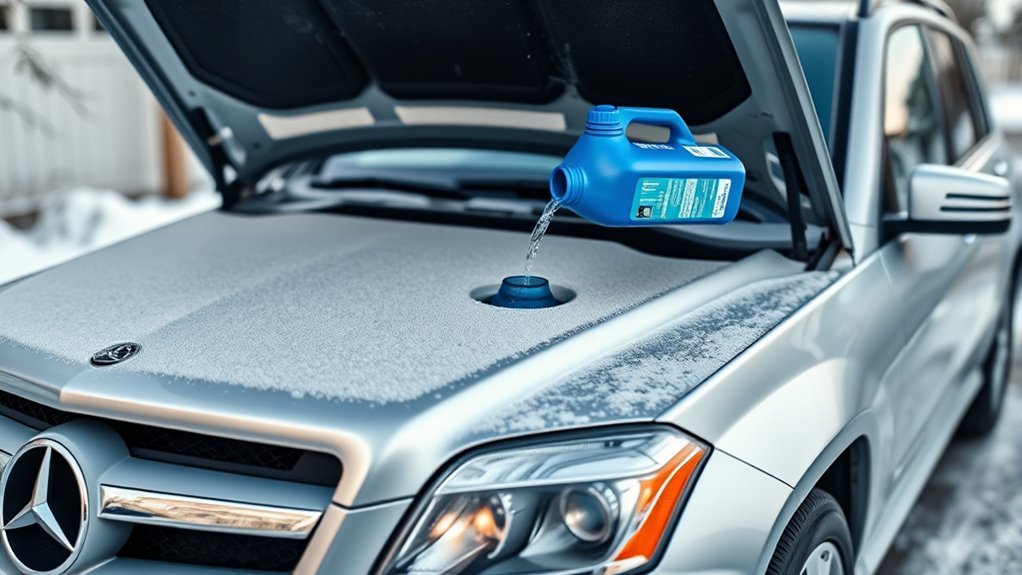
Choosing the correct Mercedes GLK 250 washer fluid matters during Canadian winters. The wrong formula can freeze in the washer lines, leave streaks, or affect the headlamp cleaning system. Mercedes-Benz recommends SummerFit for warm weather and WinterFit for freezing conditions. Understanding the correct mixing ratios and refill procedure helps keep the system working throughout the year.
Quick Answer
For a Mercedes-Benz GLK 250 BlueTEC in Canada, use Mercedes-Benz WinterFit washer fluid during freezing weather and SummerFit during warmer months. WinterFit concentrate, part number A 002 986 14 71 09, must be diluted according to the expected temperature. Choose a formula suitable for plastic headlamp lenses and avoid mixing incompatible washer fluid products.
Last checked: September 28, 2026. Product specifications and operating instructions were verified against Mercedes-Benz and manufacturer documentation.
Which Washer Fluid Fits Your GLK 250?
)
The Mercedes-Benz GLK 250 BlueTEC 4MATIC sold in Canada for the 2013–2015 model years can use Mercedes-Benz SummerFit or WinterFit washer fluid. The correct choice depends on the weather and the vehicle’s washer equipment.
The 2015 Mercedes-Benz GLK Operator’s Manual recommends washer fluid suitable for plastic headlamp lenses. It identifies SummerFit and WinterFit as suitable examples.
These products serve different purposes:
- SummerFit: Removes road film, insects, and warm-weather dirt.
- WinterFit: Cleans winter grime while providing freeze protection at the correct concentration.
- Compatible alternatives: Must meet the vehicle’s material requirements and the expected temperature range.
Mercedes also warns against mixing unknown products. Its manual specifically permits SummerFit and WinterFit to be mixed together, while other combinations may block the spray nozzles.
This is particularly important if your GLK has optional headlamp washers or heated washer equipment. Heated components do not replace the need for correctly rated winter fluid.
SummerFit vs WinterFit Washer Fluid?
SummerFit is a warm-weather cleaning concentrate. WinterFit combines cleaning agents with antifreeze protection for cold conditions.
The key difference is not simply cleaning strength. It is whether the prepared mixture can remain usable at the temperatures your vehicle will experience.
| Feature | SummerFit | WinterFit |
|---|---|---|
| Main purpose | Warm-weather cleaning | Winter cleaning and freeze protection |
| Typical use | Temperatures above freezing | Temperatures below freezing |
| Mixing instructions | 1 part concentrate to 100 parts water | Ratio depends on required freeze protection |
SummerFit Fluid Benefits
Mercedes-Benz SummerFit is designed to remove road film, insects, and residue left by car-wash products. It helps reduce smearing and glare during warmer weather.
The manufacturer specifies a mixing ratio of 1 part SummerFit to 100 parts water. For example, 40 ml of concentrate is mixed with 4 litres of water.
Its formulation is intended for Mercedes-Benz windshield and headlamp cleaning systems.
SummerFit is a suitable seasonal choice for Canadian spring and summer driving when freezing temperatures are not expected.
WinterFit Cold Protection
Mercedes-Benz WinterFit contains alcohol-based antifreeze ingredients and detergents designed to remove winter road grime.
Its freeze protection depends on the amount of concentrate used. A weak mixture may still freeze during a Canadian cold spell.
The manufacturer’s product documentation lists these mixing ratios:
| WinterFit concentrate | Water | Freeze protection |
|---|---|---|
| 1 part | 2 parts | Down to -10°C |
| 1 part | 1 part | Down to -20°C |
| 2 parts | 1 part | Down to -29°C |
These figures come from Mercedes-Benz Genuine Chemical Products documentation.
Warning: Do not use a summer dilution ratio for winter driving. A 1:200 mixture does not provide the stated WinterFit freeze protection. Choose the concentration according to the actual product label and expected temperature.
Choosing By Climate
Canadian temperatures vary significantly by region. Select the washer fluid according to the coldest conditions your vehicle is likely to encounter.
SummerFit works during warm weather. WinterFit is more appropriate before overnight temperatures begin falling below freezing.
If your area regularly experiences temperatures below -29°C, do not assume the listed WinterFit mixture provides enough protection. Look for a manufacturer-rated product suitable for those conditions and confirm compatibility with the GLK washer system.
Before winter, allow the existing fluid to become low, refill with the correctly prepared winter mixture, and operate the washers briefly so the new fluid reaches the lines and nozzles.
How Much Washer Fluid Does the GLK 250 Hold?
The GLK 250 washer reservoir supplies the windshield washers and, when equipped, the headlamp cleaning system. The amount needed for a refill depends on the remaining fluid and installed equipment.
The 2015 GLK manual provides two important reference figures:
- Vehicles with headlamp cleaning: recommended minimum washer fluid level of 3.5 litres.
- Vehicles without headlamp cleaning: recommended minimum level of 1 litre.
The dashboard warning appears when the washer fluid level drops below approximately 1 litre.
These figures describe minimum levels and the warning threshold, not the total reservoir capacity.
Some owners report adding nearly a US gallon after the warning appears. However, the amount required is not a reliable way to identify reservoir capacity.
Do not assume the tank is empty when the warning appears. Add fluid gradually and stop when the reservoir is full.
How to Check Your GLK 250 Washer System?
Start by inspecting the reservoir and checking for visible leaks. Then test the washer spray and confirm the dashboard warning behaves normally.
This sequence helps distinguish an empty reservoir from blocked nozzles, frozen fluid, or an electrical problem.
Inspect Fluid Reservoir
Park the vehicle on level ground, switch off the engine, and open the hood. Locate the washer reservoir filler cap marked with the windshield washer symbol.
Check the following:
- Inspect the cap and filler neck for damage or contamination.
- Check the visible fluid level where possible.
- Look beneath the reservoir for wet areas or signs of leakage.
- Inspect accessible hoses and connections for damage.
- Add suitable washer fluid if the level is low.
The reservoir may not have easily visible external level markings. If you cannot see the fluid level, refill carefully rather than relying on a guessed volume.
Test Washer Spray
After filling, switch on the ignition and operate the windshield washer control on the combination switch.
The GLK uses the end control on the combination stalk for windshield washing. Press it far enough to activate the washer function.
Observe the spray pattern across the windshield.
- Normal spray: Fluid reaches the glass evenly and the wipers clear it.
- Weak spray: Check the fluid level, nozzles, and possible restrictions.
- No spray with pump noise: Investigate frozen fluid, blocked lines, or disconnected hoses.
- No spray and no pump noise: Check the pump’s electrical supply and related components.
If dirt blocks a nozzle, clean its exterior gently. Avoid forcing a sharp object into the opening, which could damage the nozzle.
Also inspect the wiper blades if the fluid sprays correctly but leaves streaks.
Check Warning Light
The GLK displays a washer fluid warning when the reservoir level falls below its specified minimum.
Refill the reservoir with the correct prepared mixture and check whether the message disappears.
If the warning remains after a proper refill, inspect for leaks and consider a faulty level sensor or electrical connection.
Mercedes warns that distilled or de-ionized water can affect the washer fluid level sensor. Use the water and mixing instructions specified for the product and vehicle.
A persistent warning with a full reservoir should be investigated rather than ignored.
Winter Washer Fluid Concentrates for the GLK 250
Mercedes-Benz WinterFit is the directly documented winter washer fluid option for the GLK 250. Other concentrates may clean effectively, but their freeze protection and vehicle compatibility must be considered separately.
The following products appeared in the original comparison.
Mercedes-Benz WinterFit
Part number: 002-986-14-71-09-MBZ.
This is the Mercedes-Benz winter concentrate intended to clean winter road grime and provide freeze protection when mixed correctly.
Its advantages include documented Mercedes-Benz compatibility, published dilution ratios, and suitability for the vehicle’s washer system.
It is the straightforward option when you want to follow the manufacturer’s washer fluid guidance.
Nextzett Kristall Klar Premium
Part number: IZ-921008.
Nextzett Kristall Klar Premium is primarily a cleaning concentrate. It removes dirt, insects, and road film, but it is not a winter antifreeze product.
The manufacturer’s Kristall Klar product information explicitly states that the concentrate is not rated for freezing temperatures.
Therefore, it should not be used as the only washer fluid in a GLK 250 during Canadian winter conditions.
Although Nextzett describes its products as compatible with various washer systems, that does not establish Mercedes-Benz approval for mixing Kristall Klar with WinterFit.
Nextzett Anti-Frost
Nextzett Anti-Frost is the manufacturer’s actual winter washer fluid concentrate.
Its published mixing instructions include protection down to approximately -29°C when prepared at the specified concentration.
The manufacturer also advises against adding Kristall Klar to Anti-Frost because excessive detergent concentration may cause streaking.
Its official Anti-Frost product information provides the detailed mixing instructions.
Before using this alternative in a GLK, confirm that the selected formulation meets Mercedes-Benz’s washer-system requirements.
Five-Liter Windshield and Headlight Washer Concentrate
The original article also identifies a bulk washer concentrate under part number V60-0148-M604.
This is a windshield and headlight cleaning concentrate rather than a dedicated winter antifreeze formula.
Its stated dilution is 1:10, but that ratio does not establish freeze protection.
It may be useful for warm-weather cleaning where compatibility is confirmed. It should not replace a properly rated winter washer fluid in freezing conditions.
Which Mercedes Washer Fluid Part Numbers Should You Buy?
Mercedes-Benz part numbers identify the formulation and package size. Compare the number on the container with the product documentation before purchasing.
The original article identifies these parts:
- WinterFit: A 002 986 14 71 09, a one-litre winter concentrate.
- SummerFit: 000-986-20-00-17-MBZ, a Mercedes-Benz windshield cleaning product.
Mercedes-Benz’s chemical product documentation also lists SummerFit under the A 000 986 20 00 product family.
Packaging and replacement part numbers can differ. A Mercedes-Benz parts department can match the current ordering number to your VIN.
For Canadian winter use, prioritize the required freeze protection over the container size or product price.
How to Refill Washer Fluid Correctly?
Refilling a Mercedes-Benz GLK 250 washer reservoir is straightforward. The main requirement is to prepare the fluid correctly before pouring it into the vehicle.
Use the manufacturer’s instructions for your exact concentrate or a suitable ready-to-use premixed product.
Warning: Washer fluid concentrate may ignite if spilled onto hot engine or exhaust components. Allow the engine to cool, avoid spills around the filler neck, and keep the product away from ignition sources.
- Park on level ground and switch off the engine.
- Open the hood and locate the windshield washer reservoir cap.
- Prepare the washer fluid according to the required dilution ratio.
- Lift the filler cap using its tab.
- Pour the prepared fluid slowly into the reservoir. Use a clean funnel if needed.
- Stop when the reservoir is full, without forcing in additional liquid.
- Press the cap down until it engages securely.
- Switch on the ignition and test the washer function.
| Step | Action | Result |
|---|---|---|
| 1 | Check markings | Correct fill level |
| 2 | Pour slowly | Less spillage |
| 3 | Confirm light | System ready |
If the warning disappears and the washers spray normally, the refill was successful.
Keep unused concentrate in its original sealed container, stored upright and away from children, heat, and ignition sources.
GLK 250 Washer Fluid Problems and Fixes
Low fluid is the most common reason for a washer warning, but refilling will not repair a blocked nozzle, frozen line, failed pump, or damaged reservoir.
Use the symptoms to narrow down the cause before replacing components.
Washer Fluid Freezes
If the washer stops spraying during cold weather, the mixture may not provide enough freeze protection.
Move the vehicle to a suitable heated location and allow the system to thaw naturally.
Do not pour boiling water onto the windshield or washer components. Once the system has thawed, replace the unsuitable mixture with properly rated winter fluid.
Operate the washers briefly to circulate the replacement fluid through the lines.
Washer Pump Runs but Nothing Sprays
A running pump with no spray suggests a blocked nozzle, restricted line, frozen fluid, or a disconnected hose.
Inspect accessible components for leakage or damage. If both front and rear washer functions are affected, investigate the shared fluid supply and pump system.
If fluid escapes beneath the vehicle during operation, a damaged hose, connection, reservoir, or pump seal may be responsible.
Washer Warning Remains After Filling
If the reservoir is full but the dashboard still displays a warning, the problem may involve the level sensor or its electrical connection.
Incorrect fluid or unsuitable water can also affect the sensor’s operation.
Confirm the reservoir is actually full and inspect for rapid fluid loss. If the warning persists, have the sensor and wiring checked by a qualified technician.
Washer Fluid Leaves Streaks
Streaking may result from excessive concentrate, dirty glass, worn wiper blades, or residue from another cleaning product.
Clean the windshield and wiper blade edges, then check that the fluid was mixed correctly.
If the problem started after changing brands, residual fluid or incompatible additives may be contributing.
A complete fluid change is preferable to adding more cleaning concentrate without identifying the cause.
Note: If the washer pump has no electrical response, the reservoir leaks heavily, or the system remains blocked after thawing, have it inspected by a qualified Mercedes-Benz technician.
Frequently Asked Questions
Does Mercedes Use Special Windshield Washer Fluid?
Mercedes-Benz recommends washer fluid that meets its washer-system requirements. SummerFit and WinterFit are manufacturer-specified examples. The correct product must suit the temperature and any fitted headlamp cleaning equipment. Avoid unknown additives and incompatible mixtures.
What Is the Best Windshield Washer Fluid for a Mercedes-Benz?
Mercedes-Benz SummerFit and WinterFit are documented choices for compatible models. SummerFit is intended for warmer weather, while WinterFit provides freeze protection when mixed correctly. In Canada, choose the winter mixture according to the lowest expected temperature and your vehicle’s washer-system requirements.
Does It Matter Which Windshield Washer Fluid I Use?
Yes. The wrong washer fluid may freeze, leave streaks, block nozzles, or affect plastic headlamp lenses. Use a compatible formulation with adequate freeze protection. Mercedes-Benz also warns against mixing washer fluids other than its specified SummerFit and WinterFit combination.
What Type of Oil Is Recommended for a Mercedes Benz GLK250?
The GLK 250 BlueTEC diesel requires engine oil carrying the appropriate Mercedes-Benz approval. Its model-specific documentation lists MB 228.51, 229.31, and 229.51. SAE 5W-30 is a commonly used viscosity, but the approval printed on the container is essential. Confirm the specification against your vehicle’s manual before an oil change.
Conclusion
For Canadian Mercedes-Benz GLK 250 owners, the correct washer fluid depends on the weather. SummerFit handles warm-weather cleaning, while correctly diluted WinterFit provides protection against freezing.
Follow the specified mixing ratio, refill the reservoir carefully, and test the washers afterward. If spraying remains weak or the warning persists, inspect the system for leaks, blockages, or sensor problems before replacing parts.
Sources
- Mercedes-Benz Canada — 2015 GLK-Class Operator’s Manual: Washer fluid compatibility, warning thresholds, refill procedures, and precautions.
- Mercedes-Benz Genuine Chemical Products: Manufacturer-authored product documentation covering SummerFit and WinterFit part numbers, formulations, and dilution ratios.
- Nextzett — Kristall Klar Product Information: Cleaning properties, dilution guidance, and lack of freeze protection.
- Nextzett — Anti-Frost Product Information: Winter concentrate specifications, temperature protection, and mixing instructions.
