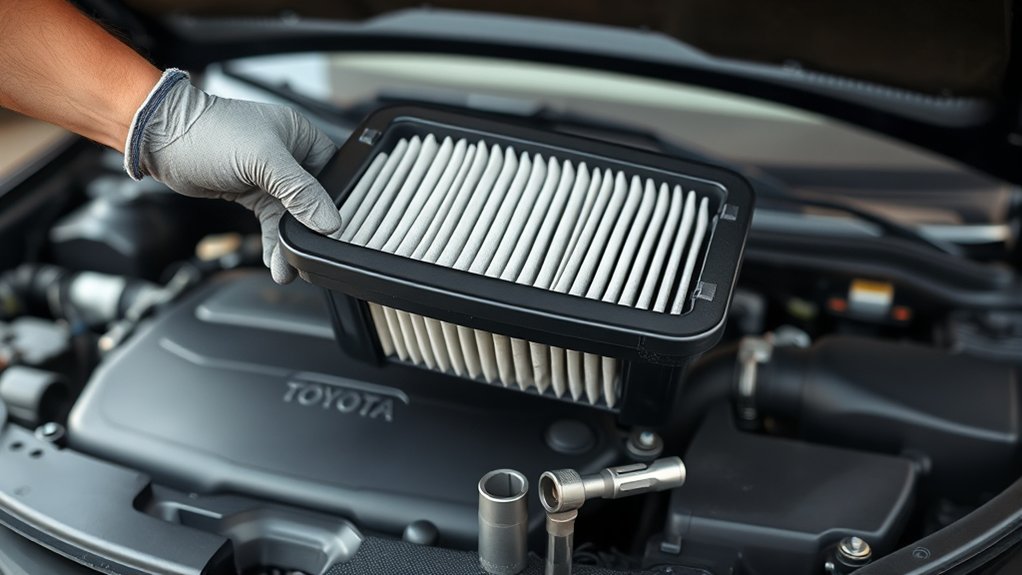
A Toyota Camry engine air filter protects the engine from road dust and debris, but its service interval depends on the model year and driving conditions. The safest approach is to follow the maintenance guide for your exact Camry rather than apply one mileage rule to every vehicle. This guide explains current U.S. intervals, inspection signs, and a safe DIY replacement process.
Quick Answer
For many recent U.S.-market Toyota Camrys, the normal engine air filter replacement point is 30,000 miles. The 2024 guide also lists 36 months, while the 2026 schedule uses 30,000-mile increments. If you mainly drive on dirt or dusty roads, inspect the filter at each 5,000-mile service and replace it sooner if it is damaged, oily, or heavily loaded.
Key Takeaways
- A 30,000-mile interval is common for recent U.S. Camrys, but the exact time and mileage limits depend on the model year and market.
- Dusty-road use calls for more frequent inspection, not an automatic one-size-fits-all annual or 25,000-kilometer replacement rule.
- Replace the filter if its pleats, frame, or seal are damaged, excessively dirty, oily, wet, or deformed.
- A new filter may restore restricted acceleration, but it generally does not improve fuel economy on a modern computer-controlled vehicle.
At a Glance
| Time Required | About 5–15 minutes |
| Difficulty | Easy for most owners |
| Tools Needed | Correct model-specific filter, clean lint-free cloth or small vacuum, and a screwdriver or socket only if the airbox uses screws |
| Cost | The price of one model-specific replacement filter; DIY replacement adds no labor charge |
Why Toyota Camry Engine Air Filter Maintenance Matters
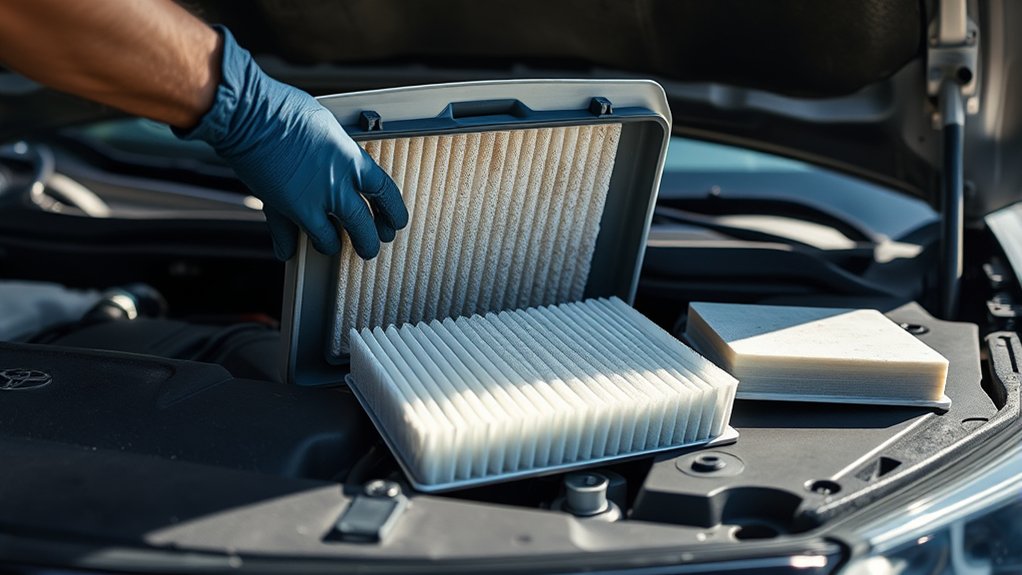
The engine draws in a large volume of outside air while it runs. The engine air filter traps dust, sand, insects, and other particles before they reach the intake system and engine. A correctly fitted filter also seals the airbox so incoming air follows the intended path.
A filter that is damaged, poorly seated, or overloaded with debris can restrict airflow or allow contaminants to bypass the filter. That may contribute to sluggish acceleration, unusual intake noise, or premature contamination inside the intake system. Toyota’s maintenance guidance calls for inspecting the filter for damage, excessive wear, and oiliness and replacing it when necessary.
Fuel economy is not a dependable way to judge a modern Camry’s air filter. According to FuelEconomy.gov, replacing a clogged filter on a modern fuel-injected, computer-controlled vehicle generally does not improve fuel economy, although it can improve acceleration when airflow was restricted.
Toyota’s 2026 U.S. Camry schedule calls for normal engine air filter replacement at 30,000-mile intervals and 5,000-mile inspections when the vehicle is driven mainly on dirt or dusty roads.
Engine Air Filter vs. Cabin Air Filter
A Toyota Camry normally has two different air filters, and they do different jobs:
- Engine air filter: Located in an airbox under the hood. It filters the air entering the engine.
- Cabin air filter: Usually located behind or near the glove compartment. It filters air entering the passenger compartment through the heating and air-conditioning system.
This article covers the engine air filter. Replacing the cabin filter will not correct an engine-airflow problem, and replacing the engine filter will not correct weak cabin airflow or odors from the vents.
Toyota Camry Engine Air Filter Replacement Intervals
Toyota’s schedule can change by model year, powertrain, and sales market. The following examples come from official U.S. maintenance guides and should not replace the guide for your specific vehicle.
| Vehicle and Conditions | Official Guidance |
|---|---|
| 2024 U.S. Camry, normal use | Replace at 30,000 miles or 36 months. |
| 2026 U.S. Camry, normal use | Replace at 30,000-mile intervals, including 30,000, 60,000, 90,000, 120,000, and 150,000 miles. |
| 2026 U.S. Camry, primarily dirt or dusty roads | Inspect at each 5,000-mile service and replace at the scheduled replacement point or sooner when inspection shows it is necessary. |
| Any model year | Replace sooner if the filter is damaged, wet, oily, deformed, incorrectly sealed, or excessively loaded with debris. |
You can review the source schedules in Toyota’s 2024 Camry Warranty & Maintenance Guide and 2026 Camry Warranty & Maintenance Guide.
Note: Do not assume that another Camry year uses the same time limit or service table. Enter your vehicle information on Toyota’s official manuals and warranty guide page, or check the maintenance guide supplied with your vehicle.
Signs a Toyota Camry Engine Air Filter Needs Replacement
Mileage is useful, but a physical inspection can reveal a problem before the next scheduled replacement. Replace the filter when you find one or more of the following:
- Heavy debris buildup: The pleats are packed with dust, leaves, insects, or other material that cannot be removed without damaging the filter.
- Torn or crushed pleats: A tear, hole, or collapsed section can allow unfiltered air to pass through.
- A damaged or deformed seal: The rubber or foam edge must sit evenly against the airbox.
- Oil or water contamination: A standard dry paper filter should not be soaked with oil, coolant, or water.
- Restricted acceleration: An extremely clogged filter can reduce airflow and make the car feel sluggish under load.
- An installation problem: The filter does not fit flat, the airbox lid will not close evenly, or part of the filter is pinched outside the housing.
Holding the filter toward a light may help reveal dense dirt, but it is only a rough check. Filter media, thickness, and construction vary, so the amount of visible light should not be used as the only pass-or-fail test.
Warning: Black exhaust smoke, a check-engine light, stalling, or a no-start condition is not proof that the air filter is the cause. Those symptoms can indicate fuel, ignition, sensor, intake, electrical, or other faults. Have the vehicle diagnosed instead of replacing parts by guesswork.
How Dusty Conditions Affect Filter Life
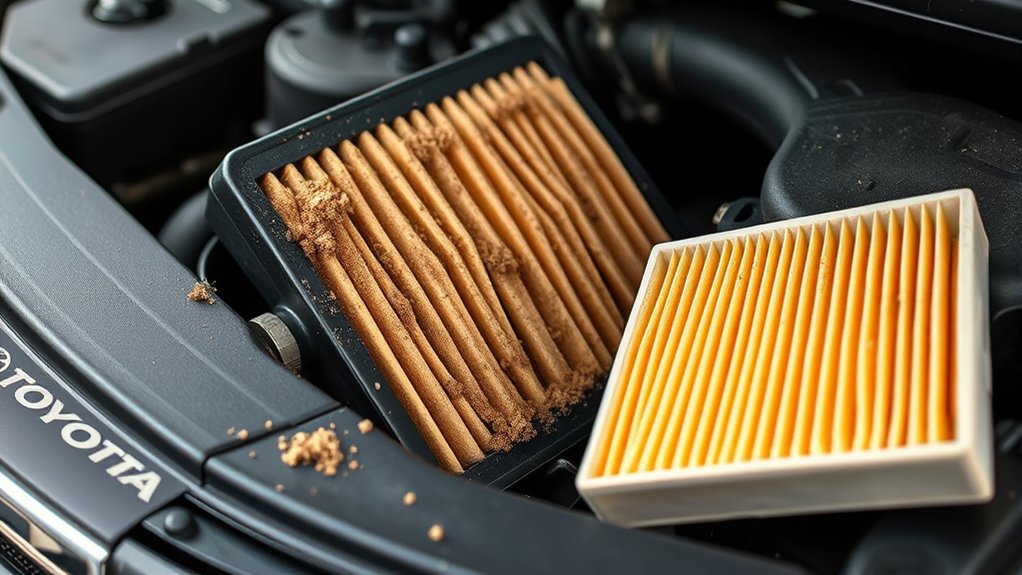
Dirt roads, construction areas, farms, unpaved parking lots, wildfire ash, and frequent travel behind other vehicles on dusty roads can load the filter more quickly. In those conditions, inspection frequency matters more than an arbitrary annual replacement date.
For the 2026 U.S. Camry, Toyota’s special-condition schedule calls for inspecting the engine air filter at every 5,000-mile service when the vehicle is driven primarily on dirt or dusty roads. That allows the filter to be replaced when its actual condition requires it while retaining the scheduled 30,000-mile replacement points.
Do not wash a standard disposable paper filter or coat it with oil. Do not strike it against a hard surface, because that can damage the media or sealing edge. If you use a serviceable aftermarket filter, follow that filter manufacturer’s cleaning and oiling instructions exactly.
How to Choose the Correct Replacement Filter
Camry filters can differ by model year, engine, powertrain, and market. Before buying a replacement:
- Confirm the vehicle’s model year.
- Check the powertrain or engine information listed for the replacement part.
- Use the VIN when a parts catalog offers VIN-based matching.
- Compare the new filter’s length, width, height, frame shape, and sealing edge with the old filter.
- Choose a filter specifically listed for your Camry rather than relying only on a similar appearance.
A filter that is too small can leave an unsealed gap. A filter that is too thick or incorrectly shaped can prevent the airbox lid from closing and may be damaged when the clips or screws are tightened.
How to Check and Replace a Toyota Camry Engine Air Filter
Warning: Park on a level surface, set the parking brake, turn the vehicle completely off, keep the key or smart key away from the car, and allow hot engine-bay parts to cool. On a hybrid Camry, do not touch or remove orange high-voltage cables, wiring, or connectors.
Before You Start
- Obtain the correct replacement filter.
- Review the owner or maintenance documentation for model-specific airbox access.
- Have a clean cloth or small vacuum ready for loose debris.
- Take a photo of the airbox, nearby hoses, and filter orientation before removing anything.
Replacement Steps
- Open and secure the hood. Make sure the vehicle is fully off before placing your hands in the engine compartment.
- Locate the engine air filter housing. It is normally a black plastic airbox connected to the engine’s intake duct.
- Inspect the surrounding area. Note the position of clips, screws, hoses, and electrical connectors. Do not disconnect a sensor or hose unless access genuinely requires it.
- Release the airbox lid. Undo the retaining clips or remove the required screws. Support the lid rather than pulling against attached wiring or hoses.
- Note the old filter’s orientation. Observe which side faces upward and how the sealing edge fits into the housing.
- Lift out the old filter carefully. Keep loose dirt from falling into the clean side of the intake opening.
- Inspect the filter and housing. Look for damaged pleats, a distorted seal, oil, moisture, leaves, nesting material, or unusual debris.
- Clean loose debris safely. Use a small vacuum or a lightly dampened lint-free cloth. Do not push dirt farther into the intake duct, and do not leave fibers or moisture inside the housing.
- Compare the filters. Confirm that the replacement matches the old filter’s dimensions, frame, seal, and orientation.
- Install the new filter. Seat it flat in the housing with the sealing edge fully inside its channel. No section should be folded, pinched, or raised.
- Close the airbox evenly. Align all tabs and edges before fastening the clips or screws. Do not force the lid closed.
- Perform a final check. Confirm that the lid is secure and that any hose, clamp, or connector disturbed during the work is correctly fitted.
Pro Tip: Write the replacement date and mileage in your maintenance record. A photo of the old filter can also help you compare how quickly the new one becomes loaded under your normal driving conditions.
Checks After Replacement
After closing the hood, start the vehicle normally and listen for unusual intake noise. A correctly installed filter should not create a whistle, air leak, or loose-rattling sound.
- The lid will not close: Recheck the filter part number, orientation, sealing edge, and airbox alignment. Do not force the clips.
- A whistle or sucking sound appears: Reopen the housing and verify that the filter and lid are evenly seated.
- The engine runs roughly or a warning light appears immediately: Turn the vehicle off and inspect any intake hose, clamp, or electrical connector that may have been disturbed.
- The old filter is soaked with oil or another fluid: Arrange a professional inspection because the contamination may have a cause beyond normal filter wear.
When to Have a Repair Shop Inspect the Camry
Engine air filter replacement is usually simple, but professional help is appropriate when:
- The airbox is cracked, warped, or missing fasteners.
- An intake hose is split, loose, or deteriorated.
- A sensor connector or wire is damaged.
- Oil, coolant, water, or rodent damage is present in the housing.
- The vehicle continues to hesitate, stall, smoke, or display a warning light after the airbox has been checked.
- You cannot identify the correct filter or close the housing without force.
Related Guides
Frequently Asked Questions
How often should I change the engine air filter on my Toyota Camry?
A 30,000-mile replacement point is common for recent U.S. Camrys. The 2024 guide lists 30,000 miles or 36 months, while the 2026 guide schedules replacement at 30,000-mile increments. Check the guide for your exact model year and inspect more often if you drive mainly on dirt or dusty roads.
Should I change my Camry’s engine air filter every 10,000 miles?
Not automatically under normal conditions. The recent U.S. Toyota schedules cited here use a 30,000-mile replacement point. A 10,000-mile replacement may waste a usable filter unless an inspection shows heavy debris, damage, contamination, or a poor seal.
How can I tell whether a Toyota engine air filter needs replacing?
Inspect it for packed debris, torn or crushed pleats, a damaged sealing edge, oil or water contamination, deformation, and an incorrect fit. Restricted acceleration can occur when a filter is severely clogged, but warning lights, smoke, stalling, or a no-start condition require broader diagnosis.
What is included in a Toyota Camry’s 100,000-mile service?
The required work depends on the model year, engine, powertrain, market, time in service, and driving conditions. For example, the 2024 U.S. guide does not list a universal engine air filter or spark plug replacement at exactly 100,000 miles. Use the maintenance guide for your specific Camry rather than a generic 100,000-mile checklist.
Will a new engine air filter improve my Camry’s gas mileage?
Usually not on a modern fuel-injected, computer-controlled Camry. Replacing a severely clogged filter may improve acceleration by restoring airflow, but FuelEconomy.gov reports that it generally does not improve fuel economy on modern vehicles.
Can I clean and reuse a Toyota Camry engine air filter?
A standard disposable paper filter should be replaced rather than washed, oiled, struck against a surface, or aggressively blown out. A serviceable aftermarket filter may be reusable, but it must be maintained according to its manufacturer’s instructions and must not be over-oiled.
Conclusion
For many recent U.S. Toyota Camrys, 30,000 miles is the normal engine air filter replacement point, but the exact time limit and service schedule depend on the model year. Inspect the filter more often when the car is used mainly on dirt or dusty roads, and replace it whenever the media or seal is damaged, contaminated, or excessively loaded. Using the correct filter and seating it properly are just as important as replacing it on time.
Sources
- Toyota 2026 Camry Warranty & Maintenance Guide — current U.S. replacement schedule, dusty-road inspections, filter inspection criteria, and hybrid safety information.
- Toyota 2024 Camry Warranty & Maintenance Guide — 30,000-mile or 36-month replacement guidance and model-year service information.
- Toyota Owners Manuals and Warranty Guides — official lookup for vehicle-specific manuals and maintenance documents.
- FuelEconomy.gov Vehicle Maintenance Guidance — evidence concerning air-filter replacement, acceleration, and fuel economy in modern vehicles.

