
Yes—cold weather can lower your Toyota Camry’s MPG even when nothing is wrong with the car. Federal fuel-economy testing shows conventional gasoline vehicles commonly lose about 10% to 20% in cold city driving, while hybrids can lose about 20% to 40%; short trips can lose even more. Cold fluids, longer engine warm-up, lower tire pressure, winter fuel, denser air, snow, cabin heat, remote starts, and idling can all contribute.
Last updated: September 22, 2026
What changed: Rechecked federal cold-weather MPG ranges and current 2026 Camry powertrain details, added Camry-specific internal resources, expanded winter MPG FAQs, and removed non-whitelisted Article schema.
Quick Answer
Your Toyota Camry’s MPG drops in winter because cold fluids increase friction, the engine stays inefficient longer, tire pressure decreases, and winter driving adds resistance. Gasoline cars commonly lose about 10% to 20% in cold city driving, while hybrids can lose more, especially on short trips.
Key Takeaways
- A moderate winter MPG decline is normal, but the amount depends on temperature, trip length, traffic, snow, tires, and your Camry’s model year.
- Hybrids often show a larger percentage drop because cold batteries, reduced regenerative braking, and cabin-heating demand limit electric operation.
- Check tire pressure when the tires are cold and use the PSI listed on the driver-side placard, not the maximum shown on the tire.
- Avoid long warm-ups. Clear the vehicle for safe visibility, then drive gently after a brief startup period.
- Track at least three full tanks and compare them with your own warm-weather average on similar routes.
- A sudden drop with warning lights, rough running, weak cabin heat, fuel odor, dragging brakes, or repeated pressure loss needs diagnosis.
At a Glance
| Time Required | 10 to 15 minutes for basic checks |
| Difficulty | Easy |
| Tools Needed | Accurate tire-pressure gauge, air source, and fuel log or trip computer |
| Cost | Usually free if you already own a gauge |
How Cold Weather Impacts Your Toyota Camry’s MPG
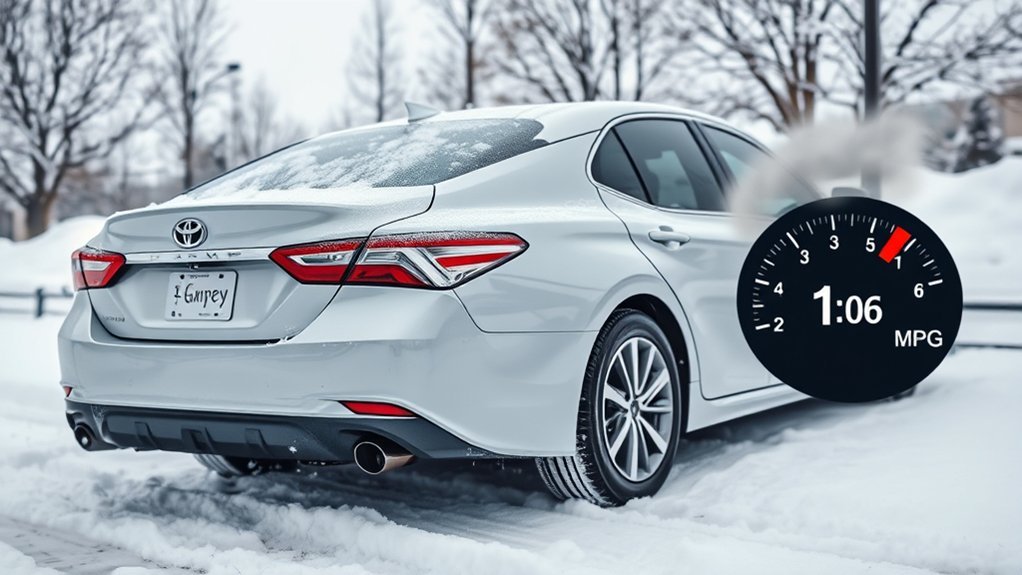
Cold weather affects several systems at once. According to the U.S. Department of Energy and EPA fuel-economy guide, a conventional gasoline car averages about 15% lower city MPG at 20°F than at 77°F. The loss can reach about 24% on short three- to four-mile trips.
The same government guidance says conventional gasoline vehicles commonly lose about 10% to 20% in city driving during cold weather. Short trips can produce losses of roughly 15% to 33%. These are broad test-based ranges, not a promise of what every Camry will achieve.
Cold weather hurts short-trip fuel economy most because your Camry spends more of each trip below its efficient operating temperature.
Winter MPG falls for several reasons:
- Cold oil and driveline fluids: Thicker fluids increase friction until the vehicle warms.
- Longer engine warm-up: The engine uses more fuel and runs less efficiently after a cold start.
- Denser air: Cold air increases aerodynamic drag, especially at highway speeds.
- Lower tire pressure: Under-inflation increases rolling resistance.
- Winter gasoline: Seasonal fuel blends can contain slightly less energy per gallon.
- Snow and slush: Poor traction and road buildup increase resistance.
- Electrical and climate loads: Defrosters, heated seats, blowers, lights, and battery charging require energy.
How Much Winter MPG Loss Is Normal?
Use your own warm-weather average as the baseline. A fixed number such as “5 MPG” can be misleading because the same numerical drop represents a much larger percentage on a lower-MPG vehicle.
| Warm-Weather Average | Example Winter Range | Basis |
|---|---|---|
| 30 MPG gasoline Camry | About 24 to 27 MPG | Illustrates a 10% to 20% city-driving loss |
| 45 MPG hybrid Camry | About 27 to 36 MPG | Illustrates a 20% to 40% city-driving loss |
| Any Camry used mostly for short trips | May fall below the broad city range | Repeated cold starts magnify the loss |
These examples are calculations from government percentage ranges, not model-specific EPA ratings. FuelEconomy.gov says its cold-weather estimates were updated using model-year 2019 data for 59 gasoline vehicles and 32 hybrids, so treat the percentages as broad benchmarks rather than Camry-specific test results. Temperature, trip length, trim, tires, road conditions, idling, and driving style can move your result outside the example range.
For the official rating side of the comparison, see our Toyota Camry EPA fuel-economy estimates guide. Use the rating for your exact model year, trim, and drivetrain, then compare it with your own multi-tank winter average.
How Cold Starts Reduce MPG
A cold engine needs extra fuel and time to reach its efficient operating temperature. Friction is also higher while the oil and transmission fluid remain cold. This combination hurts MPG most when you drive only a few miles, shut the car off, and repeat the cycle later.
Long idling does not solve the problem efficiently. An idling engine gets zero miles per gallon, and the vehicle generally warms faster when driven gently. Federal fuel-economy guidance says most manufacturers recommend driving off gently after about 30 seconds rather than waiting for a long stationary warm-up.
Warning: Never warm up or leave a gasoline engine running in a closed or attached garage. Carbon monoxide can enter the vehicle or building. Before driving, also clear the windshield, windows, mirrors, lights, roof, and cameras enough for safe visibility.
After you start your Camry, use light throttle and avoid hard acceleration until the engine has warmed. If the engine runs rough, stalls, produces a strong fuel smell, or turns on a warning light, treat that as a fault rather than normal winter behavior.
Does a Toyota Camry Hybrid Lose More MPG in Winter?
Camry powertrains vary by model year. Older U.S. Camrys may have gasoline-only or hybrid powertrains, while the 2026 U.S. Camry uses an all-hybrid powertrain and offers front-wheel drive or electronic on-demand all-wheel drive. Compare your winter MPG with the same vehicle, route, fuel, and driving pattern instead of comparing unrelated trims or model years.
Hybrid Efficiency Challenges
Cold weather often causes a larger percentage MPG drop in hybrids. Government testing reports that hybrid fuel economy can decline about 20% to 40% in city driving and about 25% to 45% on short trips under cold conditions.
The hybrid battery delivers and accepts power less efficiently when cold. Regenerative braking may recover less energy, while cabin heat can make the gasoline engine run more often. Toyota’s hybrid driving guidance also notes that in winter the gasoline engine may keep running until the engine and cabin are warm. These effects reduce the amount of time the Camry can rely on electric assistance.
Gasoline Engine Dependence
A gasoline-only Camry also burns more fuel during warm-up, but it does not depend on traction-battery temperature or regenerative braking. Its winter loss may therefore be smaller as a percentage, although short trips, idling, low tire pressure, snow, and aggressive driving can still cause a substantial decline.
For a hybrid Camry, seeing the engine run more often in cold weather can be normal. A hybrid-system warning, weak acceleration, unusual noises, or a sharp loss that continues in mild weather is not normal and should be checked.
How Does Tire Pressure Affect Camry MPG in Winter?
Air pressure falls as temperatures fall, so tires that were correct in warmer weather may become under-inflated. Check all tires at least monthly when they are cold, meaning the car has been parked for at least three hours. Use the cold PSI on the driver-side Tire and Loading Information label or in the owner’s manual. For a Camry-specific pressure walkthrough, see our winter tire-pressure guide.
The federal fuel-economy maintenance guide estimates that under-inflated tires reduce gas mileage by about 0.2% for every 1 PSI drop in the average pressure of all tires. Proper inflation also supports safer handling and more even tire wear.
Set cold tire pressure to Toyota’s placard specification. Do not inflate to the maximum pressure molded into the tire sidewall.
Note: A TPMS light may appear on a cold morning and turn off as the tires warm. You should still check pressure with a gauge because TPMS is not a substitute for monthly checks.
Tips to Improve Your Toyota Camry’s MPG in Winter
You cannot remove every cold-weather penalty, but you can limit avoidable losses. Start with the checks that affect safety and rolling resistance, then focus on trip planning and driving habits.
Maintain Proper Tire Pressure
Check pressure before long trips and at least once each month. Add air to the placard value while the tires are cold. Do not intentionally inflate above Toyota’s specification in an attempt to gain MPG.
Inspect the tread at the same time. Uneven wear may point to an alignment, balance, suspension, or inflation problem. The NHTSA TireWise guide recommends monthly pressure, tread, and damage checks.
Use the Toyota-Specified Motor Oil
Do not choose oil only because it is marketed as “winter-grade.” Use the viscosity and specification listed for your Camry’s exact model year and engine. Toyota has changed oil requirements across generations, so a grade that is correct for one Camry may be wrong for another.
| Oil Choice | Winter Guidance | What to Do |
|---|---|---|
| Toyota-specified viscosity | Designed for the engine’s lubrication and efficiency needs | Use the grade in your manual or on the oil-fill cap |
| Unapproved thicker oil | Can increase cold-start friction and reduce efficiency | Do not substitute without Toyota guidance |
| Synthetic oil | May flow well at low temperatures, but the grade still matters | Match the required viscosity and performance standard |
You can find the correct manual through Toyota’s official manuals and warranties page.
Limit Short Trips
Combine errands so the engine reaches operating temperature once instead of repeating several cold starts. Choose a route that avoids unnecessary stop-and-go traffic when road conditions allow.
Do not make extra trips simply to warm the car. Walking, public transportation, or carpooling can reduce fuel use for suitable short journeys, but safety and local conditions should guide your choice.
Limit Idling and Use Climate Controls Safely
Remote start and stationary warm-up time count against tank MPG because fuel is burned without adding miles. Use only the time needed to clear frost and make the cabin safe, then drive gently. Parking in a garage or another sheltered place can reduce the initial warm-up penalty, but never run the engine in a closed or attached garage.
Defrosters and heat are safety equipment when visibility is poor. Do not switch them off merely to chase a higher MPG number. Once the glass is clear, use the lowest comfortable setting and turn off heated accessories when they are no longer needed.
Choose Winter Tires for Safety, Not Maximum MPG
Winter tires can add rolling resistance compared with some low-rolling-resistance all-season tires, but the effect depends on tire design, pressure, temperature, and road conditions. In severe winter weather, traction and braking safety matter more than a small fuel-economy difference.
All-wheel drive can help a Camry accelerate on slippery roads, but it does not replace suitable tires or careful braking. Keep all four tires matched, correctly inflated, and appropriate for the conditions and local law. For the current hybrid system, see how Toyota Camry AWD works; for traction-focused winter advice, see how to drive a Camry safely in snow and ice.
Drive Smoothly and Remove Extra Drag
Accelerate smoothly, leave extra following distance, and anticipate stops. This saves fuel and reduces the need for hard braking on slippery roads. Use cruise control only on dry, clear roads where maintaining a steady speed is safe.
Remove unused roof racks or cargo boxes because they add aerodynamic drag. Clear heavy snow from the roof, hood, lights, and trunk before driving. Do not carry unnecessary heavy items through the winter.
Pro Tip: Compare winter fuel economy over several full tanks. One dashboard reading can be distorted by remote starts, idling, a short refill, changing routes, or a single snowstorm.
How to Track Whether the MPG Drop Is Normal
- Fill the tank and reset Trip A.
- At the next fill-up, divide miles driven by gallons added.
- Repeat for at least three tanks.
- Compare the result with your own warm-weather average on similar routes.
- Note temperature, idling time, trip length, snow, tire pressure, and roof cargo.
Use the same calculation each time: MPG = miles driven ÷ gallons added. Tank-to-tank results can vary because the pump may shut off at slightly different points, so a multi-tank average is more useful.
To calculate the percentage loss, use: (warm-weather MPG − winter MPG) ÷ warm-weather MPG × 100. For example, a drop from 40 MPG to 32 MPG is a 20% decline. Compare like with like: similar routes, fuel, tires, traffic, and idling.
Note: EPA ratings are standardized comparison values, not a guarantee of your personal MPG. Your own warm-weather baseline is usually the fairest reference for judging a seasonal change.
Debunking Myths About Winter MPG
- Myth: Every Camry loses exactly 30%. Gasoline and hybrid vehicles have different typical ranges, and short trips create larger losses.
- Myth: A long warm-up saves fuel. Extended idling lowers MPG because the car burns fuel without traveling.
- Myth: You should inflate tires to the sidewall number. Use Toyota’s cold-pressure placard, not the tire’s maximum rating.
- Myth: Any thinner “winter oil” is better. The correct choice is Toyota’s specified viscosity and standard for your engine.
- Myth: The cabin heater has no effect. Blowers, defrosters, and electrical accessories use energy, and hybrid cabin heating may keep the engine running more often.
- Myth: Premium gasoline will restore winter MPG. Use the octane grade specified in the owner’s manual; higher octane usually provides little or no benefit when it is not required.
- Myth: Fuel additives will restore winter MPG. Additives do not fix low pressure, cold-operation losses, dragging brakes, warning-light faults, or poor driving conditions.
Winter MPG Troubleshooting Checklist
Start with simple checks before assuming a major engine problem:
- Verify all four tire pressures when cold.
- Remove unnecessary roof cargo and heavy items.
- Review idling, remote-start use, and trip length.
- Check whether snow, slush, strong wind, or lower traffic speeds changed your route.
- Confirm you are using the correct oil and completing scheduled maintenance.
- Look for a check-engine, hybrid-system, TPMS, or brake warning.
- Notice whether the engine reaches its normal temperature and whether cabin heat becomes properly warm.
- Check for fuel odor, visible leaks, rough idle, weak acceleration, or a wheel that feels unusually hot after driving.
When to Consult a Professional for MPG Issues
A seasonal decrease alone usually does not require repair. Schedule an inspection when the loss is sudden, unusually severe for your normal winter pattern, continues after mild weather returns, or appears with symptoms that suggest a fault. A thermostat stuck open is one example: it can keep an engine too cool, weaken cabin heat, and increase fuel consumption.
| Sign of Concern | Action to Take | Why It Matters |
|---|---|---|
| Check-engine or hybrid warning | Have the codes diagnosed promptly | A sensor, emissions, ignition, or hybrid fault may reduce efficiency |
| Rough running, stalling, or weak acceleration | Schedule an engine inspection | These symptoms are not explained by normal winter MPG loss alone |
| Engine stays unusually cool or cabin heat remains weak | Have the cooling system, thermostat, and temperature sensing checked | An engine that does not reach normal temperature may run inefficiently |
| Fuel odor or visible leak | Stop driving if a leak is suspected and seek professional help | Fuel leaks create a fire and health hazard |
| Vehicle pulls, brakes drag, or one wheel is unusually hot | Have the brakes and alignment checked | Mechanical drag wastes fuel and can become unsafe |
| Tire repeatedly loses pressure | Inspect for a puncture, valve, bead, or wheel problem | Repeated air loss needs repair, not repeated topping off |
Frequently Asked Questions
Is it normal for Toyota Camry gas mileage to drop in winter?
Yes. Cold fluids, longer warm-up time, lower tire pressure, winter fuel, snow, and short trips can reduce MPG. Gasoline cars commonly lose about 10% to 20% in cold city driving, while hybrids may lose more.
How much MPG can a Toyota Camry lose in winter?
A conventional gasoline vehicle commonly loses about 10% to 20% in cold city driving, while hybrids can lose about 20% to 40%. Short trips can produce larger losses. Use your own warm-weather average for the most meaningful comparison.
Why is my Toyota Camry consuming too much fuel?
Check cold tire pressure, trip length, idling, roof cargo, driving habits, snow, and maintenance first. Warning lights, rough running, weak cabin heat, fuel odor, brake drag, or a sudden change that continues in mild weather should be diagnosed.
Is a Toyota Camry good in winter?
A Camry can perform well in winter with suitable tires, adequate tread, correct pressure, and careful driving. Some model years offer all-wheel drive, but AWD does not replace winter tires or shorten the stopping distance available from the tire-road grip.
Should I warm up my Camry before driving?
A long stationary warm-up is usually unnecessary. Clear the vehicle for safe visibility, allow a brief startup period, then drive gently. Never run the engine in a closed or attached garage, and avoid hard acceleration until the engine and fluids warm.
Does remote start lower Toyota Camry MPG?
Yes. Remote start burns fuel while the car is not adding miles, so repeated or long warm-ups can noticeably lower tank-average MPG. Use only the time needed for safe visibility and comfort, then drive gently.
Does using the heater reduce Camry Hybrid MPG?
It can. In cold weather, cabin-heating demand can make the gasoline engine run more often, especially early in a trip, which reduces electric-only operation and lowers MPG. Keep visibility and comfort first; do not avoid necessary heat or defrosting just to save fuel.
What tire pressure should I use in winter?
Use the cold PSI on the driver-side Tire and Loading Information label or in the owner’s manual. Check it after the car has been parked for at least three hours. Do not use the maximum pressure printed on the tire sidewall.
Do winter tires reduce MPG?
They can add rolling resistance, depending on the tire design, pressure, road, and temperature. However, winter traction and braking safety matter more than a small fuel-economy difference in severe conditions.
Can a bad thermostat cause poor winter MPG?
Yes. A thermostat stuck open can keep the engine below its normal operating temperature, which may reduce efficiency and cause weak cabin heat. Have the cooling system checked if the engine stays unusually cool or the problem continues in milder weather.
Conclusion
A winter MPG drop in your Toyota Camry is usually the combined result of cold starts, fluid friction, lower tire pressure, winter fuel, climate-control use, and difficult road conditions. You can reduce the avoidable loss by checking tires cold, using Toyota-specified oil, limiting idling, combining trips, and driving smoothly.
Track several tanks before judging the change. If fuel economy drops suddenly or comes with warning lights, rough running, weak cabin heat, fuel odor, repeated pressure loss, weak acceleration, or brake drag, have the vehicle inspected.
Sources
- FuelEconomy.gov: Fuel Economy in Cold Weather — winter MPG ranges, cold-start effects, tire pressure, winter fuel, hybrid effects, and warm-up guidance
- FuelEconomy.gov: Keeping Your Vehicle in Shape — tire-pressure MPG effect, warning-light guidance, and recommended motor oil
- FuelEconomy.gov: Driving More Efficiently — smooth driving, idling, speed, cruise control, and roof-cargo effects
- NHTSA TireWise — cold tire-pressure checks, placard pressure, TPMS, tread, tire design, and tire safety
- Toyota Manuals and Warranties — model-year-specific oil, tire, fuel, and maintenance instructions
- Toyota: 2026 Camry — current U.S. Camry hybrid powertrain, drivetrain choices, and EPA-estimated efficiency
- Haynes: Thermostat Replacement — stuck-open thermostat symptoms, weak cabin heat, and increased fuel consumption
