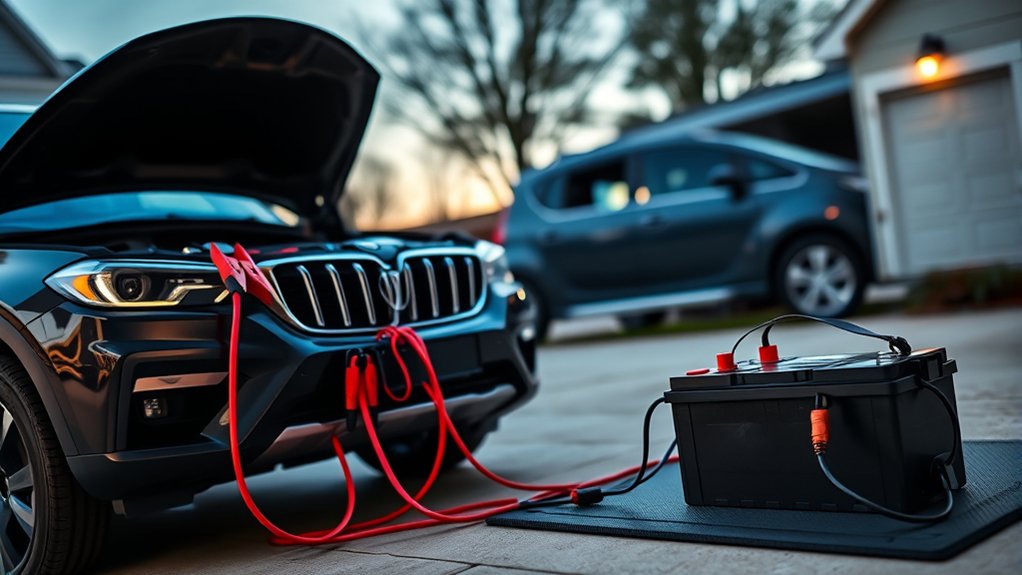
A jump starter and a battery charger both help when your vehicle’s 12-volt battery is weak, but they solve different problems. A jump starter supplies a brief burst of current so the engine can crank. A battery charger restores energy more slowly and may maintain the battery during storage. Choosing the right one depends on whether you need an immediate start or a proper recharge.
Quick Answer
A jump starter provides a brief, high-current boost so your engine can crank when the 12-volt battery is too weak. A battery charger restores the battery’s charge over time and may maintain it during storage. Choose a jump starter for roadside emergencies, a charger for recovery and maintenance, or keep both for full coverage.
Key Takeaways
- A jump starter helps start the engine but does not fully recharge the vehicle battery.
- A battery charger restores charge over several hours, depending on the battery and charger.
- Voltage, battery chemistry, engine size, and product instructions must match your vehicle.
- Never jump-start or charge a battery that is frozen, cracked, swollen, leaking, or unusually hot.
- Repeated battery failure calls for testing, not repeated jump-starting alone.
Understanding Jump Starters and Their Function
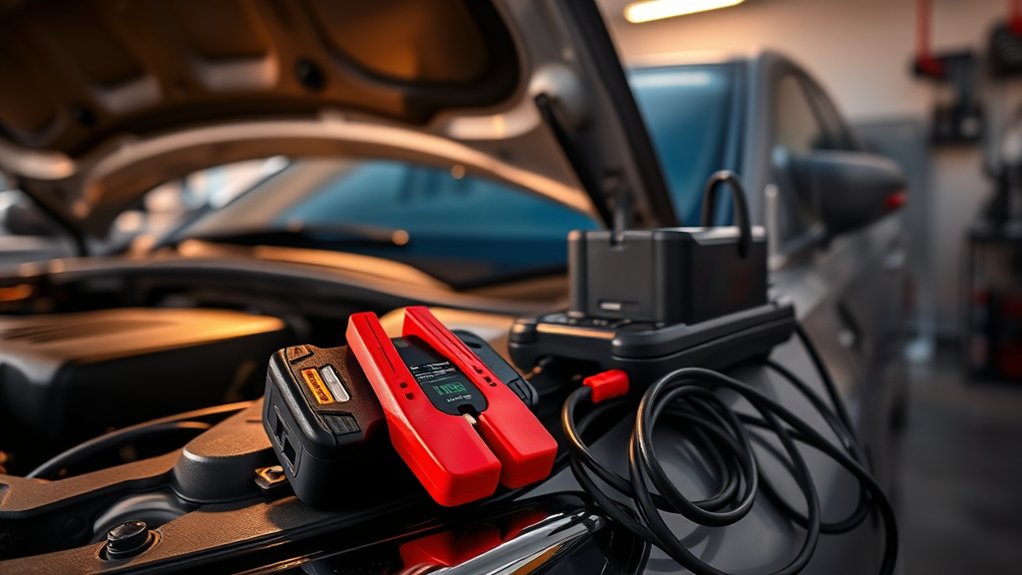
A jump starter, also called a jump pack or battery booster, is a portable device that supplies enough current to help a weak starter battery crank the engine. Unlike jumper cables, it does not require a second vehicle.
Most compact jump starters contain an internal lithium battery, clamps, a power button, and charge-level indicators. Many also include USB ports and an LED light. These extras are useful, but the most important specifications are the supported voltage, recommended engine size, cranking performance, clamp quality, and built-in safety protections.
A jump starter provides temporary starting assistance. It is not designed to restore a deeply discharged vehicle battery to a full state of charge. After the engine starts, the battery may still need to be charged and tested.
Note: Reverse-polarity, spark, temperature, and short-circuit protections vary by model. Check the product manual instead of assuming every jump starter includes the same safeguards.
How Battery Chargers Restore and Maintain a Car Battery
A battery charger sends controlled current into a rechargeable battery over time. It is useful when a battery is partly or deeply discharged, when a vehicle sits unused, or when you want to restore the battery more completely after a jump-start.
Charging time is not fixed. It depends on battery capacity, depth of discharge, condition, temperature, and charger output. A small maintainer may need much longer than a higher-output charger. The final absorption stage may also take time even after the battery voltage rises.
Regular Maintenance Benefits
Vehicles that sit for weeks can lose charge through normal self-discharge and small electrical loads. A compatible automatic maintainer can monitor the battery and supply a small amount of current when needed.
This is especially useful for seasonal cars, motorcycles, boats, recreational vehicles, and vehicles driven only on short trips. Keeping a healthy battery properly charged can reduce sulfation caused by leaving a lead-acid battery in a discharged state.
A maintainer cannot correct a parasitic electrical drain, failed charging system, internal battery damage, or worn-out battery. Those conditions require diagnosis or replacement.
Smart Charging Technology
Many current smart chargers monitor voltage and adjust their output as charging progresses. Depending on the model, the charger may use bulk, absorption, analysis, float, pulse, or maintenance stages.
Some models also offer temperature compensation, low-voltage detection, AGM mode, lithium mode, or a repair setting. These are not universal features, and a repair indicator does not prove that a battery has regained reliable capacity.
Always select a charger specifically approved for your battery’s voltage and chemistry. AGM and flooded batteries are both lead-acid designs but may require different charging profiles. Lithium batteries require a compatible lithium mode and an appropriate battery-management system.
For an example of model-specific voltage and chemistry support, review the NOCO GENIUS5 specifications or use a manufacturer’s battery-type selector such as the CTEK charger guide.
Battery Charger vs. Maintainer vs. Engine-Start Charger
- Battery charger: Restores energy to a discharged battery at a controlled rate.
- Battery maintainer: Monitors a charged or nearly charged battery and supplies current only as needed during storage.
- Engine-start charger: An AC-powered charger with a specific high-current start or boost setting. Only use this function if the charger manual and vehicle manual permit it.
- Jump starter: A self-contained portable power source intended to provide immediate cranking assistance.
Key Differences Between Jump Starters and Battery Chargers
Speed of Operation
A jump starter is designed for immediate use. Once it is connected correctly and its status indicators show that it is ready, you may be able to attempt a start within seconds.
A battery charger works more slowly because its job is to return energy to the battery. Charging may take several hours or overnight. A small maintainer can take longer, while a higher-output charger may work faster if its output is suitable for the battery.
Do not select a charger only by choosing the highest amp rating. Excessive or incompatible charging can damage a battery. Follow the battery and charger manufacturers’ recommendations.
Portability and Convenience
Most lithium jump starters are compact enough to keep in a trunk. They work without a wall outlet, which makes them useful in parking lots, remote areas, and roadside emergencies.
Most battery chargers require AC power and are better suited to a driveway, garage, workshop, or storage location. Portable DC-to-DC and solar-assisted products also exist, but they should not be confused with a standard roadside jump pack.
What Each Tool Cannot Do
A jump starter cannot prove that your battery is healthy, and it does not repair a failed charging system. A charger cannot repair cracked plates, an internal short, a frozen battery, or a battery that no longer holds usable capacity.
A jump starter solves the immediate no-start problem. A battery charger addresses the battery’s state of charge. Testing identifies why the battery became weak.
How to Handle a Dead Battery With a Jump Starter
Use a jump starter when the battery appears too weak to crank the engine and you need to move the vehicle or reach a safer location. Before connecting anything, confirm that the battery and vehicle are suitable for jump-starting.
Warning: Do not jump-start or charge a battery that is frozen, cracked, swollen, leaking, giving off a strong odor, or unusually hot. Keep flames, cigarettes, and sparks away. Wear eye protection, remove metal jewelry, and work in a ventilated area. Seek professional help when the battery condition is uncertain.
- Read both manuals. Locate the vehicle’s approved jump points and review the jump starter’s voltage, chemistry, connection, and attempt limits.
- Secure the vehicle. Shift to Park or Neutral as directed, apply the parking brake, switch off the ignition, and turn off lights, climate control, audio, and other loads.
- Inspect the battery and cables. Stop if you find physical damage, heavy corrosion that prevents a solid connection, exposed wiring, or signs that the battery may be frozen.
- Verify compatibility. Confirm the vehicle’s system voltage, battery chemistry, engine size, and any manufacturer restrictions. Do not connect a 12-volt-only pack to a different-voltage system.
- Connect the positive clamp. Attach the red clamp to the approved positive terminal or remote positive jump point.
- Connect the negative clamp. Use the approved negative terminal or chassis grounding point specified by the vehicle and jump-starter manuals.
- Activate the unit. Turn on the jump starter and confirm that its ready or boost indicator appears. Correct any polarity or temperature warning before proceeding.
- Attempt to start the engine. Crank only for the time allowed by the product manual. Pause between attempts and do not exceed the stated attempt limit.
- Disconnect safely. After the engine starts, turn off the jump pack if required and remove the clamps in the manual’s specified reverse order, normally negative first and positive second on a negative-ground system.
The NOCO GB40 user guide, for example, requires voltage and chemistry verification, permits its negative clamp on the negative terminal or vehicle chassis, and limits repeated starting attempts. Instructions for another product may differ.
Warning: Some jump starters include a manual override for batteries whose voltage is too low for automatic detection. Override mode may disable reverse-polarity and spark protections. Do not use it unless the product manual specifically permits it and you are certain the clamps are connected correctly.
What to Do After the Engine Starts
Do not assume the battery is fully recovered. If the vehicle is safe to drive, follow the owner’s manual and arrange a battery and charging-system test. A dedicated charger may be needed to restore the battery fully.
If the engine stops soon after the jump pack is removed, a charging-system fault, severely failed battery, loose connection, or another electrical problem may be present. Repeatedly jump-starting the vehicle is not a repair.
Pro Tip: Recharge the jump starter after use and check its charge before long trips or severe weather. Storage and recharge intervals vary, so follow the manufacturer’s schedule instead of leaving the pack unchecked for months.
Hybrid and Electric-Vehicle Caution
Hybrid and electric vehicles often use a separate low-voltage auxiliary battery for computers, locks, contactors, and control systems. Their jump points and procedures can differ greatly from those of a conventional gasoline vehicle.
Never connect a consumer jump starter to a high-voltage traction battery. Use only the approved auxiliary-battery procedure in the vehicle owner’s manual.
Ideal Situations for Using a Battery Charger
A battery charger is the better choice when you have access to AC power and want to restore the battery instead of obtaining only a temporary start.
Common uses include:
- Charging a battery after lights or accessories were left on
- Restoring charge after a jump-start
- Maintaining a seasonal or infrequently driven vehicle
- Charging a battery removed from service when the manufacturer permits it
- Maintaining motorcycle, boat, lawn-equipment, or recreational-vehicle batteries with a compatible mode
- Checking whether an automatic charger completes its cycle or reports a fault
Before charging, identify the battery voltage and chemistry. Select the correct mode, connect the clamps as directed, and plug in or activate the charger in the order specified by its manual.
How Long Does Battery Charging Take?
There is no reliable universal time. A rough estimate begins with the amount of capacity that must be replaced and the charger’s output, but charging losses, temperature, battery condition, and the final absorption stage add time.
For example, a partially discharged battery on a suitable 5-amp charger may complete much sooner than the same battery on a 1-amp maintainer. A large or deeply discharged battery may take considerably longer.
Do not disconnect solely because the voltage has risen or a few hours have passed. Let a compatible automatic charger complete its programmed cycle unless the battery becomes hot, swells, leaks, smells abnormal, or the charger reports a fault.
Can a Charger Recover a Deeply Discharged Battery?
Some automatic chargers can detect very low voltage or provide a force, supply, or repair mode. Recovery is not guaranteed. A battery that has been left discharged for a long time may have permanent sulfation or capacity loss.
Do not force-charge a frozen, damaged, or incompatible battery. After charging, have the battery tested if it went completely flat, is several years old, or becomes discharged again.
Choosing Between a Jump Starter and a Battery Charger
Your immediate situation usually determines the right tool. Choose a jump starter when you need portable emergency cranking power. Choose a battery charger when you have time and access to electricity to restore the battery properly.
| Feature | Jump Starter | Battery Charger |
|---|---|---|
| Primary job | Provides temporary cranking power | Restores battery charge |
| Typical result | May start the engine within minutes | Charges over several hours or longer |
| Power source | Internal rechargeable battery | Usually an AC outlet |
| Portability | Usually easy to carry in a vehicle | Usually used in a garage or driveway |
| Best use | Roadside or parking-lot emergency | Recovery, storage, and maintenance |
| Full recharge | No | Yes, if compatible and the battery is serviceable |
| Long-term maintenance | No | Available on approved automatic maintainers |
| Main matching requirement | Voltage, battery type, engine size, and cranking capability | Voltage, battery chemistry, capacity, and charge mode |
| Main limitation | Does not correct the reason the battery became weak | Needs time and usually an external power source |
Features to Check Before Buying
For a jump starter, compare:
- Supported system voltage
- Recommended gasoline and diesel engine sizes
- Cold-weather operating range
- Clamp reach and construction
- Reverse-polarity and short-circuit protection
- Charge indicator and recharge method
- Storage-temperature requirements
- Manual override behavior and warnings
For a battery charger, compare:
- Supported voltage and battery chemistry
- Charging output in amps
- Minimum and maximum battery capacity
- AGM, lithium, repair, or supply modes when needed
- Temperature compensation
- Automatic maintenance capability
- Outdoor or indoor-use rating
- Fault indicators and warranty support
Why You Should Combine Both Tools for Battery Management
Keeping both tools gives you an emergency option and a maintenance option. The jump starter can help you move a vehicle when no outlet or second car is available. The battery charger can then restore the battery more completely and help determine whether it accepts a normal charge.
This combination is especially useful when you own a vehicle that sits for long periods, drive in very cold weather, travel in remote areas, or manage several batteries.
Owning both devices does not replace routine inspection or testing. Keep battery terminals clean and secure, recharge the jump pack as directed, and investigate repeated discharge instead of treating every no-start with another boost.
Troubleshooting: What a No-Start Symptom May Mean
| Symptom | Possible Cause | Next Step |
|---|---|---|
| Rapid clicking and dim lights | Low battery charge, poor terminal connection, or high resistance | Inspect connections and test or charge the battery |
| One click with bright lights | Starter, solenoid, cable, or connection problem | Do not assume the battery is the only cause; arrange diagnosis |
| Starts after a jump but dies soon afterward | Charging-system fault, severe battery failure, or loose electrical connection | Have the battery and charging system tested |
| Battery is flat again after sitting | Weak battery, parasitic draw, or charging-system problem | Fully charge and test the battery, then check for abnormal key-off draw |
| No electrical power after a jump attempt | Incorrect jump point, poor clamp contact, blown protection device, or another electrical fault | Stop repeated attempts and consult the vehicle manual or a technician |
| Battery is swollen, cracked, leaking, frozen, or hot | Unsafe or failed battery | Do not jump-start or charge it; obtain professional assistance |
Frequently Asked Questions
What is the 80/20 rule for charging?
There is no universal 80/20 charging rule for a conventional 12-volt lead-acid starter battery. Use a charger approved for the battery’s voltage and chemistry, select the proper mode, and allow an automatic charger to complete its cycle. The 80% recommendation is more commonly discussed for some lithium-ion traction and consumer batteries.
How do I know if I need a jump-start or a new battery?
A jump-start may be reasonable after an accidental discharge, such as leaving lights on. Suspect a weak battery when cranking remains slow after a full charge, the battery repeatedly goes flat, it fails a battery test, or it is near the end of its expected service life. Charging-system and parasitic-draw problems can cause the same symptoms, so testing is better than replacing parts by guesswork.
What is the difference between a battery charger and jumper cables?
A battery charger uses an external electrical source to restore charge over time. Jumper cables transfer starting power from another compatible vehicle or battery. Jumper cables require a donor source and a vehicle-specific connection sequence, while a portable jump starter contains its own power source.
Is it better to jump-start or charge the battery?
Jump-start the vehicle when you need immediate mobility and the battery is safe to boost. Charge the battery when you have time and access to the correct equipment. After a deep discharge, a proper charge and battery test are preferable to relying only on the alternator.
Can a jump starter fully charge a car battery?
No. A standard jump starter is intended to supply a short burst of current for cranking. It does not provide the controlled, multi-stage charging needed to restore a discharged starter battery fully.
Can a battery charger start a car immediately?
A normal charger usually cannot. Some AC-powered chargers include a dedicated engine-start or boost mode. Use that function only when the charger and vehicle manuals permit it. A maintenance charger should never be treated as a jump starter.
Can I use the same charger for flooded, AGM, and lithium batteries?
Only when the charger explicitly supports each chemistry and provides the required mode. Never use a lead-acid charging profile on a lithium battery unless the battery and charger manufacturers approve it.
What should I do if the car needs another jump the next day?
Fully charge and test the battery, inspect the terminals, and test the charging system. If those pass, the vehicle may have an abnormal parasitic draw while parked. Repeated jump-starting can leave you stranded and may hide the actual fault.
Conclusion
A jump starter and a battery charger are complementary rather than interchangeable. Keep a correctly sized jump starter in the vehicle when you want portable emergency starting power. Use a compatible charger or maintainer when you need to restore charge or care for a vehicle during storage.
Before using either device, inspect the battery, verify voltage and chemistry, and follow the vehicle, battery, and equipment manuals. If the battery repeatedly loses charge or the vehicle will not stay running, stop relying on temporary boosts and have the battery and electrical system tested.
Sources
- NOCO GB40 User Guide — jump-starter compatibility, connection procedure, attempt limits, manual override, and safety warnings
- NOCO GB40 Product Information — portable jump-starter purpose, voltage, engine-size ratings, and safety features
- NOCO GB40 Operating Instructions — jump-start sequence, status indicators, and manual-override warning
- NOCO GENIUS5 Smart Charger Information — charger modes, supported battery types, automatic charging, and maintenance functions
- CTEK 12-Volt and 24-Volt Charger Guide — battery-type, vehicle-type, and use-case selection considerations

