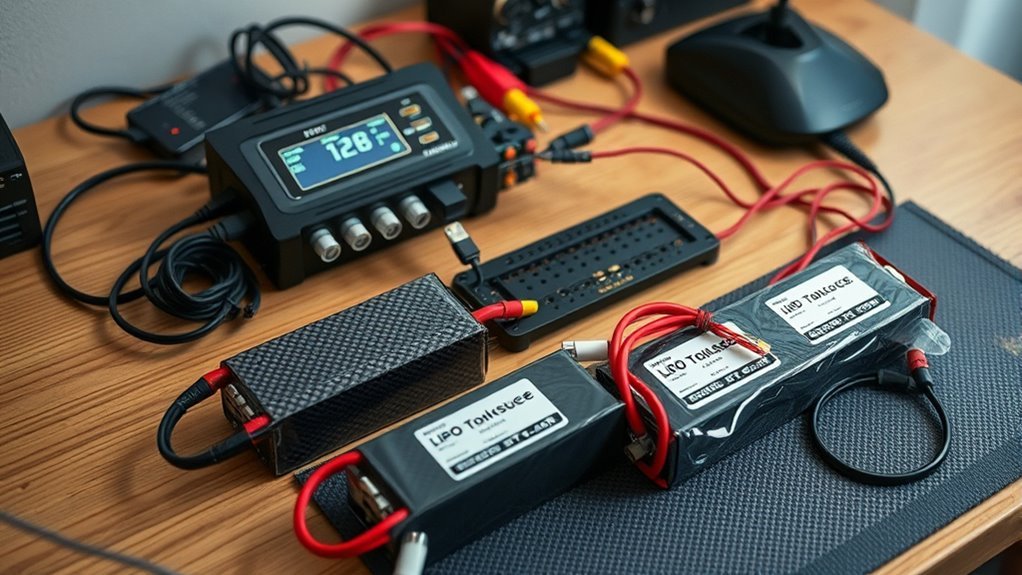
Charging LiPo batteries safely depends on controlling voltage, cell balance, and temperature. A proper balance charger keeps cell differences within 0.1V, while full charge should stop near 4.2V per cell, with slightly lower limits preferred for longer life. Storage at 3.8V reduces degradation, but parallel charging adds another layer of risk if packs are mismatched. The details matter, especially when a pack appears full but is not yet ready.
Charge LiPo Batteries Safely
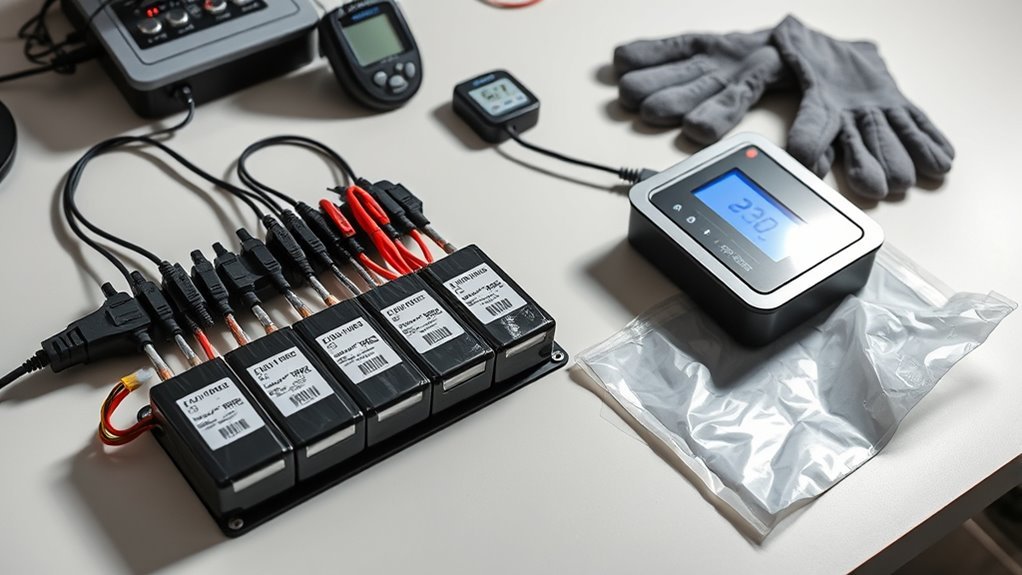
Charging LiPo batteries safely requires strict control of charge rate, cell balance, and supervision. A LiPo Battery should be charged at 1C current to limit heat and preserve cycle life; a 1300mAh pack consequently accepts 1.3A.
Before Charging, each cell Voltage should be measured. If any cell differs by more than 0.1V, the pack merits inspection before charge. A balance charger is essential because it maintains equal cell Voltage and reduces the likelihood of imbalance, thermal runaway, and premature failure.
Before charging, measure each cell voltage; imbalance beyond 0.1V calls for inspection, and a balance charger is essential.
Safety also depends on the charging environment: use non-flammable surfaces such as concrete or ceramic, and never leave the Battery unattended.
Parallel Charging is acceptable only when packs share the same cell count and nearly identical state of charge, within 0.1V, to avoid damaging current surges. Proper balance, charge discipline, and vigilant oversight support safer use and Storage.
Use the Right Charging Voltage
LiPo cells should be charged to 4.2 V per cell as the absolute safe limit, with charger settings matched to the pack’s cell count and balance charging enabled to keep each cell within specification.
For extended battery life, a lower peak of 4.15–4.17 V per cell is often preferred, as it reduces stress while maintaining practical usable capacity.
Charging temperature should remain below 45°C, and the charger configuration should always be verified against the battery’s type and rating before the process begins.
Safe Per-Cell Limits
Safe charging of a LiPo pack depends on strict per-cell voltage control: no cell should ever exceed 4.2V during charge, as doing so increases overheating risk and can trigger fire hazards.
For LiPo batteries, safe per-cell limits are enforced through balance charging, which keeps cell spread under 0.1V and improves charging safety. Before current is applied, each cell should be verified individually; voltage management prevents one weak cell from being pushed beyond its safe ceiling by a fully charged pack.
A practical target is 4.15-4.17V per cell, which reduces stress from internal resistance while preserving performance. Cells should never be driven below 3.0V, because chemical damage can become irreversible.
This disciplined approach supports liberation from failure, letting users charge multiple packs with confidence, precision, and control.
Storage Voltage Targets
For long-term storage, LiPo cells should be held at 3.80–3.85V per cell rather than at a full-charge level of 4.2V, since storing them fully charged accelerates chemical breakdown and reduces service life.
These storage voltage targets let LiPo batteries remain ready without unnecessary stress.
To store LiPo packs correctly, use a charger’s storage mode, which brings cells to the proper midpoint and preserves balance. This matters because voltage sag and internal resistance can worsen when packs are neglected or left charged.
Under ideal storage conditions, keep them cool, dry, and stable, ideally 15°C to 25°C.
Regularly check stored battery voltages every 4–6 weeks and top up if needed.
Disciplined charging LiPo practices protect capacity, extend longevity, and support battery freedom.
Balance Charge Every LiPo Pack
Balance charging equalizes the voltage of each cell in a multi-cell LiPo pack, reducing the risk of overcharging weaker cells and limiting conditions that can trigger thermal runaway.
A balance charger reads individual cell voltages through the balance tap and adjusts charge current to keep inter-cell differences within safe limits, typically below 0.10V.
For maximum safety and pack longevity, this procedure is normally performed every cycle, and it becomes mandatory after storage or deep discharge.
Balance Charging Benefits
A balance charger keeps every cell in a multi-cell LiPo pack aligned at the same voltage, reducing the risk that one weaker cell will be driven above the 4.20V safe limit during charging.
Balance charging supports cell health by limiting voltage drift and excessive internal resistance, two failures that accelerate degradation in a LiPo battery pack. Using a balance charger on every cycle gives precise cell monitoring and helps prevent thermal runaway, preserving ideal safety for users who charge packs regularly.
This practice is especially important after deep discharge or long storage, when imbalance grows. Without it, weaker cells can suffer performance issues, reducing flight time and shortening service life through the Walking Effect.
Routine balance charging protects both liberated use and long-term pack reliability.
Cell Voltage Equalization
Proper cell voltage equalization is essential for every multi-cell LiPo pack, because balanced charging keeps each cell at the same voltage and prevents one cell from exceeding the 4.20V safe limit during charge.
In practical use, cell voltage equalization relies on balance charging through a JST-XH lead, allowing the charger to read each cell voltages and correct mismatch from internal resistance differences. A pack showing more than 0.1V imbalance should be treated as suspect.
Regular balance charging after every third to fifth cycle, or after storage and deep discharge, preserves a battery management system’s balancing capability, limits voltage drift, and reduces capacity mismatch.
This disciplined process improves performance, extends cycle life, and lowers the probability of overheating or thermal runaway, a core principle in any thorough guide to safe LiPo care.
Parallel Charge LiPo Batteries Safely
Parallel charging LiPo batteries is safest when packs of the same cell count are used together, such as 4S with 4S, because mismatched series counts can create dangerous current surges and damage the cells. For safe operation, verify similar capacities and a close state of charge before connection. A cell checker should confirm each individual cell is within 0.1V, supporting controlled voltage equalization.
| Check | Limit | Why it matters |
|---|---|---|
| Cell count | Match exactly | Prevents surge |
| Capacity | Within 200mAh | Reduces imbalance |
| Cell voltage | Within 0.1V | Protects health |
A balance charger should be used with both discharge leads and balance leads attached simultaneously, allowing the packs to equalize while charging. Parallel charging is a convenience, not a shortcut; disciplined checks preserve LiPo batteries and support liberated, confident use.
Store LiPo Batteries at 3.8V
LiPo batteries should be placed into storage at 3.80V to 3.85V per cell, where chemical activity is minimized and long-term degradation slows. This storage voltage reduces reactive stress, preserves capacity, and supports longevity by limiting battery degradation during idle periods.
Store LiPo batteries at 3.80V to 3.85V per cell to minimize chemical activity and preserve long-term capacity.
For proper care, each pack should be kept in a cool dry place, ideally inside a LiPo bag or ammo box, away from sunlight and heat. A voltage check every 4-6 weeks confirms stability; if any cell drifts below 3.8V, it should be returned to the target range.
Maintaining this 8V-equivalent per two-cell pack mindset helps users keep packs ready without surrendering performance. When stored correctly, LiPo batteries can retain useful cycle life, often 200-300 cycles with disciplined handling.
Storage is not passive neglect; it is controlled preservation that protects freedom from premature replacement and wasted energy.
Know When a LiPo Pack Is Done
A LiPo pack kept at storage voltage can remain serviceable for a long time, but age and use eventually reduce its safety margin and performance.
In LiPo battery care, retirement is justified when internal resistance rises above 15–20 mOhm per cell, because voltage sag and heat then increase under load.
A puffed pack, or any swelling, is immediate battery damage and should be removed from service without delay.
Cells drift beyond 0.1V after a balance charge also signal failing cells and declining balance integrity.
If flight time falls below 60% of the pack’s original capacity, the pack is nearing end of life even if it still looks normal.
Never discharge completely below 3.0V per cell; that voltage floor prevents irreversible chemical damage.
A fully charged pack that no longer delivers stable output has entered retirement, and continued use only increases risk while reducing freedom to rely on the pack safely.
Frequently Asked Questions
Should I Charge or Balance My Lipo Battery?
Balance charging is recommended for LiPo safety because cell monitoring keeps peak voltage equal across cells, preserving battery lifespan.
Standard charging may offer higher charging speed, but balancing importance outweighs it when capacity management, discharge rates, or storage history are uncertain.
Among charging methods, a balance charger with temperature control reduces drift and protects performance.
For liberation from failure risk, the cell tap system should be used routinely.
Do You Need to Balance Lifepo4 Batteries in Parallel?
Usually not, but balancing can still matter. One study found LiFePO4 cells retain over 80% capacity after 2,000 cycles, highlighting LiFePO4 advantages for battery longevity.
In parallel, similar state of charge, cell matching, and voltage monitoring reduce surge risk. Safe charging techniques, thermal management, and safety precautions are wise when capacity differences, discharge rates, or aging packs exist.
That disciplined practice improves application suitability and preserves freedom from premature failure.
Can You Charge a Lipo With Just the Balance Lead?
No, a LiPo should not be charged with only the balance lead. Proper balance charging methods require both the main lead and balance lead, with suitable chargers providing voltage monitoring and safety precautions.
Using the balance lead alone can create common mistakes, reduce charging speed effects, weaken battery lifespan, and stress discharge rates.
In controlled charging environments, disciplined battery maintenance prevents imbalance, overheating, and thermal runaway, preserving safe, liberated operation.
Can I Charge Multiple Lipo Batteries in Parallel?
Yes—multiple LiPo packs can be charged in parallel, but only if hidden risks are controlled.
Parallel Charging requires matching cell count, similar Battery Capacity, and compatible Charger Compatibility; otherwise, currents can surge.
Safety Precautions include matching Charging Connectors, checking Voltage Monitoring within 0.1V per cell, and respecting Discharge Rates.
Balancing Importance remains critical. Proper setup shortens Charge Time, supports Battery Maintenance, and enables safer, freer charging without neglect.
Conclusion
To sum up, safe LiPo charging is a disciplined process in which even minor errors can ripple into dramatic failures. Every pack should be charged with the correct voltage, balanced carefully, and kept below 45°C to preserve performance and lifespan. Parallel charging is only safe with identical packs and strict oversight. For storage, 3.8V remains the prudent target, with regular voltage checks. When a pack is fully charged or damaged, it should be treated as a potential hazard immediately.
