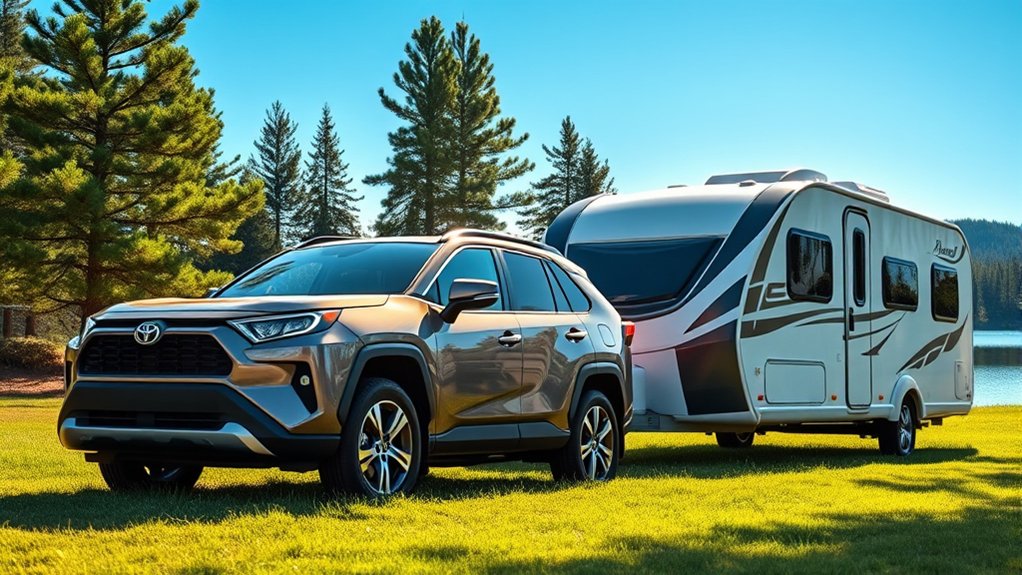
Can a Toyota RAV4 tow a caravan? Yes—many RAV4 models can tow a lightweight caravan, but the limit changes by model year, grade, drivetrain, country, and towing equipment. In the U.S., 2025 gas RAV4 models are rated at 1,500 pounds, the 2025 Hybrid at 1,750 pounds, and the 2025 Plug-in Hybrid at 2,500 pounds. For 2026 U.S. models, Toyota lists 1,750 pounds for all FWD versions and the LE AWD, while selected AWD grades are rated up to 3,500 pounds. Always compare the caravan’s actual loaded weight and hitch load with every limit for your exact vehicle.
Last updated: September 19, 2026.
Quick Answer
Yes, a Toyota RAV4 can tow a lightweight caravan when the caravan’s actual loaded weight, tongue or nose load, vehicle payload, axle loads, hitch rating, and combined weight all remain within the limits for that exact RAV4. Do not convert a towing rating from another country and assume it applies locally: for example, selected 2026 U.S. AWD RAV4s are rated up to 3,500 lb, while Toyota Australia lists 1,500 kg braked for 2026 AWD variants and 800 kg for 2WD variants.
Key Takeaways
- RAV4 towing capacity changes by model year, grade, drivetrain, powertrain, and country.
- Use the caravan’s actual loaded weight, not its empty tare weight or body length.
- Passengers, luggage, accessories, and hitch weight all consume the RAV4’s available payload.
- The 2026 U.S. RAV4 is hybrid or plug-in hybrid only; all FWD models and the LE AWD are rated at 1,750 lb, while selected AWD grades reach 3,500 lb.
- Trailer brakes, controllers, mirrors, towbar requirements, and maximum speeds depend on the vehicle, trailer, and local law.
- Accessories may improve control or durability, but they cannot raise Toyota’s published towing rating.
RAV4 Caravan Match at a Glance
| Vehicle Trailer Rating | Use the exact model year, grade, drivetrain, powertrain, market, and approved towing equipment |
| Actual Caravan Weight | Weigh the caravan in travel-ready condition with water, batteries, gas, food, luggage, bikes, and accessories aboard |
| Tongue or Nose Load | Keep the measured vertical hitch load within the vehicle, towbar, coupling, and trailer limits; it also consumes vehicle payload |
| Payload and Combined Weight | Add occupants, cargo, accessories, hitch load, and the trailer; stay within GVWR/GVM, axle ratings, and GCWR/GCM |
How Much Can a Toyota RAV4 Tow?
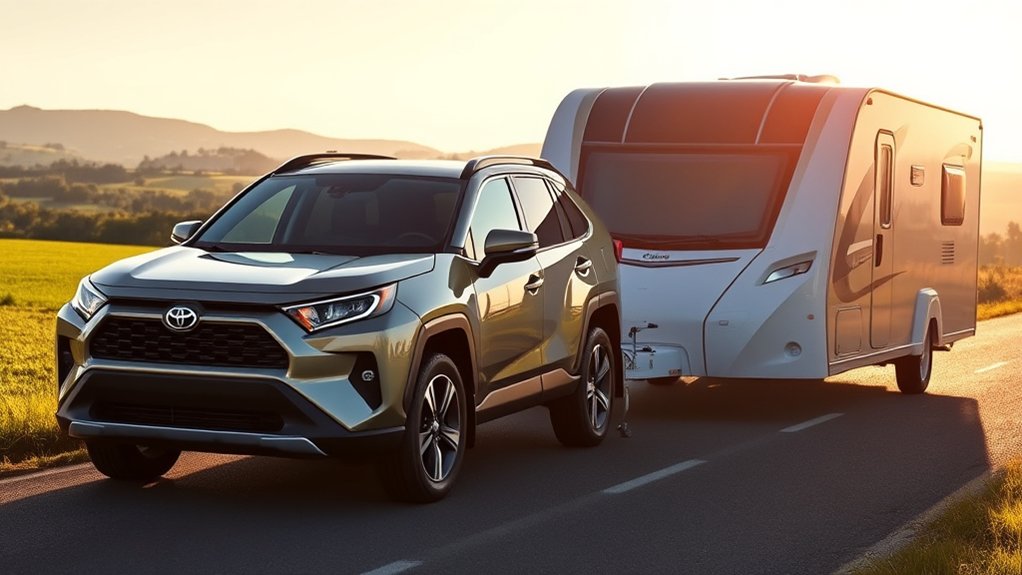
No single towing number applies to every Toyota RAV4. Ratings change with the model year, powertrain, drivetrain, grade, destination market, and installed towing equipment. Figures published in the United States cannot automatically be applied to a RAV4 sold in Australia, Canada, the United Kingdom, Europe, or another market.
If you need a broader year-by-year breakdown, see the RAV4 towing capacity by trim and year. This caravan guide focuses on matching those vehicle limits to a travel-ready caravan.
The following figures provide a current U.S.-market comparison. Confirm the final number in the documentation supplied for your exact vehicle before attaching a trailer.
| RAV4 version | Published U.S. towing figure | Important qualification |
|---|---|---|
| 2025 gas RAV4 | 1,500 lb, about 680 kg | U.S. 2025 gas grades are LE, XLE, XLE Premium, and Limited; Adventure and TRD Off-Road were not offered for MY2025 |
| 2025 RAV4 Hybrid | 1,750 lb, about 794 kg | Toyota’s U.S./Canada 2025 Hybrid owner’s manual lists a 1,750-lb Trailer Weight Rating |
| 2025 RAV4 Plug-in Hybrid | 2,500 lb, about 1,134 kg | Applies to the 2025 U.S. Plug-in Hybrid; do not transfer the figure to another market |
| 2026 U.S. RAV4 — all FWD models and LE AWD | 1,750 lb, about 794 kg | The redesigned 2026 U.S. lineup uses Hybrid or Plug-in Hybrid powertrains rather than a gas-only version |
| 2026 U.S. RAV4 — selected AWD grades | Up to 3,500 lb, about 1,588 kg | This is the range maximum and does not apply to every AWD configuration |
Toyota maintains official information for the 2025 gas RAV4, 2025 RAV4 Hybrid, and 2025 RAV4 Plug-in Hybrid. Toyota’s 2026 U.S. RAV4 launch information lists 1,750 pounds for all FWD models and the LE AWD and up to 3,500 pounds for selected AWD grades.
Note: “Up to 3,500 lb” is not the rating for every 2026 RAV4. Use the specification for your exact grade and drivetrain rather than the highest number advertised for the range.
Why Does RAV4 Towing Capacity Change by Country?
Towing ratings are homologated and published for specific markets, so converting pounds to kilograms does not convert one country’s legal or manufacturer-approved rating into another country’s rating. For example, Toyota Australia lists a 2026 RAV4 braked towing capacity of 1,500 kg for AWD variants and 800 kg for 2WD variants. Those numbers differ from current U.S. specifications even though the vehicles share the RAV4 name.
| 2026 example | Published figure | What it shows |
|---|---|---|
| U.S. selected AWD grades | Up to 3,500 lb | The U.S. maximum is configuration-specific |
| U.S. FWD and LE AWD | 1,750 lb | AWD alone does not guarantee the maximum rating |
| Australia AWD | 1,500 kg braked | Australian approval uses its own market specification |
| Australia 2WD | 800 kg braked | Drivetrain can materially change the local rating |
How to Find Your RAV4’s Exact Rating
Start with the towing or trailer section of your owner’s manual. Then check the official specification sheet for the correct model year, grade, drivetrain, powertrain, and destination market. Your Toyota dealer can also confirm vehicle-specific information from the VIN when published specifications are unclear.
Compare the vehicle’s limit with the ratings stamped on the towbar, receiver, hitch ball, ball mount, coupling, and trailer. The usable limit is always the lowest applicable rating.
Warning: Never use a higher internet figure from another trim, country, or model year. Exceeding a vehicle, hitch, axle, payload, or combined-weight rating can reduce control and may violate applicable laws or manufacturer instructions.
What Towing Terms Do You Need to Understand?
The headline towing capacity is only one part of the calculation. Caravan and vehicle labels use several terms, and the wording varies by country.
| Term | What it means | Why it matters |
|---|---|---|
| Tare or empty weight | The caravan’s stated empty weight under the manufacturer’s defined conditions | It usually excludes some or all water, food, luggage, batteries, gas, and accessories |
| Actual loaded weight | What the caravan weighs when prepared for travel | This is the number to compare with the RAV4’s trailer-weight limit |
| ATM, MTPLM, or trailer GVWR | The maximum permitted loaded weight of the caravan | It limits the caravan itself but does not prove that the RAV4 can tow it |
| Tongue or nose weight | The downward load applied to the hitch | It counts against payload and must remain within vehicle, hitch, and trailer limits |
| Vehicle payload | The allowed combined weight of occupants, cargo, accessories, and hitch load | A trailer may be below the towing limit while the RAV4 is still overloaded |
| GCWR or GCM | The maximum permitted combined weight of the loaded vehicle and loaded trailer | Both units must be considered together |
The number that matters is the caravan’s actual loaded weight, not its empty tare weight or body length.
For one current U.S. example, Toyota’s 2025 RAV4 Hybrid owner’s manual says the gross trailer weight should be distributed so that tongue weight is 9%–11%. That percentage is not a universal rule for every RAV4 sold worldwide, so use the requirement in your exact manual and stay below every vehicle, towbar, and coupling limit.
What Size Caravan Can a RAV4 Tow?
A RAV4 is generally better suited to lightweight campers than to conventional full-size caravans. However, a category name such as “compact,” “single-axle,” or “pop-top” does not guarantee compatibility. Two caravans of similar length can have very different loaded weights, nose loads, and aerodynamic demands.
| Caravan type | Possible suitability | What to verify |
|---|---|---|
| Teardrop or micro caravan | Often among the most practical choices | Loaded weight, hitch load, brakes, and storage added after purchase |
| Folding camper or lightweight trailer tent | May fit lower-capacity configurations | Water, kitchen equipment, batteries, gas cylinders, and luggage |
| Compact single-axle caravan | Some lightweight models may fit; many will not | Scale-confirmed loaded weight and the RAV4’s remaining payload |
| Pop-top or hybrid off-road caravan | Frequently too heavy for lower-rated RAV4s | Heavy chassis, batteries, water tanks, spare wheels, and off-road accessories |
| 16–18-foot caravan | Cannot be judged by length alone | Actual loaded weight, aerodynamic load, hitch weight, and all vehicle ratings |
For example, a U.S.-spec 2025 RAV4 Plug-in Hybrid is rated at 2,500 lb, about 1,134 kg. A caravan with a tare weight of 1,200–1,400 kg would already exceed that trailer-weight rating before water, food, batteries, gas, luggage, or accessories were added.
How Do You Check Whether a Caravan Is Compatible?
- Find the exact RAV4 trailer-weight rating. Use the correct owner’s manual and official specification for the model year, grade, drivetrain, powertrain, and market.
- Record every other vehicle limit. Note payload, vehicle gross weight, axle ratings, gross combined weight, and maximum hitch or tongue load where specified.
- Load the caravan as you will travel. Include water, food, gas, batteries, clothing, awnings, tools, bikes, and dealer-installed accessories.
- Measure the loaded caravan. A certified public scale gives a more reliable figure than subtracting estimated cargo from the caravan’s maximum rating.
- Measure or confirm hitch load. Include this load when calculating the RAV4’s remaining payload.
- Add the vehicle load. Count the driver, passengers, luggage, roof cargo, accessories, and hitch load.
- Check brakes and coupling equipment. Confirm that the trailer’s brakes, wiring, lights, breakaway device, safety connections, mirrors, and towbar comply with local rules.
- Use the lowest limit. The combination is unsuitable if it exceeds even one vehicle, trailer, axle, hitch, tyre, or legal rating.
Worked Example: A 2025 U.S. RAV4 Hybrid has a 1,750-lb Trailer Weight Rating. If a travel-ready trailer weighs 1,500 lb, Toyota’s 9%–11% tongue-weight guidance for that model equals about 135–165 lb. That tongue load also contributes to the vehicle’s load, so a 1,500-lb trailer is not automatically compatible until payload, axle, hitch, and combined-weight limits are checked.
Pro Tip: Weigh the fully loaded RAV4 and caravan before the first long trip and after major equipment changes. Added batteries, water tanks, bike carriers, or storage boxes can materially change both total and hitch weight.
RAV4 Caravan Towing Checklist
Complete the following checks before leaving:
- Tyres: Inspect for damage and inflate the RAV4 according to its placard or owner’s manual. Use the caravan or tyre manufacturer’s specification for the trailer tyres.
- Wheel fasteners: Check caravan wheel-nut torque at the intervals specified by the caravan manufacturer.
- Coupling: Confirm the hitch is fully engaged and secured.
- Safety connections: Attach the required chains, cables, secondary coupling, or breakaway cable correctly.
- Lights and wiring: Test indicators, brake lights, tail lights, and electric-brake connections where fitted.
- Load: Keep heavy items low, secure all cargo, and maintain the caravan manufacturer’s approved load distribution.
- Mirrors: Fit legal towing mirrors when the caravan blocks the required rearward view.
- Fluids and servicing: Follow Toyota’s maintenance schedule and address warning lights, leaks, or cooling problems before towing.
The UK government’s official towing safety checks also cover coupling security, electrical connections, tyres, load distribution, and what to do if a trailer begins to snake.
How Should You Drive a RAV4 With a Caravan?
- Accelerate, steer, and brake smoothly.
- Leave substantially more following distance than you would when driving without a trailer.
- Reduce speed before bends, descents, crosswinds, and rough surfaces.
- Use transmission or drive settings only as directed by the RAV4 owner’s manual.
- Plan fuel or charging stops, parking, and turning space before entering confined areas.
- Stop periodically to inspect the coupling, tyres, load, and safety connections.
If the caravan starts to sway, hold the steering wheel steadily, ease off the accelerator, and allow the combination to slow gradually. Avoid sudden steering or harsh braking. Follow the trailer-brake and vehicle manufacturer’s instructions if a manual brake-control function is available.
2025 U.S. RAV4 Hybrid example: Toyota’s owner’s manual says not to tow during the first 500 miles (800 km). For the next 500 miles while towing, it instructs the driver to stay below 45 mph (72 km/h) and avoid full-throttle acceleration. The same manual also says not to exceed 65 mph (104 km/h), the posted towing limit, or the trailer manufacturer’s limit, whichever is lower. Other model years and markets may have different instructions.
Driver-assistance warning: Do not assume every assistance system should remain active while towing. The 2025 U.S. RAV4 Hybrid manual instructs drivers to disable several systems while towing, including Lane Tracing Assist and Dynamic Radar Cruise Control, with additional towing-related instructions for other equipped systems. Follow the manual for your exact vehicle because newer or different RAV4 configurations may use different procedures.
Brakes, Towbars, and Towing Accessories
Every component must be compatible with the RAV4 and rated for the load. Equipment requirements also vary by country and trailer design. For receiver and fitment details, see the guide to RAV4 tow-hitch fitment and receiver options.
| Equipment | Purpose | Important limitation |
|---|---|---|
| Rated towbar or receiver | Connects the caravan to the vehicle | A higher hitch rating does not increase the RAV4’s vehicle rating |
| Correct ball mount and hitch ball | Provides the approved coupling size and height | Every part must have an adequate rating and correct fit |
| Trailer wiring | Operates lights and supported trailer functions | Use a vehicle-compatible harness installed correctly |
| Brake controller | Controls compatible electric trailer brakes | Not all caravans use electric brakes; follow local law and brake-system instructions |
| Weight-distribution hitch | Redistributes some hitch load when used in an approved application | Use only when Toyota and the receiver manufacturer expressly permit it for the exact vehicle |
| Towing mirrors | Improves the required view beside and behind the caravan | Mirror requirements depend on caravan width and local law |
Warning: Do not install a weight-distribution hitch, brake controller, or aftermarket receiver based only on general RAV4 advice. Confirm compatibility with your exact model, powertrain, structure, wiring system, receiver instructions, and local regulations.
Can You Increase a RAV4’s Towing Capacity?
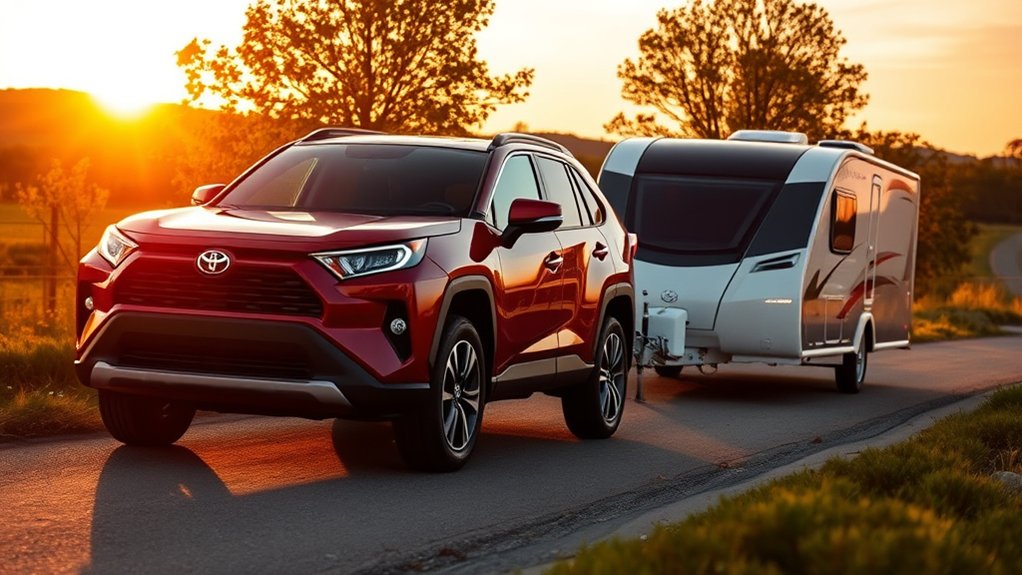
No aftermarket upgrade can increase the manufacturer-approved towing capacity printed for your RAV4. A receiver, cooler, suspension part, tyre change, or brake upgrade may change how a vehicle behaves or handles a specific accessory, but it does not rewrite Toyota’s vehicle rating.
- Keep the RAV4 serviced: Follow Toyota’s maintenance schedule and any additional inspection guidance that applies to towing or severe use.
- Protect the cooling system: Keep air inlets clear and investigate unusual temperatures, warning messages, smells, or loss of performance immediately.
- Use correct tyre pressures: Follow the driver-door placard and owner’s manual rather than applying a universal 30–35 PSI range.
- Choose approved equipment: Use a properly rated towbar, ball mount, wiring harness, and braking setup.
- Reduce unnecessary load: Extra vehicle cargo and accessories consume payload even if the caravan remains below its trailer-weight limit.
- Consider aerodynamic demand: Headwinds and a tall caravan can increase power demand and energy consumption without changing the measured trailer weight.
An auxiliary transmission or fluid cooler should not be treated as a universal RAV4 upgrade. Gas, Hybrid, and Plug-in Hybrid models use different systems. Ask Toyota or a qualified specialist whether additional cooling equipment is approved and useful for your exact powertrain.
What Does an Independent RAV4 Caravan Tow Test Show?
A useful real-world example comes from Practical Caravan’s March 2025 RAV4 Plug-in Design tow test. The tested UK-spec vehicle had a published 1,500-kg maximum towing weight and a 70-kg maximum noseweight. The reviewer towed a 1,250-kg caravan and reported generally stable behavior, while noting some side-to-side movement in crosswinds.
The test also illustrates why a headline towing capacity is not the only useful number. The 70-kg noseweight limit required careful caravan loading even though the 1,250-kg test trailer remained below the vehicle’s 1,500-kg trailer-weight maximum. That is the same principle this guide applies to payload, hitch load, axle limits, and combined weight.
Use independent tests to understand stability, visibility, hill starts, fuel or energy use, and loading behavior. Do not use a favorable road test to raise a published towing, payload, hitch, axle, or combined-weight limit.
Frequently Asked Questions
What features can help towing safety in a Toyota RAV4?
Features such as anti-lock brakes, stability control, traction control, Trailer Sway Control where equipped, reversing cameras, and driver-assistance systems may support the driver. Their availability and towing instructions vary by model year and configuration. They cannot correct an overloaded caravan, excessive speed, poor hitch weight, or an incorrectly fitted coupling.
Can I use a weight-distribution hitch with my RAV4?
Use one only when the owner’s manual and the manufacturer of the installed towbar or receiver permit it for your exact vehicle and application. A weight-distribution hitch changes the forces placed on the vehicle and coupling, so it is not a universal RAV4 upgrade.
How do I determine my RAV4’s actual towing capacity?
Check the towing section of the owner’s manual and the official specification for the exact model year, grade, drivetrain, powertrain, and market. Confirm the result with Toyota using the VIN when necessary. The lowest rating among the vehicle, towbar, receiver, ball mount, coupling, axle, payload, and combined-weight limits controls the setup.
How much tongue weight should a RAV4 trailer have?
It depends on the exact RAV4 and market. As one verified example, Toyota’s 2025 U.S. RAV4 Hybrid owner’s manual specifies tongue weight of 9%–11% of gross trailer weight. A 1,500-lb trailer would therefore correspond to about 135–165 lb, but the measured load must also remain within the vehicle, hitch, coupling, and payload limits.
What tyre pressure should I use while towing with a RAV4?
Use the pressure shown on the RAV4’s tyre placard or specified in its owner’s manual for the installed tyres and load. Inflate the caravan tyres according to the caravan or tyre manufacturer’s guidance. Check pressures when the tyres are cold unless the manufacturer instructs otherwise.
Are towing accessories available specifically for the RAV4?
Depending on the market and model year, compatible equipment may include a rated towbar or receiver, wiring harness, ball mount, hitch ball, towing mirrors, and brake-controller installation hardware. Every component must be compatible with the exact RAV4 and rated for the intended load.
Does a caravan’s tare weight tell me whether the RAV4 can tow it?
No. Tare weight describes an empty or partly equipped caravan under defined conditions. You must compare the RAV4’s limit with the caravan’s actual travel weight after adding water, batteries, gas, food, luggage, accessories, and other cargo.
Can a RAV4 tow a 16–18-foot caravan?
Possibly, but length alone cannot answer the question. Check the caravan’s measured loaded weight, tongue or nose load, braking system, aerodynamic profile, and the RAV4’s remaining payload against every applicable vehicle and hitch rating. Many caravans in that size range will be too heavy for lower-capacity configurations.
Does the 2026 RAV4 tow more than the 2025 model?
Some 2026 U.S. RAV4 configurations do. Toyota lists 1,750 lb for all 2026 U.S. FWD models and the LE AWD, while selected AWD grades reach 3,500 lb. For comparison, the 2025 U.S. gas RAV4 is rated at 1,500 lb, the Hybrid at 1,750 lb, and the Plug-in Hybrid at 2,500 lb. The exact figure still depends on configuration and market.
Sources
- Toyota USA: 2026 RAV4 — current U.S. lineup, powertrains, grades, and towing-capacity information.
- Toyota USA: 2025 RAV4 — official gas-model lineup and 2025 grade information.
- Toyota Owners: 2025 RAV4 Hybrid Owner’s Manual — Trailer Weight Rating, tongue-weight guidance, break-in, driving, and towing precautions.
- Toyota USA: 2025 RAV4 Plug-in Hybrid — official Plug-in Hybrid model information.
- Toyota Australia: 2026 RAV4 — 2WD and AWD braked towing-capacity examples showing market-specific ratings.
- Practical Caravan: RAV4 Plug-in Design Tow Test — independent 2025 towing observations with a 1,250-kg caravan.
- UK Government: Tow a Trailer With a Car Safety Checks — coupling, tyre, loading, electrical, and trailer-sway safety guidance.
Conclusion
A Toyota RAV4 can tow a lightweight caravan when the complete combination remains within every applicable rating. The important numbers are the rating for the exact vehicle, the caravan’s measured travel-ready weight, its tongue or nose load, the RAV4’s remaining payload, axle limits, hitch limits, and the permitted combined weight.
Do not choose a caravan by body length, empty weight, or another owner’s RAV4 alone. First identify your exact model year, grade, drivetrain, powertrain, and country specification. Next, weigh the caravan as it will actually travel. Finally, confirm payload, hitch, axle, braking, and combined-weight limits before buying or connecting the trailer.
