
The safest way to clean a Toyota RAV4 Limited engine bay is with a controlled, low-moisture wipe-down rather than a hose or pressure washer. Toyota owner guidance warns against applying water inside the engine compartment, so remove loose debris first, apply automotive-safe cleaner to a towel or soft nylon brush, wipe residue with a barely damp microfiber towel, and dry the compartment fully before starting the vehicle.
Last updated: September 19, 2026
Method note: This guide is based on Toyota owner information and U.S. EPA vehicle-washing guidance. It does not claim hands-on testing across every RAV4 model year or powertrain.
Quick Answer
To clean a Toyota RAV4 engine bay safely, switch the vehicle off, let it cool, remove loose debris, and apply an automotive-safe cleaner to a towel or soft nylon brush rather than spraying the compartment. Remove residue with a lightly dampened, thoroughly wrung-out microfiber towel, dry the area completely, and do not hose or pressure-wash the engine bay.
Key Takeaways
- Check the owner’s manual for your exact RAV4 model year and powertrain before beginning.
- Use a low-moisture, spray-to-towel method instead of a hose or pressure washer.
- Do not remove the 12-volt battery unless the manual or a repair procedure specifically requires it.
- Use soft nylon brushes and microfiber towels; do not use stainless-steel brushes.
- Stop and obtain professional help if you find an active leak, fuel odor, damaged wiring, battery damage, or a warning light.
At a Glance
| Safest Method | Dry debris removal, cleaner applied to a towel or soft brush, then a barely damp wipe and thorough drying |
| Best For | Dust, leaves, light oily film, fingerprints, and routine cosmetic inspection |
| Keep Dry | Air-intake openings, exposed electrical connections, fuse-box interiors, alternator openings, and hybrid high-voltage components |
| Stop and Diagnose | Active leaks, fuel odor, damaged wiring or connectors, battery damage, smoke, sparking, or a new warning message |
Warning: Toyota owner guidance warns not to apply water inside the engine compartment because electrical components may catch fire. This guide therefore does not recommend a pressure washer, garden-hose rinse, or steam cleaner for the engine bay. Do not direct forceful compressed air into connectors, seals, or electronic modules, and never handle hybrid high-voltage components or remove their protective covers.
What Can You Safely Clean in a RAV4 Engine Bay?
Use this quick decision guide before applying any cleaner. The goal is to clean accessible cosmetic surfaces without turning a detailing job into electrical or mechanical work.
| Area | Safest approach | When to stop |
| Plastic covers and painted ledges | Cleaner on a towel or soft nylon brush; follow with a barely damp wipe | Stop if the cleaner stains, softens, or discolors the finish |
| Hoses and wiring-loom exteriors | Light towel cleaning only when the parts are intact | Stop for cracks, fraying, exposed conductors, or loose connectors |
| Alternator, fuse box, connectors, and modules | Prefer a dry towel or dry soft brush; keep cleaner and water out of openings | Stop for trapped moisture, corrosion, damaged seals, or open connectors |
| Air intake or exposed air filter | Keep the opening dry and cover it loosely if cleaner could drip nearby | Stop if water or cleaner enters the intake path |
| Orange high-voltage cables, inverter covers, or service-plug areas | Do not touch, disconnect, remove covers, or clean underneath | Use qualified hybrid service if contamination or damage is near high-voltage equipment |
Why Cleaning Your Engine Bay Matters
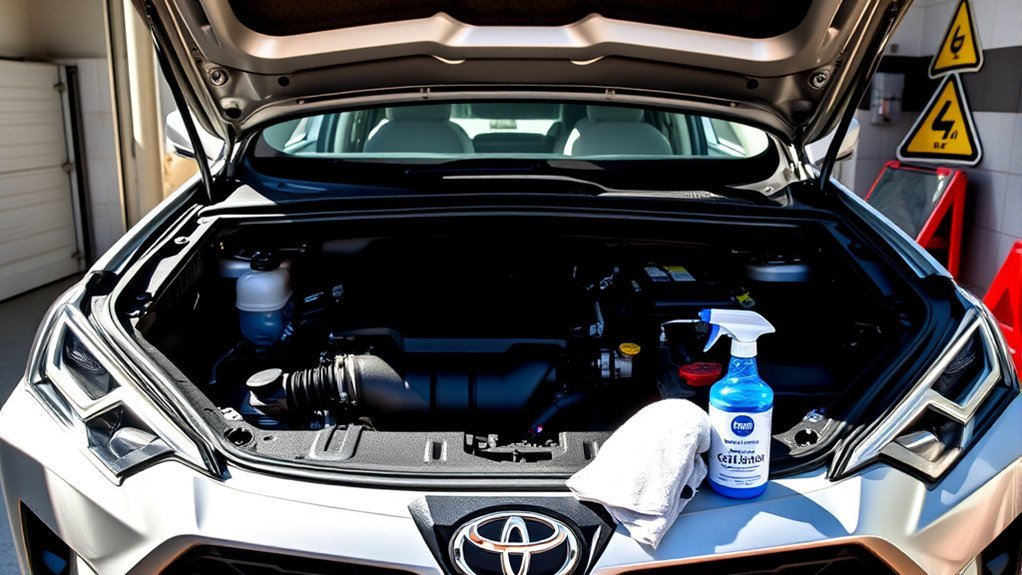
A clean engine bay does not automatically increase horsepower, fuel economy, or engine life. Its main value is visibility. Removing leaves, dust, oily film, and animal nesting material makes it easier to inspect hoses, wiring, fluid reservoirs, fasteners, and surrounding surfaces.
Cleaning may help you notice:
- Fresh oil, coolant, washer-fluid, or battery residue
- Cracked hoses or damaged wiring insulation
- Loose caps, clips, covers, or weather seals
- Leaves packed near the windshield cowl
- Rodent nests, droppings, or chewed wires
- Corrosion around the 12-volt battery terminals
Rule of thumb: Use only enough moisture to lift dirt without forcing liquid into electrical components.
Cleaning is not a substitute for repair. If you find an active leak, fuel odor, melted wiring, a swollen battery, or damaged electrical connectors, stop and have the vehicle inspected before driving.
What Do You Need to Clean a RAV4 Engine Bay?
Gather the supplies before opening the hood. Choose products labeled safe for automotive plastics, painted metal, rubber, and wiring insulation.
- Nitrile or chemical-resistant gloves
- Safety glasses
- Several clean microfiber towels
- Soft nylon detailing brushes in two or three sizes
- A vacuum with a crevice tool or a low-powered hand blower
- An automotive all-purpose cleaner or diluted engine-bay cleaner
- A spray bottle for controlled application
- A small container of clean water for dampening towels
- Foam swabs or microfiber-wrapped plastic tools for narrow gaps
- Absorbent pads or old towels to catch drips
- Optional plastic bags and reusable ties for vulnerable components
- An under-hood plastic or rubber protectant, if desired
Do not use gasoline, brake cleaner, carburetor cleaner, oven cleaner, bleach, strong alkaline household cleaner, or another aggressive solvent for general engine-bay detailing. Do not use a stainless-steel or wire brush. Metal bristles can scratch finishes, damage labels and insulation, or contact electrical terminals.
Note: Test the cleaner on a small, inconspicuous area first. Follow its dilution, dwell-time, ventilation, protective-equipment, and surface-compatibility instructions. An EPA Safer Choice product intended for outdoor use can reduce environmental risk, but it must still be compatible with automotive materials.
How Do You Prepare a RAV4 Engine Bay for Cleaning?
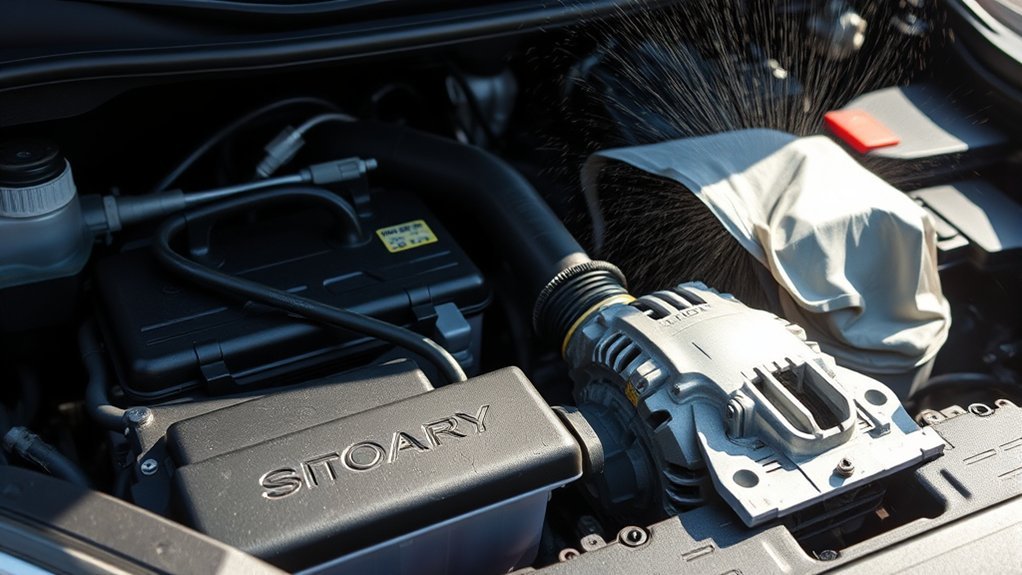
Park on a level surface, select Park, apply the parking brake, switch the vehicle completely off, remove the key or keep the smart key away from the vehicle, and let the engine compartment cool until every surface you plan to touch is safe to handle.
Confirm the exact year and powertrain before proceeding. For U.S. models, the 2025 RAV4 Limited was sold with either a gasoline or hybrid powertrain, while the redesigned 2026 RAV4 Limited is hybrid. Toyota’s 2026 RAV4 Plug-in Hybrid uses SE, Woodland, XSE, and GR SPORT grades rather than Limited. Use Toyota’s manual lookup to identify the instructions for your exact vehicle.
2026 model-year note: The U.S.-market 2026 RAV4 lineup is electrified. The Limited grade is part of the hybrid lineup, while the 2026 Plug-in Hybrid has separate grades. This matters because the under-hood layout and high-voltage components differ by powertrain.
Warning: On a hybrid or plug-in hybrid, do not touch, disconnect, clean underneath, or remove covers from high-voltage components. Do not handle service plugs or attempt to clean damaged high-voltage wiring. Have a Toyota dealer or qualified hybrid technician address contamination in those areas.
Should You Disconnect the 12-Volt Battery Before Cleaning?
You normally do not need to remove or disconnect the 12-volt battery for a low-moisture cosmetic cleaning. Keeping it connected avoids unnecessary loss of settings and possible feature reinitialization. Toyota owner information notes that power-back-door operation may need initialization after the battery has been disconnected and reconnected.
Disconnect the battery only when the owner’s manual, a repair procedure, or a qualified technician specifically instructs you to do so. If disconnection is required, review Toyota’s battery-disconnection guidance. Toyota’s general replacement procedure starts by disconnecting the negative cable first. For a separate battery-service procedure, see how to change a Toyota RAV4 battery.
Do not disconnect a battery simply to compensate for spraying water around the engine. Battery disconnection does not make water intrusion safe and does not protect every electronic module or connector.
What Should You Cover Before Cleaning?
Because this guide uses very little moisture, extensive wrapping should not be necessary. However, loosely cover vulnerable areas when their design leaves them exposed or when cleaner could drip onto them.
Potential areas include:
- The alternator
- The fuse and relay box
- Exposed aftermarket electrical connections
- An exposed or aftermarket air filter
- The air-intake opening
- Damaged, loose, or partially disconnected plugs
- The positive jump terminal or exposed battery terminals
Do not seal hot parts in plastic, and remove every bag or cover before starting the vehicle. Do not unplug sensors, ignition coils, or wiring connectors merely to clean around them. If the airbox itself needs service rather than cosmetic wiping, use the separate Toyota RAV4 engine air filter guide.
How Do You Clean a Toyota RAV4 Engine Bay Step by Step?
Before applying cleaner, inspect the engine bay under good lighting. Do not clean over an unidentified wet spot. Blot it with a white towel and determine whether it may be oil, coolant, fuel, battery electrolyte, or another vehicle fluid.
- Remove loose debris. Pick out large leaves by hand, then use a vacuum and soft brush around the cowl, hood hinges, plastic covers, and accessible ledges. Avoid pushing debris into openings.
- Photograph the engine bay. A quick reference photo can help you confirm that caps, covers, bags, and clips are returned to their original positions.
- Spot-test the cleaner. Test an inconspicuous section of plastic or painted metal and check for discoloration.
- Apply cleaner to the tool. Spray the product onto a microfiber towel or nylon brush rather than broadcasting it across the engine bay.
- Work one small area at a time. Clean plastic covers, painted ledges, brackets, hoses, and wiring looms gently.
- Agitate stubborn film. Use a soft nylon brush with light pressure. Do not scrub identification labels, exposed terminal surfaces, drive belts, pulleys, insulation, or delicate connector seals.
- Do not allow cleaner to dry. Wipe each section before moving to the next one.
Pro Tip: Fold each microfiber towel into quarters. Use one clean face for each pass, then refold it. This prevents dissolved grease from being spread back across the engine bay.
Do not spray cleaner toward the air intake, alternator, fuse box, ignition components, battery vents, belt path, pulleys, or electrical connectors. The flywheel is not an exposed detailing surface and should not be part of routine engine-bay cleaning.
How Do You Remove Cleaner Without Rinsing the Engine Bay?
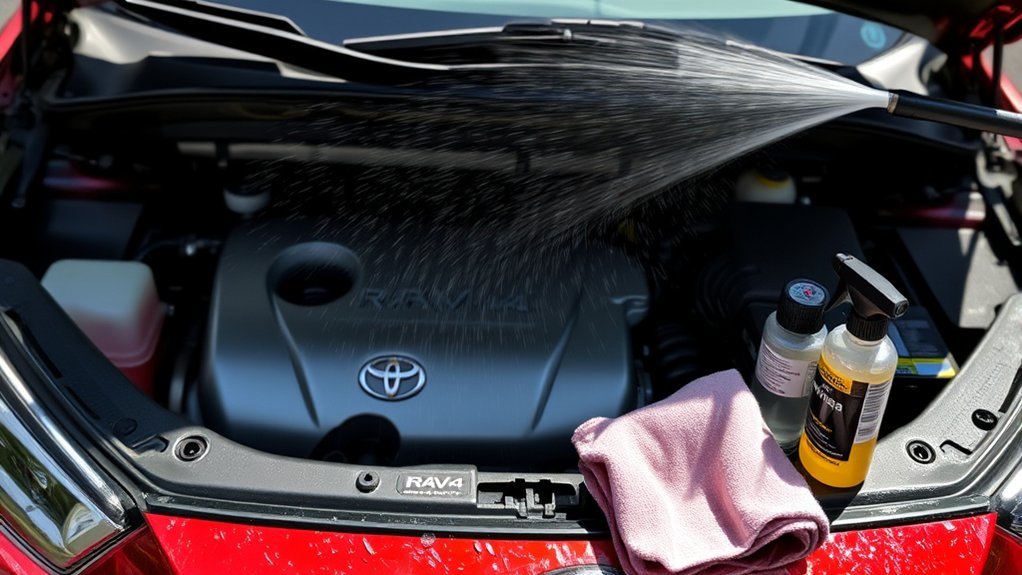
Toyota’s vehicle-care guidance warns against applying water inside the engine compartment. That vehicle-specific warning is stricter than many generic detailing guides that allow a low-pressure rinse, so this RAV4 procedure removes cleaner with towels instead of a hose or pressure washer.
The warning appears in Toyota RAV4 owner information, including the RAV4 Hybrid vehicle-care instructions. Check the manual for your exact year before cleaning because component layouts and powertrains vary.
How Much Moisture Should You Use?
Lightly dampen a clean microfiber towel with water and wring it out until it no longer drips. Wipe the cleaned area to remove product residue, then follow immediately with a dry towel.
For textured plastic, touch the damp towel to a nylon brush and work the area gently. This transfers a small amount of moisture to the brush without spraying liquid through the compartment.
Do not use:
- A pressure washer at any distance
- A garden hose, even on a mist or shower setting
- A pump sprayer that saturates the compartment
- A steam cleaner around wiring, sensors, seals, or electronics
- Forceful compressed air that could drive moisture or debris into connectors
How Do You Clean Hard-to-Reach Areas?
Wrap a microfiber towel around a smooth plastic detailing tool to reach narrow ledges. Foam swabs are useful around embossed lettering, bolt heads, and plastic trim seams.
Do not push tools beneath electrical connectors, pry wire looms away from their clips, or force a towel into the belt and pulley area. If a space cannot be reached without disconnecting or moving a component, leave it alone or have it professionally detailed.
How Should You Clean Around Electrical Components?
Clean around the alternator, fuse box, battery terminals, connectors, and electronic modules with a dry towel or dry brush whenever possible. If oily contamination is present directly on an electrical component, do not saturate it with a general-purpose cleaner.
Stop if you find:
- A connector that is open, cracked, or partly detached
- Green or white corrosion inside an electrical connection
- Frayed, melted, or chewed wiring
- Water already trapped inside a fuse-box cover
- A battery that is swollen, leaking, cracked, or heavily corroded
These conditions require diagnosis rather than further detailing.
How Do You Dry a Toyota RAV4 Engine Bay?
Use dry microfiber towels to remove all visible moisture and cleaner. Pay particular attention to horizontal ledges, bolt recesses, reservoir caps, the battery tray, fuse-box edges, wiring channels, and the base of the windshield cowl.
A small hand blower may be used on its lowest setting to move loose droplets from open ledges, but do not aim high-pressure air directly into connectors, vents, seals, bearings, or electronic modules.
Leave the hood open in a shaded, ventilated area until no visible moisture remains. Drying time varies with temperature, humidity, how much moisture was used, and the number of recesses or textured surfaces in the compartment.
Do not use a heat gun, open flame, high-temperature hair dryer, or another concentrated heat source. Heat can deform plastics and seals and may ignite flammable residue.
How Do You Finish Detailing the RAV4 Engine Bay?
Once the surfaces are clean and completely dry, perform a final cosmetic pass:
- Buff painted ledges and plastic covers with a clean microfiber towel.
- Use a dry detailing brush to remove lint from textured surfaces.
- Clean the underside of the hood with cleaner applied to a towel, keeping liquid away from the hood insulation.
- Remove every protective bag, tie, towel, and absorbent pad.
- Return removable cosmetic covers only if they were removed according to the owner’s manual and all fasteners are intact.
Avoid glossy or greasy dressings on belts, pulleys, caps, pedals, reservoirs, electrical connectors, battery terminals, or surfaces that may become hot. Excess dressing attracts dust and can make future leak inspection more difficult.
Can You Use Plastic Restorer in a RAV4 Engine Bay?
A plastic or rubber protectant is optional. Select a water-based product whose label specifically states that it is suitable for automotive under-hood plastics and rubber.
- Confirm the surface is clean, cool, and completely dry.
- Apply a small amount of product to a microfiber applicator rather than spraying it across the compartment.
- Spread a thin, even layer over cosmetic plastic covers and appropriate rubber surfaces.
- Keep the product away from belts, pulleys, electrical connections, engine labels, hot exhaust components, and fluid caps.
- Allow the specified dwell time, then buff away every trace of excess product.
Do not assume every “restorer” provides UV protection. Use that description only when it appears on the product label, and follow the manufacturer’s instructions.
What Should You Avoid When Cleaning a RAV4 Engine Bay?
- Using a pressure washer or hose. Water can enter connectors, modules, intake components, or other areas that are difficult to dry.
- Disconnecting the battery unnecessarily. This may erase settings or require vehicle-feature initialization without making wet cleaning safe.
- Cleaning a hot engine. Hot surfaces can cause burns, evaporate cleaner too quickly, and expose products to temperatures outside their intended range.
- Using a wire or stainless-steel brush. Metal bristles can scratch coatings, damage insulation, and contact electrical terminals.
- Spraying cleaner indiscriminately. Apply it to a towel or brush so you can control exactly where it goes.
- Cleaning over an active leak. Degreasing can hide useful evidence and allow a mechanical problem to continue.
- Removing connectors or hybrid covers. Routine cosmetic cleaning does not justify disturbing electrical systems.
- Applying too much dressing. Heavy residue traps dirt and can contaminate belts or hot components.
- Allowing runoff into a storm drain. Vehicle-cleaning residue may contain detergent, oil, metals, and hydrocarbons.
Note: Work over absorbent pads or towels and keep cleaner residue out of streets and storm drains. The U.S. EPA’s vehicle-washing guidance explains that wash water can carry detergent, metals, grease, and hydrocarbons. Follow local requirements when disposing of contaminated towels or absorbent material.
What Should You Check Before Starting the RAV4?
Because routine low-moisture detailing does not require battery removal, most owners will not need to reattach the battery. Whether the battery remained connected or was disconnected under a model-specific procedure, complete the following checks before switching the vehicle on.
Check All Connections and Covers
- Confirm that no connector, hose, wire loom, cap, dipstick, or reservoir lid was loosened.
- Verify that the air-filter housing and intake duct are closed and properly seated.
- Check that the fuse-box cover is latched.
- Remove all plastic bags, towels, ties, brushes, and tools.
- Confirm that cosmetic engine covers and clips are secure.
- Make sure nothing is resting near belts, fans, pulleys, or hot exhaust components.
Do not claim to have “checked the spark plugs” unless the vehicle was being serviced for another reason. Ignition components should not be removed during routine engine-bay cleaning.
Inspect for Moisture or Cleaner Residue
Use a bright flashlight to inspect the alternator area, fuse-box perimeter, battery tray, wiring channels, connector tops, air-intake housing, and recesses in plastic covers.
Blot any visible moisture with a dry towel and allow more air-drying time. Do not start the vehicle while cleaner is pooled on a component or while a protective covering remains installed.
Perform a Careful Post-Clean Start Check
Once the engine bay is dry and clear of tools, start the vehicle normally. On a hybrid or plug-in hybrid, confirm that the READY indicator appears as expected.
Observe the vehicle without reaching into the engine bay:
- Listen for unusual squealing, rattling, or rough running.
- Check the instrument panel for new warning lights or messages.
- Look for smoke, steam, sparking, or a new fluid leak.
- Notice any fuel, burning-plastic, or strong chemical odor.
If the vehicle runs roughly, will not enter READY mode, displays a warning, or has an unusual odor, switch it off. Do not repeatedly restart it. Check for a forgotten cover or obvious moisture, then contact a Toyota dealer or qualified technician if the cause is not immediately clear.
Related Guides
Frequently Asked Questions
Can I use a pressure washer on my Toyota RAV4 engine bay?
No. Toyota warns against applying water inside the engine or motor compartment. A pressure washer can force moisture past seals and into connectors, sensors, modules, the alternator, or the air intake. Use cleaner applied to a towel or soft brush, followed by a damp-towel wipe.
How often should I clean my RAV4 engine bay?
Toyota does not publish a universal six-month cosmetic-cleaning interval. Inspect the engine bay during routine maintenance and clean it when leaves, dust, animal nesting material, road residue, or oily film makes inspection difficult. Vehicles used on dusty roads or parked beneath trees may need attention more often.
Is it safe to use water around electrical components?
Avoid spraying or pouring water into the engine bay. For residue removal, use a microfiber towel that has been lightly dampened and thoroughly wrung out. Clean electrical housings, connector exteriors, and fuse-box surfaces with a dry towel or dry brush whenever possible.
What degreaser is best for a Toyota RAV4 Limited?
Use an automotive cleaner labeled safe for painted metal, plastic, rubber, and wiring insulation. Follow its dilution and dwell-time instructions and spot-test it first. Avoid aggressive solvents and highly alkaline household cleaners. Apply the product to a towel or nylon brush instead of spraying the entire compartment.
Can I clean the engine bay without removing the battery?
Yes. Battery removal is normally unnecessary for a low-moisture cosmetic detail. Keep the vehicle switched off, avoid spraying the battery and electrical components, and use controlled towel application. Disconnect the battery only when your model-specific manual or a qualified repair procedure requires it.
What should I cover before cleaning a RAV4 engine bay?
With this low-moisture method, extensive wrapping is usually unnecessary. Loosely protect the alternator, fuse and relay box, exposed aftermarket electrical connections, exposed air filters or intake openings, damaged or partly disconnected plugs, and exposed battery or jump terminals when cleaner could drip onto them. Remove every cover before starting the vehicle.
Can I clean a RAV4 Hybrid or Plug-in Hybrid engine bay myself?
You may remove accessible loose debris and wipe ordinary cosmetic surfaces, but do not touch high-voltage components, remove their covers, disconnect service plugs, or clean damaged high-voltage wiring. Stop and seek qualified service when contamination is near high-voltage equipment. For U.S. 2026 models, note that the Limited grade is hybrid, while the Plug-in Hybrid uses different grade names.
What should I do if the RAV4 runs roughly or shows a warning after cleaning?
Switch the vehicle off and do not keep restarting it. Check for visible moisture, a forgotten plastic cover, a loose intake connection, or a disturbed cap or connector. Allow additional drying time. If the warning or rough running remains, have the vehicle inspected by a Toyota dealer or qualified technician.
Conclusion
The safest way to clean a Toyota RAV4 Limited engine bay is to control moisture from start to finish. Remove dry debris first, apply automotive-safe cleaner to a towel or soft nylon brush, wipe residue away with a barely damp microfiber towel, and dry every surface before starting the vehicle.
Do not rely on pressure, nozzle distance, plastic bags, or battery disconnection to make wet cleaning safe. Check the owner’s manual for the exact model year and powertrain, avoid hybrid high-voltage components, and stop when you discover an active leak, damaged wiring, battery damage, or a warning message. Before closing the hood, remove every cover and tool, confirm the intake and fuse-box covers are secure, and make sure the compartment is visibly dry.
Sources
- Toyota Manuals and Warranties — model-year-specific owner information and safety instructions
- Toyota RAV4 Hybrid Owner’s Manual: vehicle-care instructions — warning against applying water inside the engine compartment
- Toyota USA Newsroom: 2025 RAV4 — confirms gasoline Limited and Hybrid Limited grades for 2025
- Toyota: 2026 RAV4 — confirms the 2026 Limited grade in the hybrid lineup
- Toyota: 2026 RAV4 Plug-in Hybrid — confirms SE, Woodland, XSE, and GR SPORT plug-in-hybrid grades
- 2024 Toyota RAV4 and RAV4 Hybrid Quick Reference Guide — notes that the power back door needs reinitialization after battery disconnection
- Toyota: How to Replace a Car Battery — general battery handling and negative-terminal-first disconnection guidance
- U.S. EPA: Vehicle Maintenance and Washing — pollutants in vehicle wash water and runoff-control practices
- U.S. EPA: Safer Choice Outdoor Use — outdoor-use cleaner criteria and relevant product categories
