Measuring a fish correctly helps you follow local fishing rules, record your catch accurately, and release fish with less stress. The basic process is simple: lay the fish flat, close its mouth, measure in a straight line, and use the exact length method required for that species. Total length, fork length, lower jaw fork length, and girth each serve a different purpose, so the right method matters.
Quick Answer
To measure fish length, place the fish flat on its side with the mouth closed. For total length, measure from the tip of the closed mouth to the farthest tail tip. For fork length, measure from the closed mouth to the center of the tail fork. Always measure in a straight line.
Key Takeaways
- Use the length method listed in your local fishing regulations for the species you caught.
- Measure fish on a flat surface, not along the curve of the body.
- Keep the mouth closed and the body straight before reading the measurement.
- Use total length, fork length, lower jaw fork length, or girth depending on the species and purpose.
- Handle fish gently, wet your hands first, and reduce time out of water when releasing them.
At a Glance
| Time Required | 30 seconds to 2 minutes per fish |
| Difficulty | Easy, but accuracy depends on correct positioning |
| Tools Needed | Fish ruler, bump board, measuring tape, fabric tape, or string and ruler |
| Cost | Usually free if you already have a ruler; low cost for a basic fish measuring board |
Understanding Measurement Methods

When you measure fish length, understanding the different methods is vital because each technique serves a specific purpose. Some fishing rules use Total Length, while others use Fork Length or Lower Jaw Fork Length. Measuring the wrong way can make a legal fish look illegal, or an illegal fish look legal.
Total Length measures from the tip of the closed mouth to the farthest tip of the tail. The fish should lie on its side with its mouth closed and its body straight. This method includes the tail, and many regulations use it for common sport fish.
Fork Length measures from the tip of the closed mouth to the center of the tail fork. This method is common for fish with deeply forked tails, such as amberjacks, dolphin, mackerel, and some other offshore species.
For billfish and some large pelagic species, Lower Jaw Fork Length may be used. In that method, you measure from the tip of the lower jaw to the center of the tail fork. The key is simple: match your measurement method to the rule for the exact species and location where you fish.
You may also need a girth measurement when estimating fish weight or preparing information for a replica mount. Girth does not replace length for legal-size checks unless your local rule says so, but it helps create a more complete record of the catch.
Note: Fishing regulations vary by state, water body, season, and species. Always check the current rules before keeping a fish.
Preparing to Measure the Fish
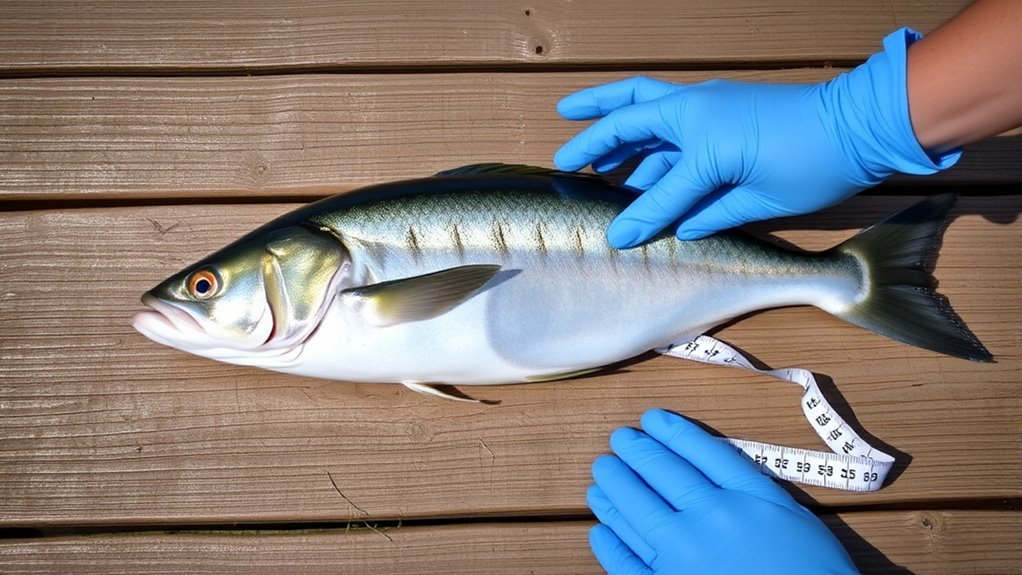
Before you measure the fish, gather all necessary tools, including a tape measure, ruler, bump board, or fabric measuring tape. Having the tool ready before you land the fish helps you work faster and reduces handling time.
Choose a flat, solid surface for the measurement. A hard boat deck, cooler lid, measuring board, or dock surface works better than soft sand, grass, or a curved surface. The measuring tool must lie flat for the reading to be accurate.
Secure the fish gently but firmly so it does not slide, flop, or fall back into the water before you finish. If you plan to release the fish, keep your hands wet and work quickly.
Gather Necessary Tools
To accurately measure fish length, you need simple tools that help you take a straight, repeatable reading. A flexible measuring tape, fabric ruler, fish ruler, bump board, or string can all work. The measuring tool should be longer than the fish so you do not have to estimate the final inches.
A bump board gives the cleanest reading because the fish’s nose rests against a fixed stop. A tape measure works well too, but only if it lies flat and straight. If you use string, wrap or stretch it carefully, then measure the string against a ruler.
| Tool | Purpose | Notes |
|---|---|---|
| Flexible Tape Measure | Measure fish length or girth | Best for different fish sizes and curved girth measurements |
| Fabric Ruler | Measure girth or length | Lightweight and easy to carry in a tackle bag |
| String | Measure girth when no tape is available | Use with a ruler for a final reading |
| Flat Surface | Support the fish during measurement | Helps prevent bent-body readings |
| Bump Board | Measure fish length accurately | Best for tournaments and catch-photo-release records |
Choose Measurement Location
Selecting the right measurement location is vital for getting accurate fish length readings. Choose a flat, hard surface where the fish can rest straight and where the measuring tape or board will not bend.
Position the fish on its side with its mouth closed. This alignment is essential for precise total length measurements and fork length measurements. Start at the most forward point used by the required method, usually the tip of the closed mouth or lower jaw.
For total length, pinch or compress the tail fin only if your local regulation requires that style of measurement. Some rules specify a natural tail position, while others allow a pinched tail. Follow the rule where you fish, then measure from the tip of the mouth to the farthest tip of the tail.
Make sure the fish lies straight along the measuring tape. Do not measure along the body’s curve because that can add extra length and create an inaccurate result.
Prepare Fish Positioning
Proper fish positioning is essential for obtaining accurate length measurements. Even a small bend in the body can change the reading, especially on longer fish.
Lay the fish flat on a hard surface, with the body straight and the mouth closed. Position the fish on its side for total length, fork length, or lower jaw fork length. Keep the head aligned with the zero mark on the ruler or bump board.
For total length, straighten the body and confirm the tail endpoint required by your local rule. For fork length, aim for the center of the tail fork rather than the longest tail tip. For lower jaw fork length, start at the tip of the lower jaw and end at the center of the fork.
Use a flexible measuring tape or board without forcing the fish into an unnatural shape. If you plan to release the fish, finish the measurement quickly and return it to the water as soon as possible.
Warning: Do not hang a fish vertically by the jaw just to measure it. Support the body horizontally, especially if you plan to release the fish.
Measuring Total Length
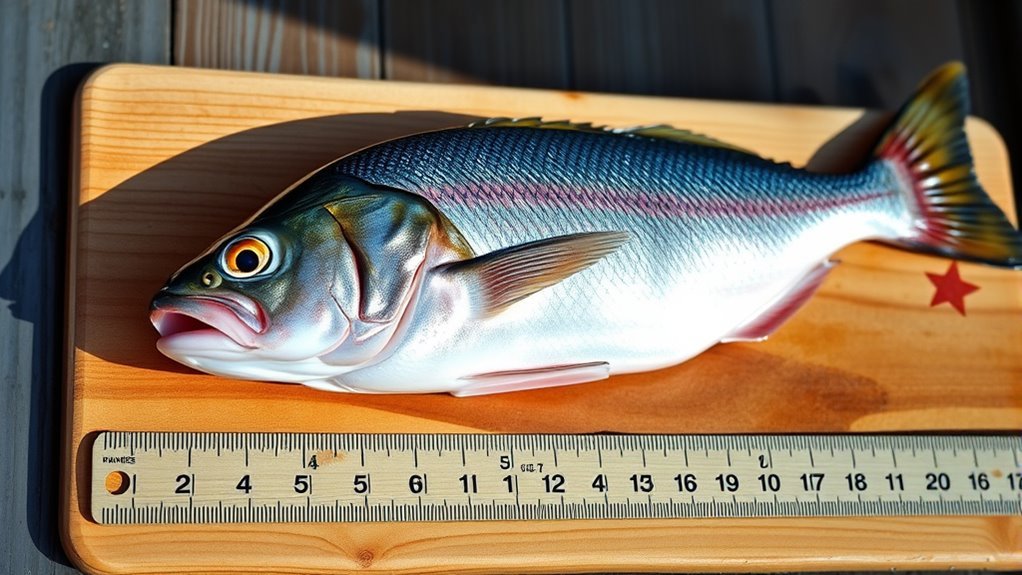
Measuring Total Length accurately is vital for many fish species because legal size limits often depend on this measurement. Total length is the straight-line distance from the most forward part of the closed mouth to the farthest point of the tail.
To begin, place the fish on its side and make sure the mouth is closed. Align the fish’s mouth with the zero mark on your ruler, tape, or bump board. Keep the body straight without stretching it.
Next, read the measurement at the farthest tip of the tail. If the tail has ragged edges or long filaments, include the farthest natural tip unless the local rule says otherwise. Measure in a straight line, not along the contour of the fish.
Total Length matters for species such as snappers, groupers, red drum, bass, trout, and many freshwater and saltwater fish. By using the correct method, you help support sustainable fishing practices and avoid mistakes when checking legal size limits.
Step-by-Step Total Length Method
- Wet your hands first. This helps protect the fish’s slime layer if you plan to release it.
- Lay the fish flat. Use a ruler, bump board, cooler top, or other firm surface.
- Close the mouth. The mouth should not be open or extended.
- Line up the head. Place the tip of the mouth at the zero mark.
- Straighten the body. Avoid bending the fish to fit the board or camera frame.
- Check the tail rule. Use the natural or pinched tail position required by your regulation.
- Read the farthest point. Record the length to the nearest accepted increment.
Pro Tip: If the fish is close to the legal limit, measure it more than once. When in doubt, release it instead of risking an undersized catch.
Measuring Fork Length
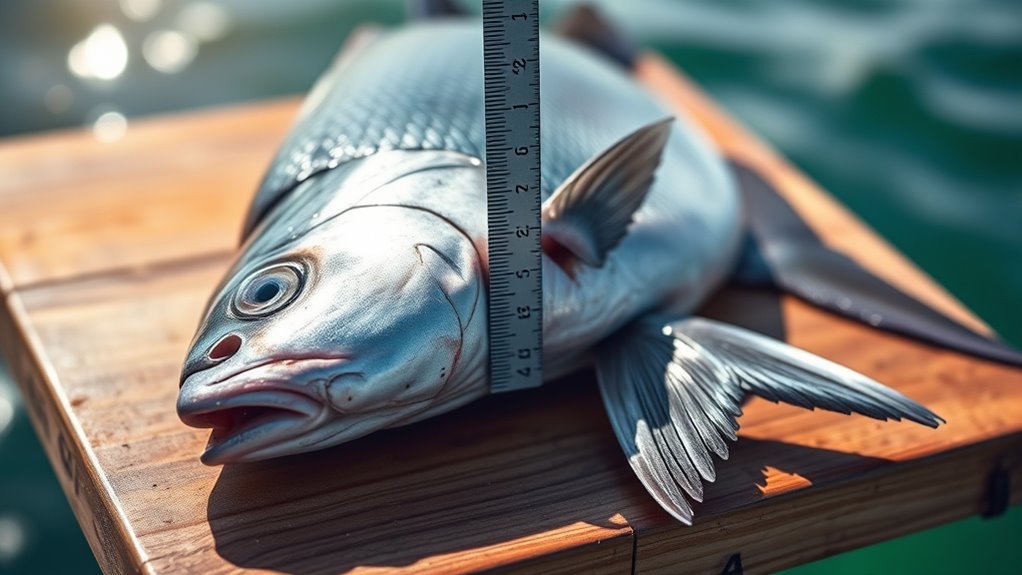
Measuring fork length is a critical step for fish with forked tails. This method is often used for species where total length can vary more because of tail shape, tail damage, or long tail tips.
You’ll need to measure from the tip of the closed mouth to the center of the tail’s fork while ensuring the fish lies flat on its side. The measurement should be a straight line from the head to the fork, not a curved line along the fish’s body.
This technique requires precision because the location of the tail fork directly affects your reading. A small error can matter when a fish is near the legal minimum or maximum size.
Fork Length Definition
Fork length is a critical measurement for anglers. It is defined as the distance from the tip of the closed mouth to the center of the tail’s fork. This gives anglers and fisheries managers a consistent way to measure specific fish species.
Understanding fork length helps you comply with fishing regulations and avoid legal issues with undersized or oversized catches. Here are key points to remember:
- Measure when the fish is positioned flat on its side.
- Confirm the mouth is closed for accuracy.
- Measure to the center of the tail fork, not the longest tail tip.
- Avoid overestimating the fish’s length to prevent penalties.
- Recognize that fork length differs from total length, which includes the full tail tip.
Measurement Technique Steps
To accurately determine fork length, follow a series of precise steps to keep your reading consistent and regulation-friendly.
First, position the fish on its side and make sure it is stable. Start measuring at the tip of the fish’s closed mouth. Extend the tape measure straight to the center of the tail’s fork.
Keep the tape flat and avoid measuring along the body’s curve. Measuring along the contour can overestimate the fish’s length and create a false reading.
Different methods exist for measuring fish, but for species such as amberjacks, hogfish, dolphin, and mackerel, fork length may be the required method in some areas.
Accurate measurement is fundamental for compliance with fishing regulations and contributes to the sustainable management of fish populations.
Species Requiring Fork Length
When fishing for certain species, knowing how to measure fork length accurately is essential for compliance with regulations.
Fork length is defined as the distance from the tip of the closed mouth to the center of the tail’s fork. Miscalculating this measurement can lead to legal consequences, especially when a fish is close to the legal limit.
Here are some key species that may require fork length measurements depending on location:
- Amberjacks
- Hogfish
- Dolphin
- Mackerel
- Tuna
- Some other fork-tailed offshore species
Ensure you measure in a straight line and avoid following the fish’s contour, as this can distort the fish’s length.
Consistent and accurate use of fork length techniques promotes responsible fishing practices and helps sustain fish populations.
Always be diligent about these guidelines to stay compliant and protect marine ecosystems.
Measuring Lower Jaw Fork Length
Lower Jaw Fork Length, often shortened to LJFL, is used for certain billfish and other species listed under specific regulations. Instead of starting at the closed mouth, this method starts at the tip of the lower jaw.
To measure it, place the fish flat and straight. Start the ruler or tape at the forward tip of the lower jaw, then measure in a straight line to the center of the tail fork. Do not use the top of the head or the full tail tip unless the rule specifically tells you to.
This method is important because billfish have long bills that would make total length misleading. Lower Jaw Fork Length creates a more consistent measurement across fish with extended upper jaws.
Measuring Girth and Weight
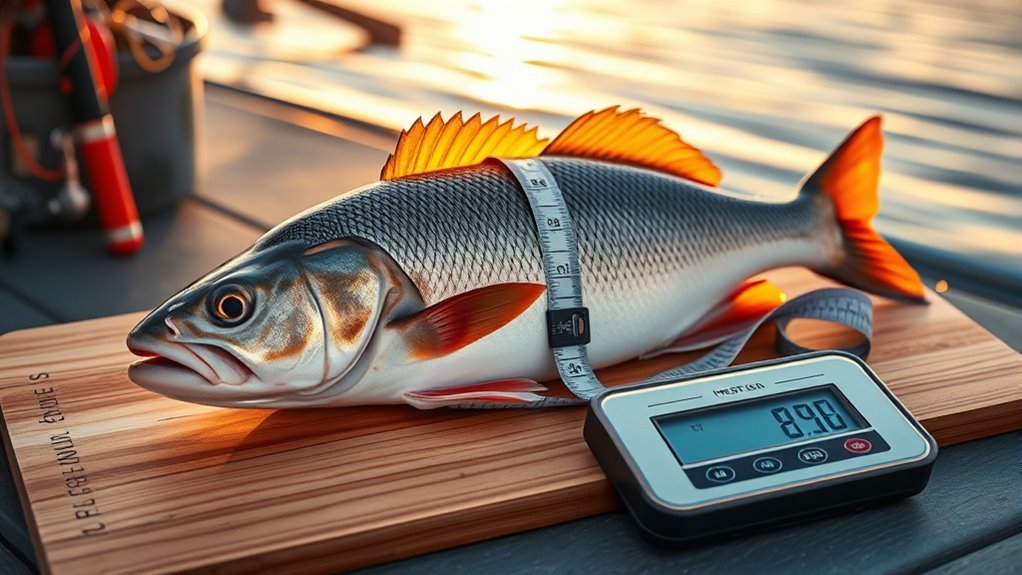
Measuring a fish’s girth and weight is vital for anglers who want to accurately assess their catch, estimate weight, or order a replica mount. Girth is the distance around the thickest part of the fish’s body.
Measure girth around the thickest part of the fish’s body, keeping the tape snug but not tight enough to compress the fish.
To measure girth, wrap a fabric ruler around the thickest part of the fish’s body. Keep it snug, level, and smooth, but do not squeeze the fish or distort its shape.
If you do not have a fabric ruler, use a piece of string. Wrap the string around the thickest part of the fish, mark the point where it meets, and then measure the string against a ruler or tape measure.
Girth measurements are important for estimating weight. A common estimate uses this formula: (girth × girth × length) ÷ 800. Use inches for both girth and length.
For instance, a fish that measures 24 inches in length with a 10-inch girth would weigh approximately 3 pounds: 10 × 10 × 24 ÷ 800 = 3. Combining accurate girth and length measurements improves your weight estimations and helps you record catch details more responsibly.
Always remember that weight formulas are estimates, not exact scale readings. Body shape, species, season, and condition can all affect the real weight.
Using a Bump Board
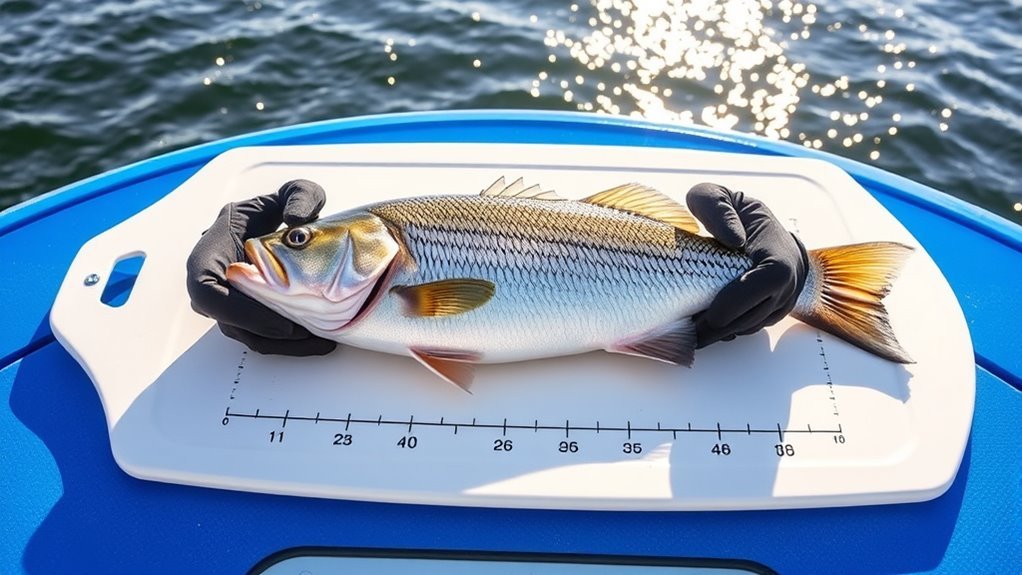
A bump board provides an efficient method for accurately measuring fish length. It is useful for recreational anglers, kayak anglers, guides, and competitive tournaments.
A bump board has a vertical stop at the zero mark. This stop keeps the fish’s nose in the right position and reduces guessing. It also makes photographs easier to verify in catch-photo-release events.
To achieve the most precise measurement of the fish’s length, follow these steps:
- Place the bump board on a stable surface and make sure it is secured.
- Position the fish with its nose against the 90-degree edge at the zero mark, confirming its mouth is closed.
- Straighten the fish’s body along the board, aligning it with the measurement markings.
- Check whether the rule requires a natural tail, pinched tail, or fork-length reading.
- Capture clear photographs showing the fish’s nose at the zero mark for compliance with catch-photo-release documentation.
Using a bump board not only supports accurate measurements but also serves as a standard in catch-photo-release tournaments where verification of catch sizes is essential.
Quick Measurement Techniques
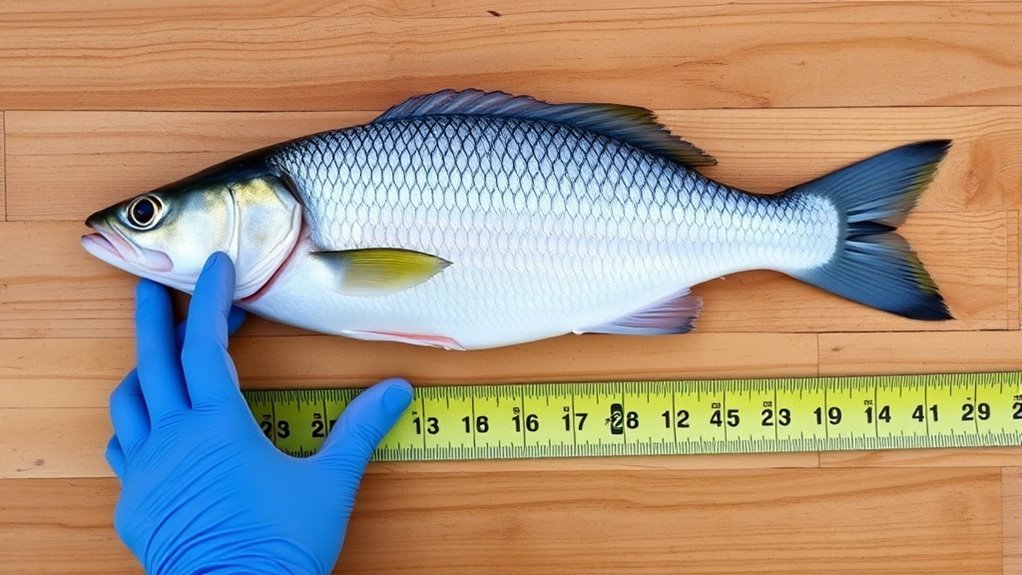
Although precise measurements are essential for effective catch-and-release practices, quick estimation techniques can save valuable time on the water.
One effective method is to use your forearm as a reference. Measure from your elbow to the tip of your middle finger before your trip, then remember that number. Many adults measure around 17 to 20 inches in that span, but your own measurement is more useful than a general estimate.
A personal body reference, such as your forearm length, can help you estimate quickly, but it should not replace a legal measurement when size limits matter.
For fish smaller than your forearm reference, lay your forearm alongside the fish for an immediate rough measurement. For larger fish, mark common lengths on your fishing rod, paddle, cooler lid, or net handle.
You can also utilize your fishing rod as a measuring stick by adding thread wraps, tape marks, or permanent marks at intervals such as 12, 14, 16, 18, and 20 inches. This allows you to estimate fish length while keeping the fish close to the water.
Finally, always keep a tape measure attached to a zinger, lanyard, tackle bag, kayak crate, or boat console. Easy access minimizes time spent searching for it during the catch-and-release process. These techniques improve efficiency without replacing the need for accurate measurements when regulations apply.
Common Measurement Mistakes to Avoid
Small mistakes can change the final reading, especially when a fish is close to the legal limit. Avoid these common errors before you keep, release, photograph, or record a catch.
- Measuring along the curve: Always measure in a straight line, not over the fish’s back or belly curve.
- Leaving the mouth open: An open mouth can change the starting point and affect the result.
- Using the wrong method: Total length, fork length, and lower jaw fork length are not interchangeable.
- Reading from a bent tape: A tape that bows, twists, or lifts off the surface can give a poor reading.
- Letting the fish flop: Movement can shift the fish away from the zero mark.
- Guessing on close fish: If the fish is near the legal limit, measure carefully and release it if you are unsure.
- Taking too long: Long handling times can harm fish intended for release.
Best Practices for Handling Fish
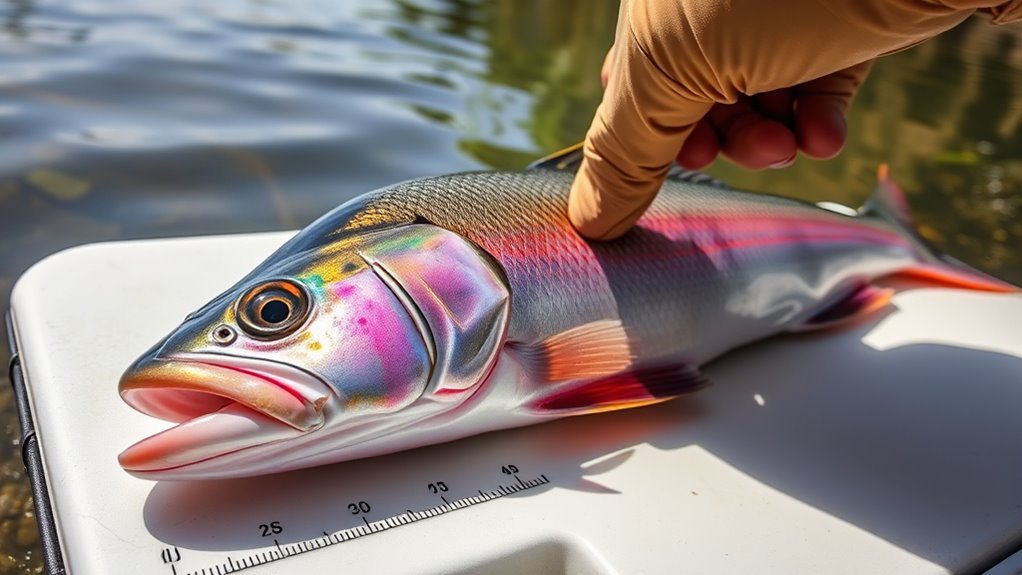
To enhance fish survival and minimize stress during handling, keep fish in or near the water as much as possible while unhooking and measuring. Proper techniques protect the fish and help you record the fish’s length accurately.
Follow these best practices for handling fish:
- Submerge the fish when practical: Keep it in water while unhooking to reduce stress and improve survival odds.
- Minimize time out of water: Measure and photograph quickly to prevent unnecessary harm.
- Use quick estimation when legal size is not an issue: Measure against a known reference for a fast length estimate.
- Wet your hands or use wet gloves: This helps protect the fish’s protective slime layer.
- Support the body horizontally: Use both hands for larger fish instead of holding them only by the jaw.
- Avoid dry towels or rough surfaces: These can remove slime and damage scales.
Finally, use proper revival techniques when needed. Hold the fish upright in the water and let water move over its gills. Release it only when it can swim away under its own power.
These practices contribute to healthier fish populations and responsible angling.
Measuring Fish for Catch-Photo-Release
Catch-photo-release, often called CPR, is common in tournaments and conservation-focused fishing. In this format, the fish is measured, photographed, and released instead of being brought to a weigh-in station.
For a clean CPR photo, place the fish on an approved measuring board with the nose against the stop. Keep the mouth closed if the rules require it. Make sure the entire fish, the zero mark, and the final length mark are visible in the photo.
Do not cover the tail, measurement marks, or fish’s head with your hand. If a tournament identifier is required, keep it visible without blocking the measurement. Take the photo quickly, then release the fish carefully.
Measuring Fish for a Replica Mount
If you want a replica mount, you need more than one length measurement. A taxidermist or replica maker usually needs total length, girth, weight if available, and clear photos from both sides.
Measure total length from the closed mouth to the tail tip. Then measure girth around the thickest part of the body. Take photos in natural light if possible, and include close-ups of markings, fins, tail shape, and color patterns.
A replica does not require keeping the fish. Good measurements and photos can help recreate the catch while allowing the fish to return to the water.
Frequently Asked Questions
How do you properly measure fish length?
Lay the fish flat on its side, close the mouth, and measure in a straight line. For total length, measure from the tip of the closed mouth to the farthest tail tip. For fork length, measure from the closed mouth to the center of the tail fork.
How do you measure fish length without measuring tape?
Use a known reference, such as your forearm, fishing rod marks, paddle marks, cooler marks, or a piece of string. Measure that reference before your trip. These methods help with quick estimates, but use a proper ruler or bump board when legal size limits matter.
How do you measure fish for a replica?
Measure total length from the closed mouth to the tail tip, then measure girth around the thickest part of the fish. Record the weight if you have a scale, and take clear photos of both sides, the tail, fins, and color patterns.
What are the main measurements of a fish?
The main fish measurements are total length, fork length, lower jaw fork length, girth, and weight. Total length uses the full body and tail. Fork length ends at the center of the tail fork. Girth measures around the thickest part of the body.
Should you pinch the tail when measuring a fish?
It depends on the regulation for that species and location. Some rules allow or require a pinched tail for total length, while others use the natural tail position. Check the local rule before keeping a fish near the size limit.
Is fork length the same as total length?
No. Fork length measures from the closed mouth to the center of the tail fork. Total length measures from the closed mouth to the farthest tail tip. Total length is usually longer than fork length on fish with forked tails.
Sources
- Florida Fish and Wildlife Conservation Commission — fish measurement methods and regulation-focused measuring guidance
- International Game Fish Association — angling rules and catch documentation standards
- NOAA Fisheries Recreational Fishing — responsible recreational fishing and fishery conservation information
Conclusion
Accurate fish measurement starts with a flat surface, a straight fish, a closed mouth, and the right method for the species. Total length, fork length, lower jaw fork length, and girth each tell a different part of the story.
When you measure carefully, you protect yourself from regulation mistakes and help support responsible catch-and-release practices. Keep your tools ready, handle fish gently, and release fish quickly when they are not being kept. That way, your fish tales stay accurate, legal, and respectful of the resource.