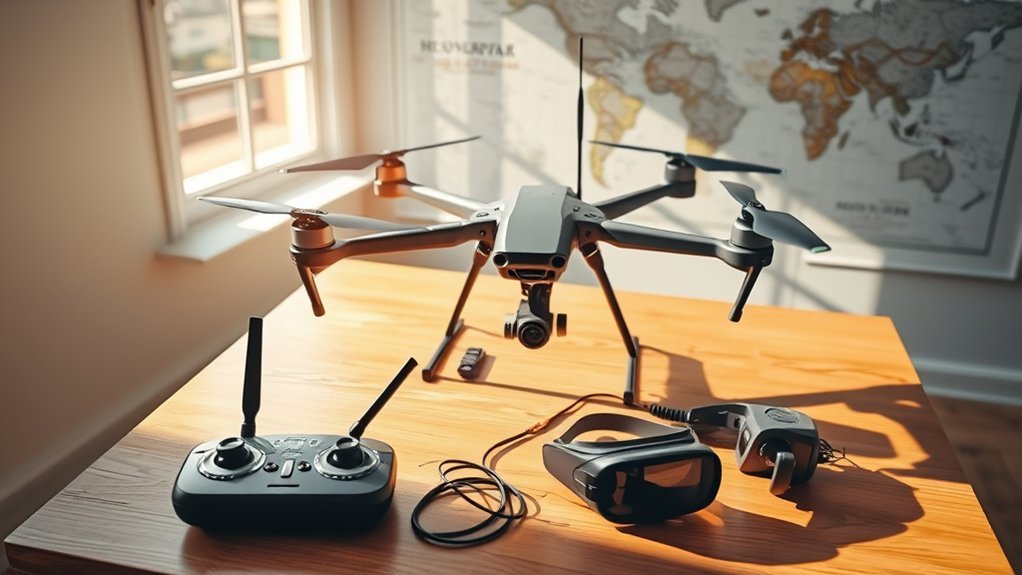
A reliable long-range FPV flying setup is defined by margin, not by headline range. For many multirotor builds, a 6” to 7” frame is a common starting point because it can trade some freestyle agility for efficient cruising and more room for the battery, GPS, and antennas. Your real usable range is the first limit you reach: legal visual-line-of-sight rules, battery reserve, video quality, control-link margin, weather, or recovery capability.
Last updated: September 11, 2026 — revised for current Betaflight GPS Rescue guidance, ExpressLRS configuration guidance, and current U.S./EU FPV operating rules.
Quick Answer
Build long-range FPV as a balanced system: efficient airframe and props, a battery matched to current draw, a dependable control link, correctly mounted antennas, a stable video link, GPS Rescue that has been tested at short range, and a turn-back plan with reserve. Do not set your flight distance from the radio’s advertised range alone.
Key Takeaways
- Treat 6” to 7” as a common long-range multirotor starting point, not a rule; prop size, all-up weight, motors, battery voltage, and payload must work as one system.
- Use a proven control link such as ExpressLRS or TBS Crossfire, then protect the link budget with correct packet-rate choices, legal RF power, and clean antenna placement.
- Set a turn-back threshold from your own current draw, consumed mAh, wind, and route instead of copying another pilot’s battery percentage.
- Use GPS, OSD data, failsafe testing, DVR or coordinate logging, and recovery planning before extending distance.
- Check the rules that apply where you fly, including FPV observer/VLOS requirements, altitude and airspace limits, registration or Remote ID where applicable, and legal radio bands/output power.
At a Glance
| Best Frame Size | Usually 6” to 7” for efficient cruising and better payload support |
| Difficulty | Intermediate to advanced, because setup, tuning, and recovery planning matter |
| Core Gear | Efficient frame, reliable radio link, quality antennas, GPS, OSD, high-capacity battery, and tuned video system |
| Biggest Risk | Weakest-link failure: legal/VLOS limit, battery reserve, video or control link, GPS setup, weather, or recovery access |
Understanding Long Range FPV Flying
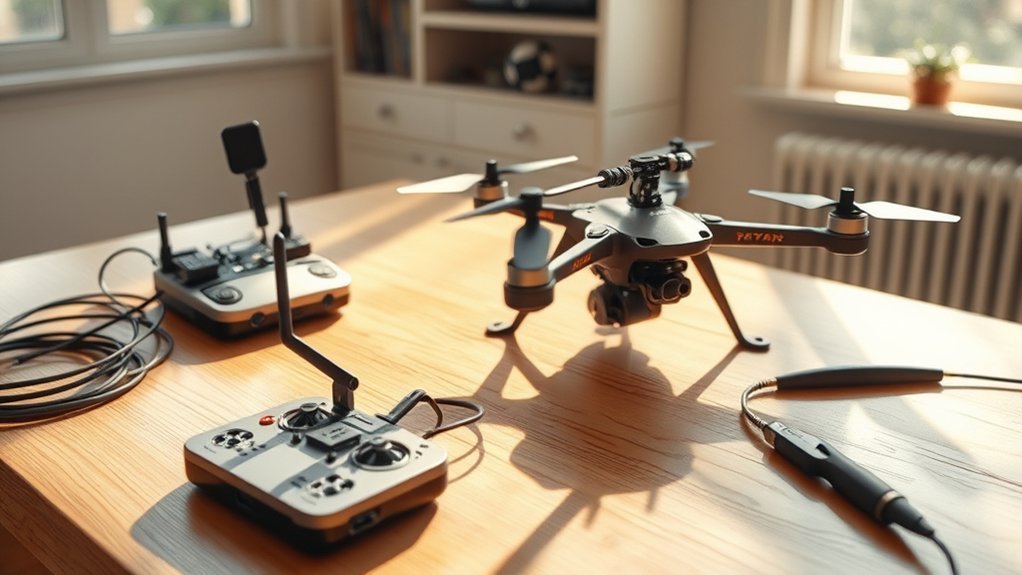
Long-range FPV flying means designing and operating an aircraft for efficient cruising, dependable links, navigation data, and enough energy to return safely. The term does not have one universal distance. A flight may be technically easy for the radio system but still be unsafe or unlawful because the aircraft is no longer visible to the pilot or observer, the return battery margin is too small, or terrain blocks the video link.
For Betaflight multirotors, GPS Rescue is an emergency recovery feature, not a substitute for flight planning. Current Betaflight guidance says Rescue depends on a working GPS, a properly calibrated accelerometer, stable level flight, a valid home point, and enough satellites. The default minimum is eight satellites for a home point, while Betaflight recommends confirming a solid fix and testing Rescue at close range before relying on it. See the current Betaflight GPS Rescue guide.
Battery choice is part of the same system. High-discharge Li-Ion packs built from cells such as 18650 or 21700 formats can offer useful energy density for efficient cruising, while LiPo packs are better suited when the build needs higher current and sharper throttle response. The right choice depends on prop size, motors, voltage, all-up weight, cruise current, payload, temperature, and the reserve you need for the return leg.
Log or display GPS coordinates, distance from home, link quality, battery voltage, and consumed mAh when your equipment supports them. These values help you make an early turn-back decision and can also help with recovery after an unplanned landing.
What Actually Limits Long-Range FPV Distance?
Your usable range is the shortest of several limits, not the maximum specification of one component. Check these in order before extending a route:
| Limit | What to verify |
|---|---|
| Legal/airspace | VLOS or observer requirements, altitude, airspace authorization, site restrictions, and local RF rules. |
| Battery | Outbound consumption, headwind return, voltage sag, temperature, and emergency reserve. |
| Video link | Breakup pattern, terrain blockage, antenna aim, polarization, connectors, and receiver performance. |
| Control link | Link quality, packet rate, receiver antenna orientation, RF power, interference, and failsafe behavior. |
| Recovery | GPS home lock, tested Rescue behavior, DVR/coordinates, beeper or telemetry, and a safe way to reach a landing site. |
If one of these limits is weak at short range, fix it before flying farther. Long-range reliability comes from margin across the whole system.
Warning: Do not treat a long-range capable drone as permission to fly anywhere. In many areas, drone rules require visual line of sight, altitude limits, airspace awareness, and safe separation from people, aircraft, roads, and property.
Essential Gear for Long Range FPV

When gearing up for long-range FPV, choose components as one system instead of chasing the biggest battery or highest RF power. Six- and seven-inch multirotors are common because larger props can support efficient cruising and extra payload room, but the correct size still depends on weight, terrain, transport needs, and the kind of flying you do. Pair the airframe with clean wiring, a GPS module, a battery matched to cruise current, and a control system such as TBS Crossfire or ExpressLRS that is configured for your legal RF band and environment.
Frame Selection Criteria
Selecting the right frame for long-range FPV flying affects efficiency, payload room, antenna placement, durability, and repairability. A 6” or 7” frame is a common choice for a multirotor cruiser, but do not pick a frame by prop diameter alone. Start with the payload and battery you need, then make sure the motors, propellers, ESC, and voltage are matched to the resulting all-up weight.
Prioritize a frame that is light enough to cruise efficiently but stiff enough to avoid excessive vibration. Carbon fiber frames are common because they offer a strong strength-to-weight ratio. Look for secure battery mounting, protected camera placement, room for GPS and a beeper, clean wiring paths, and antenna mounts that keep active elements away from carbon fiber, battery mass, and high-current wiring.
Motor size and KV must be chosen with the propeller, battery voltage, and all-up weight. A larger stator or lower KV is not automatically “more efficient” unless it suits the rest of the build. For a dedicated selection process, see this guide to matching FPV motors and KV to props, battery, and frame.
Optimal Battery Configuration
To maximize endurance, match the battery configuration to the aircraft’s real cruise current instead of choosing by mAh alone. High-discharge Li-Ion packs built from 18650 or 21700 cells can be useful for efficient cruising because they often store more energy for their weight, while LiPo packs tolerate higher current demand and are usually the better fit for aggressive throttle use or heavier lift.
Compare packs by both voltage and energy. Watt-hours are a better cross-voltage comparison than mAh alone: nominal volts × amp-hours = watt-hours. Wiring cells in parallel increases capacity while keeping the same pack voltage; wiring cells in series increases voltage. Any series/parallel pack must stay within the voltage, current, connector, ESC, motor, and charging limits of the complete build.
Effective battery management means checking pack health, monitoring voltage under load, watching consumed mAh, and avoiding a return plan that depends on using nearly all available capacity. Old, cold, damaged, or poorly matched packs can sag hard even when their resting voltage looks normal.
Radio Control Options
For long-range FPV, the control link must be configured for link margin, not just low latency. TBS Crossfire and ExpressLRS are widely used options, but actual performance depends on frequency band, packet rate, antennas, output power, interference, installation, and terrain. Follow the legal frequency and power rules for your region rather than copying another pilot’s settings.
With ExpressLRS, lower packet rates generally trade latency for receiver sensitivity and link budget. Current ExpressLRS documentation lists 2.4GHz 50Hz LoRa at -115 dBm sensitivity versus -105 dBm at 500Hz, which illustrates why a lower rate can be more forgiving when range matters. Choose a rate that fits your use case, then monitor link quality instead of relying on distance alone. See the ExpressLRS packet-rate guidance.
Mount receiver antennas so their active elements are clear of carbon fiber, battery mass, and high-current wiring. If you use ExpressLRS, this site’s ExpressLRS binding and configuration guide covers the setup side; this page should stay focused on long-range system planning.
Choosing the Right Antennas
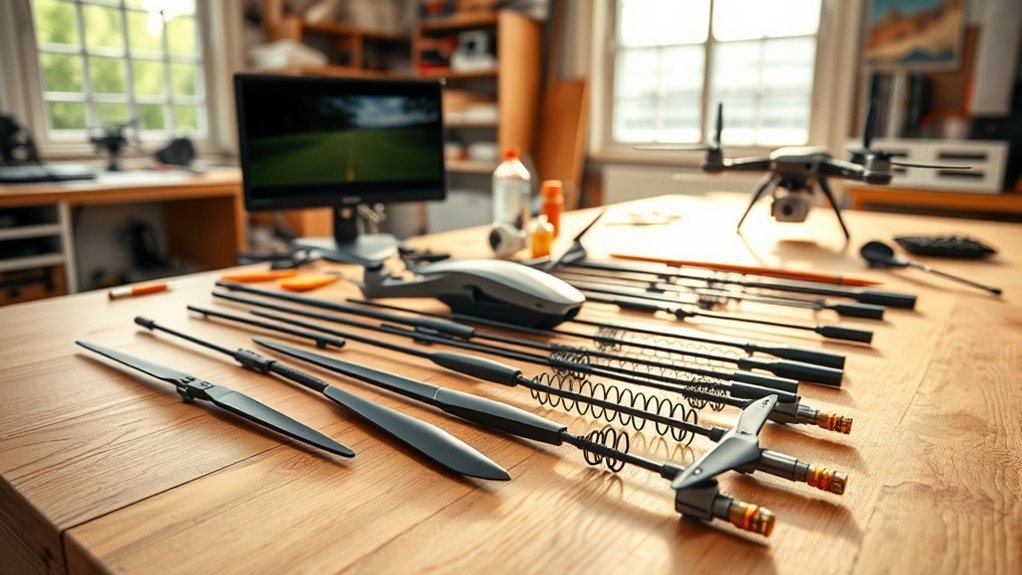
When it comes to reliable long-range performance, choosing the right antennas is essential. Your antennas can greatly affect usable range, signal strength, video clarity, control reliability, and recovery confidence. A powerful transmitter with a poor antenna setup can perform worse than a modest transmitter with clean antenna placement.
Consider these key factors:
- Omnidirectional vs. directional antennas: Omnidirectional antennas offer broad 360-degree coverage, while directional antennas, such as patch antennas, focus signal strength in a specific direction.
- Antenna gain: Higher-gain directional antennas concentrate energy into a narrower pattern. That can improve link margin in the aimed direction, but it also makes alignment more important.
- Frequency choice: Use antennas that match your actual video and control frequencies. A mismatched antenna can reduce range and may damage equipment.
- Quality matters: Upgrading to higher-quality antennas can turn an inconsistent setup into a more reliable long-range system.
- Placement: Elevate antennas away from the drone body, battery, carbon fiber, and power wiring to reduce interference and maximize transmission range.
On the ground station side, many pilots use an omnidirectional antenna for nearby coverage and a patch or helical antenna for distance. This type of diversity setup can help maintain video when the drone changes angle or moves across different parts of the flight path.
Pro Tip: Before changing transmit power, improve antenna placement first. Clean antenna orientation, solid connectors, and proper mounting often solve range problems without adding heat or breaking output-power rules.
Setting Up Your Drone for Long Range
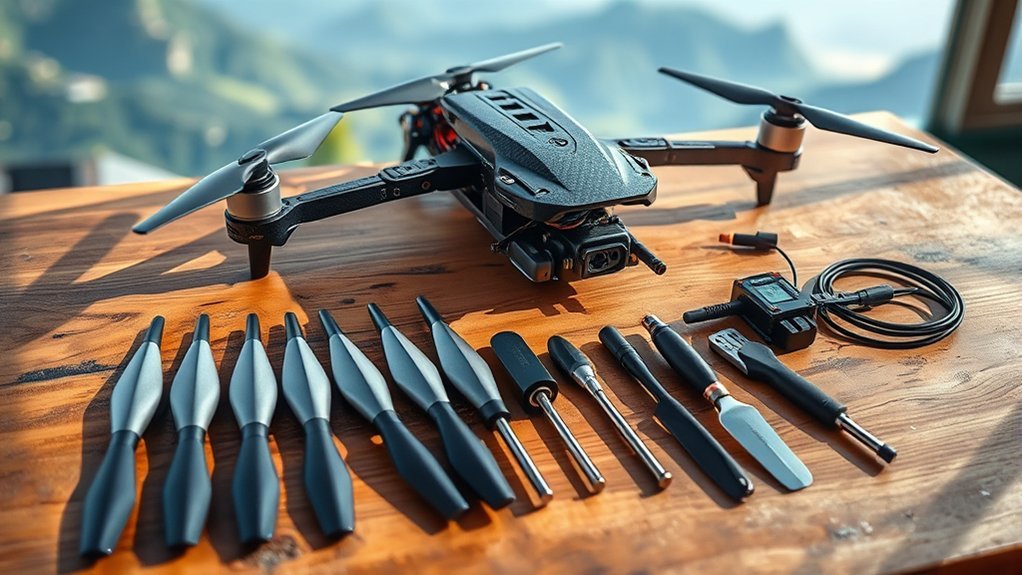
Set up a long-range drone by giving each system a clear job: propulsion and power, control link, video link, navigation, flight data, failsafe, and recovery. For many multirotor cruisers, a 6” to 7” frame is a practical starting point, but the final build should be chosen around all-up weight and the payload you actually intend to carry.
Install the receiver antenna where carbon fiber and the battery do not shadow it. Keep video and control antennas secure and separated from high-current wiring where practical. Use a quality receiver or goggle module, and test the video system on the ground and at short legal distances before extending the route.
Install an On-Screen Display (OSD) and show the data that can change a decision: battery voltage, consumed mAh, flight timer, distance from home, direction to home, altitude, GPS coordinates, satellite count, and control-link quality when supported. Too many decorative OSD elements can make urgent information harder to see.
For Betaflight GPS Rescue, wait for a stable fix and confirmed home point before takeoff. Verify level-mode behavior, Rescue altitude strategy, hover throttle, ground speed, satellite count, and failsafe action. Test Rescue at close range over an open area before trusting it farther away. Betaflight specifically warns against arming without a GPS fix if you expect Rescue to bring the aircraft home.
How Do You Determine a Safe Usable Range?
Do not define usable range from a transmitter specification. Build it from short, repeatable flights that remain within the rules for your location.
- Prove the aircraft first: confirm clean video, stable control-link quality, correct GPS home direction, predictable voltage sag, and normal motor/ESC temperatures.
- Fly a short out-and-back route: record consumed mAh, voltage under load, flight time, wind direction, and the weakest link you observed.
- Repeat in less favorable conditions: a safe route in calm air may become a poor route with a headwind on the return leg.
- Set your turn-back threshold: base it on your own logged consumption and an emergency reserve, not on another pilot’s battery percentage.
- Extend gradually: if video, control quality, battery margin, GPS behavior, or recovery access worsens, fix that limit before increasing distance.
This method gives you a build-specific operating envelope without pretending that one “maximum range” number applies to every aircraft or location.
Battery Management for Extended Flights
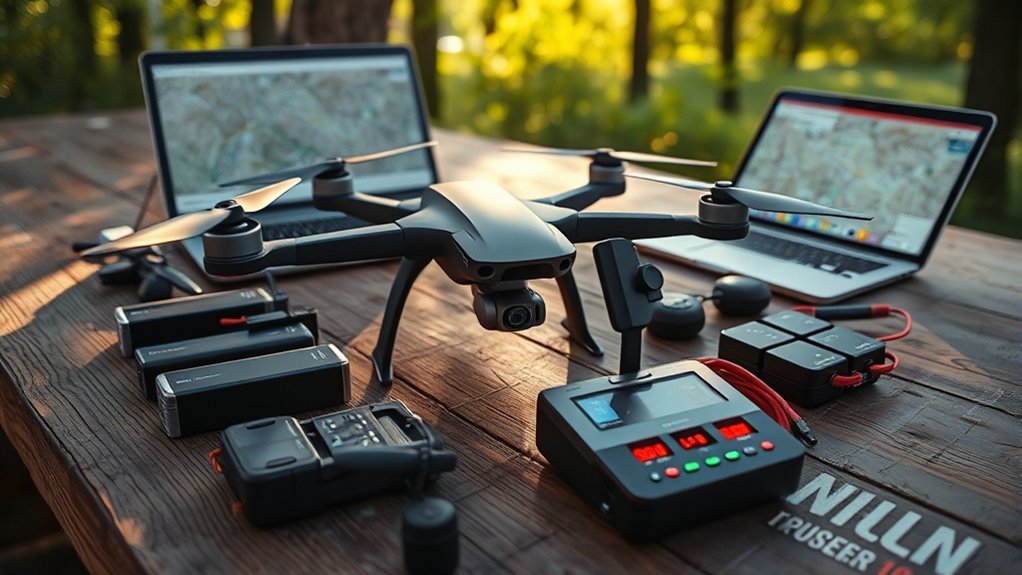
Battery management determines whether a long-range flight ends with a controlled return or a forced landing. Use the pack’s behavior under load, not just its label, to plan endurance.
- Use Li-Ion only when the pack’s continuous current capability fits the aircraft’s cruise and climb demand; use LiPo when the build needs higher current headroom.
- Compare watt-hours as well as mAh when you compare packs with different voltages.
- Wire packs in parallel only when you understand cell/pack matching, current sharing, connector limits, and safe charging.
- Monitor voltage under load, consumed mAh, distance from home, and wind so you can turn back before the return becomes marginal.
- Inspect for swelling, damaged wraps, loose balance leads, weak cells, corrosion, or abnormal temperature before launch.
Set your return point before takeoff. Your reserve must cover the return leg plus plausible penalties such as a headwind, a climb to clear terrain, a route change, or a go-around from an unsafe landing spot.
Watch voltage sag during the parts of the flight that demand power. A pack can recover to a normal-looking resting voltage after landing even if it sagged badly under load. Cold weather and aging cells can make that problem worse.
Optimizing Video Transmission
To achieve ideal video transmission in long-range FPV flying, upgrading your Video Transmitter (VTX) can help when your current setup is weak, noisy, or limited. A VTX with adjustable output power can improve image stability when used legally and cooled properly. However, power alone does not fix poor antennas, damaged coax, bad mounting, or blocked line of sight.
Pair your VTX with antennas that match the correct frequency and polarization. Use omnidirectional antennas for broad coverage and directional antennas when you need stronger signal in one area. Keep the VTX cool, mount antennas securely, and check SMA or MMCX connectors before every serious flight.
Here’s a quick comparison of VTX options:
| Feature | Benefits |
|---|---|
| Higher Output Power | Improved signal strength when used within legal and thermal limits |
| Adjustable Power Output | Customization based on distance, heat, location, and rules |
| Omnidirectional Antennas | Broad 360-degree reception for nearby and changing flight angles |
| Directional Antennas | Enhanced signal quality in a focused area |
| Diversity / Multipath-Resistant Receiver | Better handling of antenna-angle changes, multipath, and weak-signal conditions |
Testing and optimizing your antenna placement can reduce signal loss from obstructions. Walk-test your video feed, review DVR footage, and check for breakup patterns before flying farther. If the video gets noisy in one direction, your ground antenna aim, drone antenna angle, terrain, or polarization may be the real problem.
GPS, OSD, and Return-to-Home Setup
GPS and OSD data are core decision tools for long-range FPV. At minimum, display the values that tell you whether to continue or turn back: battery voltage, consumed mAh, flight timer, distance from home, direction to home, altitude, GPS coordinates, satellite count, and control-link quality when supported.
For current Betaflight GPS Rescue, a valid 3D fix and home point matter more than simply seeing a GPS icon. Betaflight’s default minimum satellite setting is eight, and its current guide recommends confirming solid position data, home distance, and the home arrow before relying on Rescue. It also recommends testing Rescue carefully at close range over a forgiving area.
Set the Rescue altitude strategy for the terrain you actually fly. A fixed altitude that clears one field may be wrong for a route with hills, trees, or structures, while an unnecessarily high climb can waste battery. Confirm level-mode hover, throttle behavior, forward speed, and failsafe recovery before extending distance.
Do not enable “arming without fix” for normal long-range flights if you expect GPS Rescue to return the aircraft. Betaflight warns that Rescue cannot fly home without a valid home point. Review the current GPS Rescue documentation after firmware updates because behavior and settings can change.
Note: GPS rescue depends on correct setup, enough satellites, flight controller configuration, battery reserve, and safe altitude. Treat it as a backup system, not as your main flight plan.
Safety Precautions for Long Range Flying
Before you launch into long-range FPV flying, establish a thorough pre-flight checklist to make sure your drone is ready. Include emergency procedures in your planning, such as activating GPS Rescue mode, logging GPS coordinates, and choosing safe landing zones along your route. Being methodical about these precautions can reduce risks and improve your safety while flying.
Pre-Flight Checklists
While you prepare for a long-range flight, conducting a thorough pre-flight checklist helps protect your drone, your surroundings, and your flight plan. Follow these pre-flight checks to minimize risks:
- Verify battery levels: Confirm your drone, radio, goggles, ground station, and action camera batteries are charged.
- Check battery condition: Inspect for swelling, damaged wraps, poor cell balance, or loose connectors.
- Check GPS module: Verify that GPS is functional, locked, and correctly configured for navigation.
- Inspect video receiver: Confirm the receiver, goggle module, antennas, DVR, and VTX channel are working correctly.
- Assess control link quality: Check link quality, RSSI or equivalent telemetry, receiver antenna mounting, and failsafe behavior.
- Confirm props and motors: Look for cracked props, loose motor screws, bent shafts, and blocked motor bells.
- Review weather: Check wind direction, gusts, rain risk, temperature, and visibility before launch.
- Maintain line of sight where required: Plan your route so you can follow your local visibility and observer rules.
Adhering to this checklist helps create a safer and more predictable long-range flying experience.
Emergency Procedures Planning
Establish an emergency plan before every long-range flight. Configure and test GPS Rescue for the failsafe behavior you intend to use, but do not assume it will automatically solve a low-battery problem. If battery reserve is becoming unsafe, turn back or choose a controlled landing site early. Log GPS coordinates and keep DVR recording enabled when possible; the last visible location, OSD coordinates, telemetry, and beeper can all help during recovery.
| Emergency Scenario | Recommended Action |
|---|---|
| Signal Loss | Use the tested failsafe/GPS Rescue behavior; regain manual control only after the link and video are stable |
| Low Battery | Turn back or choose a controlled landing site early; do not wait for Rescue to solve an energy shortage |
| Video Breakup | Turn toward home, gain safe altitude if needed, and avoid flying behind obstacles |
| Sudden Weather Changes | Land immediately if wind, rain, or visibility worsens |
| Lost Drone | Use last GPS coordinates, DVR footage, beeper, radio telemetry, and a safe recovery route |
Conduct thorough pre-flight checks focused on battery condition, antenna integrity, GPS lock, and failsafe settings. Continuously monitor weather conditions so you can make informed decisions during your flight. These steps can greatly improve safety and control during long-range operations.
Legal Considerations for Long Range FPV
Long-range-capable hardware does not automatically make long-distance operation legal. Rules vary by country, airspace, aircraft weight, operating purpose, launch site, and radio band. Check the rules for the exact place and type of operation before you fly.
- United States, recreational: FAA rules require the drone to remain within visual line of sight of the operator or a co-located visual observer in direct communication with the operator. Recreational flights in Class G airspace are limited to 400 feet AGL; controlled airspace requires FAA authorization and compliance with the authorized altitude. TRUST, registration, and Remote ID requirements may also apply. See the FAA recreational flyer rules.
- United States, Part 107: if the remote pilot uses FPV technology, a visual observer must keep the aircraft within unaided sight. Flying beyond the ability to maintain the required visual line of sight generally requires an applicable FAA waiver. See the FAA Part 107 operating requirements.
- European Union, open category: EASA requires VLOS, or for FPV a UA observer alongside the remote pilot who keeps the drone in sight; the open category is generally limited to 120 metres. See the EASA open-category guidance.
- Radio link: choose the legal regulatory domain, frequency range, and output power for your region. ExpressLRS, for example, provides different regulatory-domain firmware options rather than one universal 868/915MHz setting. See the ExpressLRS regulatory-domain options.
- Launch-site restrictions: airspace rules and land-management rules are not the same thing. In the U.S., the National Park Service generally restricts launching, landing, or operating a drone from NPS-administered lands unless approved, while FAA airspace rules still govern the airspace itself. Check the NPS UAS guidance and current FAA airspace information before a trip.
Wherever you fly, give way to crewed aircraft, avoid uninvolved people, respect property and site rules, and treat a legal visual-line-of-sight boundary as a hard range limit even if your control and video links can reach much farther.
Common Long Range FPV Mistakes to Avoid
Many long-range failures come from system mistakes rather than one bad component. Avoid launching with a weak GPS fix, flying with damaged antennas, using a pack that sags badly, or relying on Rescue behavior you have never tested. Do not copy another pilot’s packet rate, Rescue altitude, motor/prop combination, battery threshold, or RF power without checking whether it fits your aircraft, firmware, terrain, and local rules.
Another common mistake is chasing distance before learning the aircraft. Start with short flights, review your logs and DVR, then extend gradually. Watch current draw, voltage sag, link quality, and video breakup. If one system looks weak at short range, it will not become safer at long range.
Finally, avoid overloading the drone. Extra cameras, oversized batteries, trackers, mounts, and accessories can reduce efficiency if they push the aircraft beyond its comfortable weight range. A lighter, cleaner build often flies longer than a heavy build with a bigger battery.
Related Guides
Frequently Asked Questions
How far can a long-range FPV drone fly?
There is no single safe or legal distance. Hardware may be capable of several kilometers or more, but your usable range is whichever limit comes first: VLOS/observer rules, airspace, battery reserve, video quality, control-link margin, weather, terrain, or recovery access. Set range from short test flights and your own logged return margin, not from a transmitter specification.
How do you extend range on an FPV drone?
Improve the whole system: reduce unnecessary weight, use an efficient prop/motor combination, choose the battery for real cruise current, improve antenna placement, use an appropriate control-link packet rate, reduce electrical noise, verify connectors, and test video reception. Extend distance gradually only after GPS Rescue, failsafe behavior, and return-battery margin are proven at short range.
What is the best size for a long-range FPV drone?
For multirotor long-range builds, 6” to 7” frames are common because they provide room for efficient props, larger batteries, GPS, and antennas. They are not automatically the best choice for every mission. Payload, portability, wind, all-up weight, battery voltage, motor/prop matching, and the legal category of the aircraft can change the right size.
What frequency is used for long-range FPV?
There is no universal long-range frequency. Control links may use 2.4GHz or region-specific sub-GHz bands, while video can use analog or digital systems on bands permitted by local rules. With ExpressLRS, choose the correct regulatory domain for your region; do not assume that 868MHz or 915MHz is legal everywhere.
Is GPS Rescue enough to protect a long-range FPV drone?
No. GPS Rescue depends on a valid home point, sufficient satellite data, correct accelerometer/level behavior, suitable Rescue settings, battery reserve, and successful testing. Treat it as an emergency backup. Your main plan should still include a legal route, early turn-back threshold, OSD monitoring, and recovery options.
Do you need a visual observer when flying FPV?
It depends on the rules that apply where you fly. In the U.S., recreational FPV can use a co-located visual observer in direct communication with the operator to satisfy VLOS requirements, and Part 107 FPV operations require a visual observer to maintain unaided sight. In the EU open category, FPV operation requires a UA observer alongside the remote pilot who keeps the drone in sight.
Conclusion
Long-range FPV is a weakest-link problem. Build efficiency helps, but distance is only useful when the battery can bring you back, the video and control links keep margin, GPS Rescue is correctly configured, and the flight stays inside the rules for your location. Prove each system at short range, log what the aircraft actually consumes, set an early turn-back threshold, and extend gradually only when the previous flight left comfortable margin.
Sources
- FAA Recreational Flyers & Community-Based Organizations — current U.S. recreational VLOS, observer, altitude, registration, TRUST, and Remote ID guidance.
- FAA Small UAS Regulations (Part 107) — current U.S. commercial/Part 107 operating requirements, including FPV use with a visual observer.
- FAA Part 107 Waivers — identifies visual-line-of-sight operations that require a waiver under Part 107.
- Betaflight GPS Rescue documentation — current Rescue setup, satellite/home-point requirements, testing guidance, altitude modes, and failsafe behavior.
- ExpressLRS Lua / Packet Rate documentation — current packet-rate configuration and sensitivity trade-offs.
- ExpressLRS Firmware Options — current regulatory-domain choices for supported RF bands.
- EASA Open Category FAQ — EU VLOS, FPV observer, and 120-metre open-category guidance.
- National Park Service UAS Guidance — explains NPS restrictions on launching, landing, or operating drones from NPS-administered lands.
