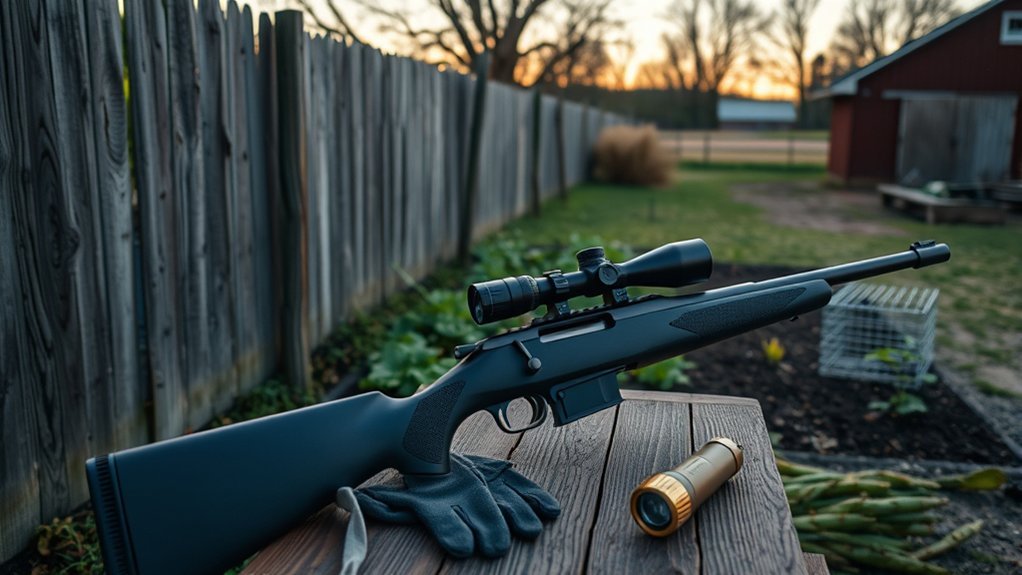
Short-range pest and varmint control means stopping rats, rabbits, pigeons, and corvids close to your home, barn, or garden, typically inside 50 yards, without disturbing neighbors or livestock. The right setup pairs a quiet, accurate firearm with ammunition matched to the target, plus the safety habits and legal permissions that keep you compliant. This guide covers the calibers, accessories, and rules that actually matter, based on current U.S. and UK regulations.
Quick Answer
For most backyard and farm pests, a .22LR rimfire rifle loaded with subsonic ammunition offers the best mix of quiet operation, low cost, and enough power for rats, rabbits, and pigeons inside 50 yards. Step up to .17 HMR for longer shots on corvids and rabbits, or a .410 shotgun for close-range, moving targets. Before you shoot, confirm the species isn’t legally protected and that you have the landowner’s written permission.
Key Takeaways
- Subsonic .22LR rimfire ammunition is the quietest, most affordable choice for rats, rabbits, and pigeons inside 50 yards.
- .17 HMR extends effective range to roughly 150 yards on corvids and rabbits, but costs more per round and is louder.
- .410 shotguns suit close, moving targets in gardens and farmyards.
- A suppressor is legal in most U.S. states but is federally regulated: you still need an approved ATF background check and registration even though the transfer tax dropped to $0 on January 1, 2026.
- In the UK, rifles and most shotguns require a firearm or shotgun certificate, and many “pest” bird species can only be controlled under a general licence.
- Written landowner permission and knowledge of local discharge-distance rules are required before any shooting-based pest control.
Last checked: September 29, 2026 — verified current U.S. suppressor tax-stamp rules and UK firearms/air weapon licensing thresholds against official sources.
Understanding the Basics of Short-Range Pest Control
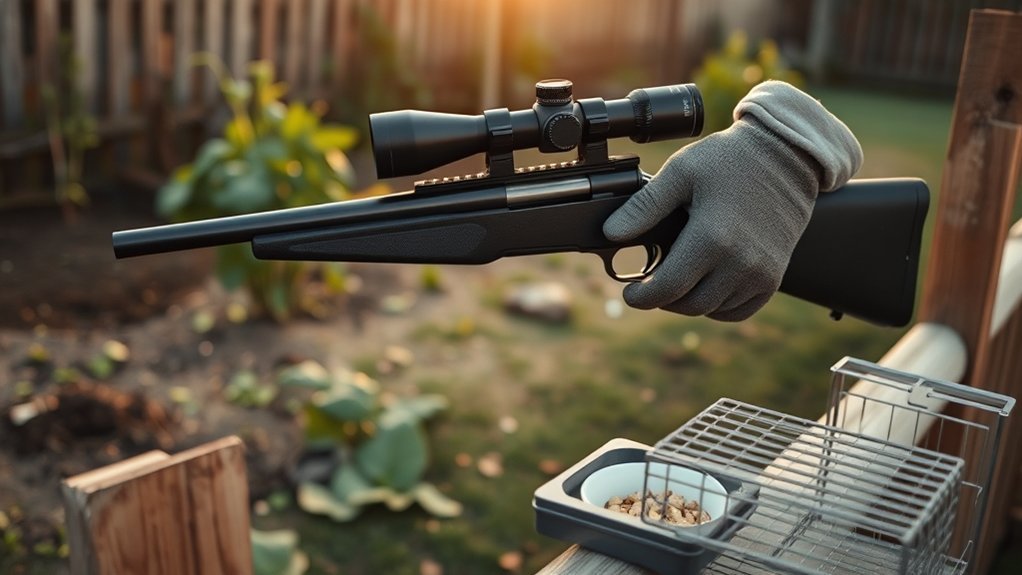
Short-range pest control uses targeted strategies to manage small pests, such as rodents and birds, within roughly 50 yards. This approach favors precision and discretion over volume, using tools like air rifles, .22LR rimfire rifles, and shotguns chosen for their accuracy and reduced noise signature, a real advantage in residential areas and around livestock.
Subsonic ammunition, which stays below the speed of sound (about 1,125 feet per second at sea level), further cuts down on report and helps avoid the “crack” of a supersonic round breaking the sound barrier.
Traps and bait stations still have a place alongside firearms, giving you a multi-method approach to pest populations. Regularly monitoring pest activity lets you adjust tactics instead of guessing at what’s working.
Key Safety Precautions for Short-Range Pest Control
Safety precautions matter as much as marksmanship in short-range pest control. Essential gear, a clear shooting lane, and correct firearm handling all reduce the chance of an accident.
Essential Safety Gear
Wearing safety glasses protects your eyes from debris and ricochet fragments during pest control work. Hearing protection, such as earmuffs or earplugs, guards against the cumulative hearing damage that comes from repeated firearm noise, even at short range.
If you’re also using pesticides or bait, gloves and a respirator or dust mask reduce skin contact and inhalation risk. Sturdy, closed-toe footwear protects against uneven ground and dropped equipment, and high-visibility clothing helps others see you if you’re working near a shared property line or a road.
Proper Firearm Handling
Safety gear is only part of the picture; correct firearm handling matters just as much.
| Precaution | Description | Importance |
|---|---|---|
| Safe Direction | Always point the firearm in a safe direction, even when you believe it’s unloaded. | Prevents accidental discharge injuries. |
| Check Surroundings | Inspect for people, pets, and property before shooting, and confirm what’s beyond the target. | Guarantees a clear, safe line of fire. |
| Regular Maintenance | Inspect and clean the firearm on a routine schedule. | Keeps the action functioning safely and reliably. |
These three precautions echo the NRA’s fundamental rules of gun safety: always keep the muzzle pointed in a safe direction, keep your finger off the trigger until you’re ready to shoot, and keep the firearm unloaded until you’re actually ready to use it. Knowing local laws on firearm use for pest control is part of handling a gun responsibly, not a separate afterthought.
Clear Shooting Environment
A clear shooting lane is essential for safe, effective pest control. Before you shoot, identify the target positively and make sure you have an unobstructed line of sight; guessing at movement in brush is how accidents happen.
A solid backstop, such as a berm, thick tree line, or the ground itself at a downward angle, catches stray shots and keeps them from traveling past the target. Scouting the terrain in daylight helps you spot hazards and plan safe shooting angles ahead of time.
Keeping distance from occupied buildings reduces noise complaints and risk, and your local jurisdiction may set a specific minimum discharge distance from dwellings, roads, or property lines, so check this before you plan a shooting position.
Choosing the Right Firearm and Ammunition
Picking the right firearm for pest management comes down to the target species, noise tolerance of the area, and local law. Getting this right improves results and keeps you on the right side of the regulations.
Firearm Types Overview
.22LR rimfire rifles are a common choice for lightweight, effective control of small pests like rats and rabbits, especially in noise-sensitive areas. Air rifles offer a quieter alternative for garden and barn use, with far less noise and a shorter effective range.
For close-range work around livestock, a .410 shotgun fitted with a legal sound moderator (where your local law allows it) cuts down on disruption. A semi-automatic shotgun, such as a 12- or 20-gauge Beretta A400 Upland, gives you a quick follow-up shot when several pests flush at once, at the cost of more noise and recoil than a rimfire rifle.
Ammunition Selection Criteria
Choosing the right ammunition matters as much as the firearm itself. Weigh these factors:
- Caliber choice: .22LR for quiet, close-range work; .17 HMR or .223 for larger pests and longer ranges.
- Bullet design: Hornady’s .17 HMR V-MAX uses a polymer-tipped bullet designed for rapid expansion on small game like corvids and rabbits.
- Firearm compatibility: confirm the ammunition matches your firearm’s chamber and barrel specifications; this is a safety issue, not just a performance one.
- Noise reduction: a purpose-built subsonic round, such as CCI’s Sub-Sonic HP .22LR (a 40-grain hollow point rated at roughly 1,050 feet per second), is quieter than standard-velocity loads in urban or residential settings.
Legal Considerations for Firearm-Based Pest Control
Firearm-based pest control is legal in most places, but the rules differ by country, state, and even municipality, so treat the following as a starting point, not a substitute for checking your own local law.
In the United States: you generally don’t need a special permit to shoot common, unprotected pests on land you’re authorized to use, but you still need written permission from the landowner if it isn’t yours, and you must follow any state or local discharge-of-firearms ordinances. Many wild bird species, including most native songbirds and, in many circumstances, crows, are protected under the Migratory Bird Treaty Act, and killing a protected species without a federal permit is a criminal offense regardless of whether it’s considered a “pest.”
In the UK: rifles and most shotguns require a firearm certificate or shotgun certificate issued by the police, and you must carry it (or be able to produce it) when shooting. Air rifles up to 12 ft/lb (and air pistols up to 6 ft/lb) are generally exempt from certification in England and Wales, but Scotland requires an air weapon licence for most air rifles regardless of power. Many bird species that are commonly treated as pests, including most corvids, are otherwise protected, and can only be controlled under a general licence issued for specific purposes, such as preventing serious damage to livestock or crops.
Warning: A suppressor (“silencer”) is not an over-the-counter accessory in the U.S. It is regulated as an NFA item under the National Firearms Act: you must submit an ATF Form 4, pass a background check, and wait for approval before you can legally possess one. The federal transfer tax dropped to $0 on January 1, 2026, but the registration and approval process is unchanged; possessing an unregistered suppressor is a federal felony.
Warning: Don’t assume a bird or animal counts as “fair game” just because it’s a nuisance. Many species are legally protected, for example under the U.S. Migratory Bird Treaty Act or the UK’s general licence system, and shooting a protected species without the correct permit or licence can carry serious fines. Confirm a pest’s legal status with your state wildlife agency (US) or Natural England/NatureScot (UK) before you shoot.
Must-Have Accessories for Effective Pest Control
A handful of accessories make a real difference in short-range pest control:
- Quality scope: a good scope improves target acquisition and shot placement, especially in low light.
- Noise-reducing options: subsonic ammunition is the simplest way to cut down on noise with no extra legal steps; a suppressor reduces it further but requires the ATF approval process described above (or, in the UK, being covered on your certificate).
- Appropriate ammunition: match bullet weight and design to the pest; over-penetrating rounds waste energy and increase the risk of a stray hit.
- Reliable carry case: a padded, lockable case protects the firearm in transport and supports safe storage between uses.
The right gear reduces disturbance and improves consistency, but none of it replaces proper preparation and a clear plan.
Best Ammunition for Different Pests
Matching ammunition to the target keeps shots humane and effective. For rats and rabbits, standard or subsonic .22 LR rimfire ammunition offers a low noise profile suited to residential and farmyard settings.
For longer-range work on rabbits and corvids, .17 HMR with a polymer-tipped bullet extends effective range to roughly 150 yards while keeping recoil manageable.
For close-range garden or farmyard use, a .410 shotgun loaded with a subsonic cartridge, such as Lyalvale Express’s Magnasonic line, keeps noise down for small, close targets.
Across all of these, a subsonic load in rimfire or shotshell form is the simplest way to reduce report without adding hardware or paperwork, which makes it a good default for noise-sensitive locations.
Best Practices for Targeting Common Pests and Varmints
Effective pest and varmint control comes down to picking the right equipment and using techniques suited to the species you’re targeting, all within the safety and legal framework covered above.
Effective Targeting Techniques
Understanding a pest’s behavior improves your results more than any single piece of gear. A few practical techniques:
- Learn feeding and nesting patterns: knowing where and when a pest feeds tells you where to set up.
- Use bait to concentrate activity: this creates a predictable shot rather than a chase.
- Stay still and use cover: sudden movement alerts wary species like corvids long before a shot is possible.
- Match the firearm to the species: an air rifle for close garden pests, a rimfire rifle for longer yard or field shots.
Choosing Appropriate Equipment
For rats and squirrels in noise-sensitive areas, a .22LR rimfire rifle with subsonic ammunition is a solid default. For pigeons and corvids at slightly longer range, a lightweight 12- or 20-gauge semi-automatic shotgun offers versatility with manageable recoil. A .410 shotgun with a legal moderator suits discreet, close-range work around livestock.
Safety Precautions and Regulations
The safety and legal points already covered (landowner permission, species protections, and certificate or permit requirements) apply here too. Carrying your firearm or shotgun certificate (UK) or relevant documentation, and informing neighbors of planned shooting activity, keeps things transparent and avoids misunderstandings.
Techniques for Quiet Shooting in Pest Management
Quiet pest control comes down to picking the right ammunition and, where legal, the right hardware. A .410 shotgun fitted with a moderator, such as the UK-market Hushpower, cuts report noticeably for close-range work. For rifles, subsonic .22LR ammunition reduces sound without any extra legal step, making it a practical default near livestock and residential areas.
A lightweight .17 HMR rifle offers a quieter, longer-range option than a shotgun, giving good accuracy on rabbits and corvids out to roughly 150 yards. Where suppressors are legally available to you, they further reduce the sound signature, but see the legal considerations above before adding one to your setup.
Pro Tip: Pattern or zero your firearm with the exact ammunition you plan to use for pest control. Point of impact can shift noticeably between standard-velocity and subsonic loads, even in the same caliber.
Tips for Maintaining Your Firearm and Equipment
Regular maintenance keeps a firearm reliable and safe, and neglecting it can cause the kind of malfunction that ruins both accuracy and safety. Key habits:
- Clean after use: residue buildup affects both reliability and accuracy over time.
- Inspect key components: check the firing mechanism, barrel, and stock for wear or damage.
- Store properly: a dry, climate-controlled space prevents rust, especially in humid conditions.
- Use the right solvents and lubricants: products made for your firearm type protect it without damaging finishes or seals.
Note: If you’re using pesticides or bait alongside a firearm-based approach, store both separately and label them clearly; mixing chemical and firearm storage areas increases the risk of an accident with either.
Resources for Further Learning in Pest Control
Effective pest control takes more than the right equipment; understanding pest behavior and regulations matters just as much. A few places to go deeper:
| Resource | Description |
|---|---|
| EPA Citizen’s Guide to Pest Control and Pesticide Safety | Federal guidance on safe pesticide use and integrated pest management. |
| State or county extension offices | Local, expert pest identification and management advice. |
| National Pesticide Information Center (NPIC) | Pest-specific, science-based control information. |
| Local public health department | Guidance on pest-related health risks in your area. |
These resources help you make informed decisions and stay current as regulations and best practices evolve.
Frequently Asked Questions
What are some important facts about pest control?
Effective pest control relies on an integrated approach that combines biological, mechanical, and chemical methods rather than any single tactic. Correct pest identification, safe handling of any chemicals, and ongoing monitoring are essential for minimizing environmental impact and preventing repeat infestations.
What are the three rules for pest control?
The three core rules are: correctly identify the pest, use an integrated approach with more than one control method, and continually monitor results so you can adjust your strategy for lasting, sustainable control.
What are common pest control mistakes?
Common mistakes include skipping proper pest identification, assuming more pesticide always means better results, and using outdoor-rated chemicals indoors. These missteps often lead to ineffective treatment, unnecessary health risks, and avoidable environmental harm.
What are the four main methods of pest control?
The four main methods are biological control, cultural control, mechanical control, and chemical control. Each offers a different way to manage pests, and combining them sustainably is usually more effective than relying on one alone.
Do I need a permit to shoot pests on my own property?
You usually don’t need a special permit to control common, unprotected pests on land you’re authorized to use, but you still must follow state, local, or national firearm-discharge laws, and you need written permission if the land isn’t yours. Many wild bird species are protected and require an official permit or licence before you can shoot them, regardless of whether they’re considered a pest.
Is it legal to use a suppressor for pest control shooting?
In the U.S., suppressors are legal to own in most states but are federally regulated under the National Firearms Act; you must pass a background check and register the suppressor with the ATF before using it, even though the transfer tax is now $0 as of January 1, 2026. In the UK, a sound moderator for a firearm already covered on your certificate is generally legal to own and use.
Sources
- ATF – National Firearms Act
- U.S. Fish & Wildlife Service – Migratory Bird Treaty Act of 1918
- BASC – General Licences
- NRA – Gun Safety Rules
- Hornady – .17 HMR V-MAX Ammunition
- CCI Ammunition – Sub-Sonic HP .22 LR
- EPA – Citizen’s Guide to Pest Control and Pesticide Safety
Conclusion
In the domain of pest control, choosing the right tools is akin to a musician selecting the perfect instrument; each plays a unique role in creating harmony. Just as a finely tuned violin produces beautiful melodies, a well-chosen firearm and the proper ammunition guarantee effective management of pests. By adhering to safety protocols and best practices, individuals can conduct their pest control efforts with precision, transforming an unruly symphony of nuisances into a manageable and serene environment.
