
Eco Mode can make routine driving in an equipped Toyota Camry feel calmer and may help you avoid unnecessary bursts of acceleration. It is most useful during commuting, moderate stop-and-go traffic, and steady cruising. Exact controls and effects vary by model year, trim, powertrain, and market, so verify the feature in the manual for your vehicle.
Quick Answer
Use Eco Mode for everyday commuting, moderate traffic, and relaxed cruising when gentle accelerator response suits the road. You can usually keep it selected and press the accelerator farther when more power is needed. Choose Normal or Sport only when you prefer a more immediate response. Eco Mode does not guarantee higher MPG.
Key Takeaways
- Eco Mode is most useful when you can accelerate gently and maintain a predictable speed.
- A dashboard Eco Driving Indicator is not always the same thing as a selectable Eco drive mode.
- You do not have to leave Eco Mode for every merge, pass, or hill; use more accelerator when needed.
- Eco Mode cannot cancel the fuel penalty from speeding, hard acceleration, repeated braking, cold short trips, or underinflated tires.
- EV Mode is a separate, condition-limited hybrid feature and does not have one universal Camry speed limit.
First, Confirm That Your Camry Has Selectable Eco Mode
Look near the center console or shift selector for an ECO button or a drive-mode selector labeled Eco, Normal, and Sport. On an equipped vehicle, selecting Eco Mode normally illuminates an Eco drive-mode indicator or displays a confirmation message in the instrument panel.
Do not assume that every green ECO symbol means a selectable mode is active. Some Camrys have an Eco Driving Indicator that responds to how economically you are using the accelerator. That indicator may appear and disappear while driving even when the car has no separate Eco Mode button.
Toyota changes the available controls among model years and trims. The official 2025 Camry Quick Reference Guide, for example, shows dedicated Eco, Normal, Sport, and EV controls, while older Camrys may use a different switch layout or may not include every mode.
Note: Button labels, available settings, indicator behavior, and whether a selected mode remains active after restarting can vary. Use the Toyota manual for your exact model year as the controlling source.
How to Turn Toyota Camry Eco Mode On and Off
- Start the vehicle: On a hybrid, confirm that the READY indicator is illuminated before driving.
- Locate the drive-mode control: Look for an ECO button or a selector with Eco, Normal, and Sport positions.
- Select Eco Mode: Press the ECO control while you can do so without taking attention away from the road.
- Confirm activation: Check for the Eco drive-mode indicator or a message in the instrument display.
- Return to Normal: Press the Normal control, or press the Eco control again if that is how your model is designed.
Many drive-mode systems allow a mode change during normal driving, but the control layout and switching logic are not universal. Operate the switch only when traffic conditions allow and follow the instructions for your Camry.
Warning: Do not look down for an extended period, reach awkwardly for a mode switch, or delay necessary acceleration while entering traffic. Road position, visibility, and vehicle control take priority over drive-mode selection.
How Toyota Camry Eco Mode Works
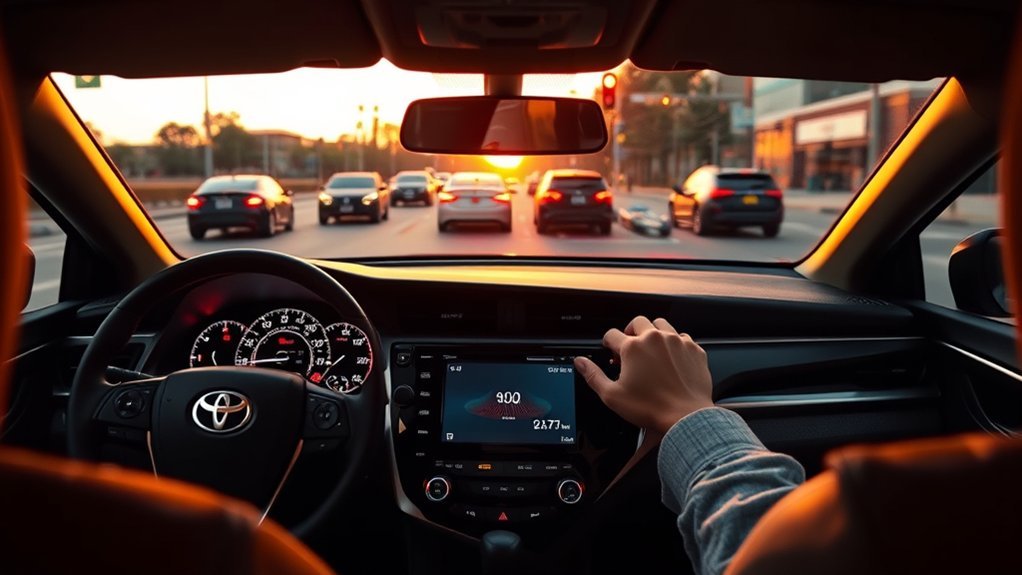
Toyota describes Eco Mode on the current Camry as a setting that helps achieve lower fuel consumption during trips involving frequent acceleration and braking. It does not provide a guaranteed MPG increase or create one fixed operating pattern for every Camry.
On many equipped models, Eco Mode moderates the relationship between initial accelerator-pedal movement and requested driving force. The car may feel less eager during the first part of pedal travel, which can make gradual acceleration easier. Pressing the accelerator farther still requests additional power when traffic or terrain requires it.
Certain Camry generations also change parts of the powertrain or climate-control strategy in Eco Mode. You may notice a calmer accelerator response, less aggressive heating or cooling, or restricted automatic fan operation. These changes encourage efficiency; they do not create a fixed vehicle-speed limit.
A gasoline Camry with a conventional automatic transmission does not use the same powertrain strategy as a Camry Hybrid with an electronic continuously variable transmission. Even within one generation, trim, drivetrain, software calibration, and sales market can affect what the driver notices.
Best Times to Use Eco Mode
Eco Mode is most helpful when your route does not require repeated bursts of acceleration. The setting can support smoother inputs, but the greatest difference still comes from how you drive.
Daily City Driving
Eco Mode can work well in moderate urban traffic. Its gentler initial response may help you pull away from traffic lights gradually instead of surging toward the next stop.
Look several vehicles ahead and ease off the accelerator when traffic begins slowing. On a hybrid Camry, gradual deceleration can give the regenerative braking system more opportunity to recapture energy, although no hybrid can recover all the energy used to accelerate.
Relaxed Highway Cruising
You can use Eco Mode on the highway when traffic is moving steadily and frequent acceleration is unnecessary. Maintaining a consistent legal speed normally matters more than which drive mode is selected.
Once the vehicle is cruising at a stable speed and power demand is low, the difference between Eco and Normal may be small. Eco Mode can still help a driver avoid unnecessary pedal movements as traffic speed changes slightly.
Routine Commutes and Light Loads
Eco Mode suits familiar routes with ordinary passenger and cargo loads. It can be comfortable for drivers who prefer a calm accelerator rather than a sensitive initial response.
Mild weather can also make any climate-control tradeoff less noticeable. In extreme heat or cold, use the heating, air conditioning, and defogging settings needed for comfort and clear visibility.
Slow-Moving Traffic
Eco Mode can make low-speed accelerator inputs easier to control in moving stop-and-go traffic. It cannot, however, make an inefficient driving pattern efficient. Racing forward and braking hard still wastes energy.
FuelEconomy.gov reports that aggressive driving can reduce gas mileage by roughly 10% to 40% in stop-and-go traffic. Eco Mode helps only when it supports smoother driving.
When to Switch Out of Eco Mode
You do not normally need to turn Eco Mode off to protect the engine or transmission. The vehicle can still provide more power when you press the accelerator farther. Another mode may simply give you a response that feels better for the situation.
Merging or Passing
You can remain in Eco Mode while merging or passing and apply additional accelerator pressure when needed. Do not delay necessary acceleration because you are trying to preserve a dashboard economy reading.
Normal or Sport Mode may feel more natural if you prefer a quicker initial response. Changing the mode is optional; it does not add tire grip, shorten the distance needed to pass, or replace a safe gap in traffic.
Warning: Never delay necessary acceleration, windshield defogging, heating, or cooling merely to remain in Eco Mode. Visibility, control, and safe positioning in traffic come first.
Steep Hills
Eco Mode can remain selected on a hill, and the powertrain can still respond to greater accelerator input. However, the initial pedal response may feel subdued. Normal or Sport may provide a more direct feel if your Camry is equipped with those settings.
Climbing requires additional energy in every mode. A lower instantaneous or trip MPG reading on a steep grade does not, by itself, indicate a malfunction.
Extreme Weather or Windshield Defogging
On certain Camry models, Eco Mode changes heating, cooling, compressor, or automatic fan operation to prioritize efficiency. Adjust the climate controls or leave Eco Mode when you need stronger cooling, heating, or windshield clearing.
FuelEconomy.gov’s hot-weather guidance confirms that air-conditioning demand can reduce fuel economy. That is not a reason to tolerate an unsafe cabin temperature or an obstructed view through the windows.
Snow, Rain, or Low-Traction Conditions
A gentler accelerator response can sometimes make a smooth start easier, but Eco Mode is not a traction-control system, snow mode, or substitute for suitable tires. It does not increase grip or shorten stopping distance.
Reduce speed, leave more room, make gradual steering and braking inputs, and follow model-specific instructions for traction-control or drive-mode settings.
Eco Mode vs. Normal, Sport, EV Mode, and the Eco Indicator
The best setting depends on the response you want and the equipment fitted to your Camry. Your vehicle may not include every item shown below.
| Setting or Indicator | Typical Feel or Function | Best Used For | Important Limitation |
|---|---|---|---|
| Eco Mode | Often moderates initial accelerator response; other control changes vary | Routine commuting, moderate traffic, and relaxed cruising | Does not guarantee better MPG or replace efficient driving habits |
| Normal Mode | Balanced, predictable response | Mixed conditions and everyday driving | May feel more sensitive than Eco Mode |
| Sport Mode | Quicker response on equipped models | Curving or hilly roads, or whenever the driver prefers a more immediate feel | Does not add traction or require the driver to use aggressive inputs |
| EV Mode | Requests limited electric-only operation on an equipped hybrid | Short, low-power movement when system conditions allow | May be rejected or canceled because of battery state, temperature, speed, or power demand |
| Eco Driving Indicator | Shows when accelerator use falls within an economical range on certain models | Feedback about driving technique | It may not represent a selected drive mode and can turn on or off as pedal input changes |
EV Mode is not a stronger version of Eco Mode. Eco Mode changes vehicle response or supporting systems to encourage efficiency. EV Mode requests condition-limited electric-only propulsion from the hybrid system.
The gasoline engine may start automatically whenever the hybrid system requires it. Do not apply a universal 20-mph cutoff to every Camry because battery charge, temperature, vehicle speed, accelerator demand, and model-specific programming affect availability.
Does Toyota Camry Eco Mode Actually Save Gas?
Eco Mode may help if its gentler response changes the way you accelerate, brake, and manage speed. Toyota does not publish one universal percentage improvement for every Camry, route, driver, and climate.
A driver who already accelerates gradually may notice little difference between Eco and Normal. A driver who frequently makes abrupt pedal inputs may gain more from the smoother response. Pressing the pedal much farther to compensate for Eco Mode can erase part or all of the benefit.
Judge the result over several comparable trips rather than one short dashboard reading. Traffic, wind, temperature, trip length, tire pressure, fuel formulation, climate-control demand, and vehicle load can all change the displayed MPG.
Pro Tip: Compare Eco and Normal over the same regular route for several complete trips. Reset the trip meter, keep speed and climate settings similar, and compare calculated fuel use or a longer-term average instead of relying on one brief reading.
How to Get Better Results From Eco Mode

The button alone cannot create efficient driving. Use Eco Mode as a reminder to reduce unnecessary speed changes and plan your movements earlier.
- Accelerate progressively: Apply steady pressure instead of stabbing the accelerator.
- Anticipate traffic: Ease off early when a light changes or vehicles ahead begin slowing.
- Maintain a sensible speed: Fuel economy generally falls as highway speed and aerodynamic drag increase.
- Brake gradually when safe: Hybrid models can recover some energy through regenerative braking, but abrupt stops still waste energy.
- Check tire pressure: Use the cold pressure listed on the driver’s door-jamb label, not the maximum printed on the tire sidewall.
- Remove unused cargo: Extra weight and external racks increase energy demand.
- Use climate control sensibly: Keep the cabin safe and comfortable without selecting a more extreme temperature than necessary.
- Maintain the vehicle: Address warning lights and follow Toyota’s specified fluids, oil grade, tire requirements, and maintenance schedule.
DOE and EPA fuel-economy guidance emphasizes moderate acceleration, sensible highway speed, reduced idling, and steady driving. Those habits can have a greater effect than switching between Eco and Normal Mode.
Government vehicle-maintenance guidance also confirms that correct tire pressure supports fuel economy, tire life, and safety.
Short Trips and Cold Starts
Eco Mode can be used on a short trip, but short journeys are not ideal for maximum fuel economy. The engine and emissions system may spend much of the trip warming up, while heating, defrosting, or cooling represents a larger share of the total energy used.
FuelEconomy.gov’s cold-weather guidance explains that cold temperatures affect short trips more because the vehicle spends a larger portion of the journey below its most efficient operating temperature. Combining several errands into one warmed-up trip can help more than repeatedly selecting Eco Mode after separate cold starts.
What You May Notice While Driving in Eco Mode
The most noticeable difference is often accelerator feel. Your Camry may respond more gently during the first part of pedal travel, making routine urban driving feel calmer and reducing accidental surges in traffic.
Some drivers find that response too subdued when entering a highway or climbing a grade. That does not necessarily indicate a fault. Apply more accelerator when needed, or select Normal or Sport if you prefer a more direct initial response.
Certain models may also change climate-control operation. The cabin can take longer to reach a demanding temperature setting when Eco-related climate control is active. Use the comfort and defogging settings you need instead of accepting poor visibility or unsafe heat or cold.
Eco Mode should not cause warning lights, harsh mechanical operation, unusual noises, severe hesitation, or abnormal loss of power. Those symptoms require diagnosis and should not be dismissed as normal drive-mode behavior.
Toyota Camry Eco Mode Troubleshooting
There Is No ECO Button
Your Camry may not have a selectable Eco Mode, or the control may be incorporated into a drive-mode selector rather than a separate button. Check the center console, instrument-panel menus, and the owner’s manual for your exact year and trim.
The ECO Symbol Comes and Goes
You may be seeing the Eco Driving Indicator rather than an Eco drive-mode indicator. On equipped models, the Eco Driving Indicator can turn off when accelerator input leaves the economical range and return when driving becomes gentler.
Eco Mode Does Not Stay Selected After Restarting
Mode-memory behavior varies. Some vehicles return to a default mode after the powertrain is restarted, while others may retain certain settings. This behavior is not proof of a malfunction unless it conflicts with the instructions for your model.
Eco Mode Feels the Same as Normal
The calibration difference can be subtle, especially during steady cruising or very gentle acceleration. Compare the response from a stop or during moderate acceleration, but do not perform abrupt tests in traffic.
A Warning Light or Abnormal Power Loss Appears
A check-engine light, hybrid-system warning, overheating warning, harsh operation, unusual noise, or severe power loss is not a normal Eco Mode characteristic. Follow the warning message, stop when required, and arrange qualified diagnosis.
Common Toyota Camry Eco Mode Myths
Myth: Eco Mode Always Increases MPG
Eco Mode can encourage efficient inputs, but it cannot guarantee an improvement. A driver who compensates for the gentler response by pressing the accelerator farther may see little or no benefit.
Myth: Leaving Eco Mode On Harms the Engine
Eco Mode is a factory-designed operating setting intended for normal vehicle use. Using it as described should not damage the powertrain. Investigate warning lights, unusual noises, harsh operation, overheating, or abnormal power loss rather than assuming the selected mode caused them.
Myth: Eco Mode Prevents Safe Acceleration
On many implementations, Eco Mode changes the response to initial pedal movement rather than imposing a low fixed power ceiling. Press the accelerator farther when necessary. Choose another mode if its more immediate response feels easier to control.
Myth: Every Camry EV Mode Has the Same Speed Limit
EV Mode availability and cancellation conditions depend on the specific hybrid system. Battery charge, temperature, vehicle speed, climate demand, and accelerator input can affect operation. Follow the instructions for your Camry instead of applying one number to every version.
Related Guides
Frequently Asked Questions
When should you use Eco Mode on a Toyota Camry?
Use it during routine commuting, moderate stop-and-go traffic, and steady cruising when you do not need an especially sensitive initial accelerator response. It is most useful when it encourages smooth acceleration, early coasting, and gradual braking.
How do you turn on Eco Mode in a Toyota Camry?
Start the vehicle, locate the ECO button or drive-mode selector near the center console, select Eco, and confirm that the Eco drive-mode indicator or confirmation message appears. Controls vary, so use the instructions for your model year.
Why does my Camry not have an Eco Mode button?
Your year or trim may not have selectable Eco Mode, or the function may be part of a multi-mode selector. A green ECO symbol may also be an Eco Driving Indicator rather than a selected mode. Check the owner’s manual and the controls fitted to your vehicle.
Is it okay to drive in Eco Mode all the time?
It is generally suitable for normal driving when used as Toyota describes. You can apply more accelerator when needed or select Normal or Sport if you prefer a more immediate response. Always prioritize safe acceleration, visibility, heating, cooling, and defogging.
Does Eco Mode help on the highway?
It may help if it reduces unnecessary acceleration and speed changes. During steady cruising, the difference can be small because speed and power demand are already stable.
Do you have to turn off Eco Mode before merging or passing?
No. You can remain in Eco Mode and press the accelerator farther to request more power. Normal or Sport may feel more responsive, but changing modes is optional and should never distract you from selecting a safe gap in traffic.
Does Eco Mode stay on after you restart the Camry?
That depends on the model year and control system. Some Camrys return to a default drive mode when restarted. Check the instrument display after startup and follow the mode-memory description in your owner’s manual.
Can Eco Mode damage the engine or transmission?
Normal use of a factory-installed Eco Mode should not damage the powertrain. Warning lights, overheating, unusual noises, harsh operation, or abnormal power loss should be inspected rather than treated as normal Eco Mode behavior.
When should you avoid Eco Mode?
Choose another mode when you prefer a more immediate accelerator response or when an Eco-related climate setting is not providing enough heating, cooling, or defogging. Safety, visibility, and control are more important than possible fuel savings.
What is the difference between Eco Mode and EV Mode?
Eco Mode adjusts vehicle response or supporting systems to encourage efficient driving. EV Mode, available on equipped hybrids, requests limited electric-only operation. The hybrid system can reject or cancel EV Mode when its operating conditions are not met.
Conclusion
Eco Mode is a practical everyday setting when you want a gentler initial accelerator response during commuting, moderate traffic, or relaxed cruising. You can normally request more power by pressing the accelerator farther, so changing modes for every merge, pass, or hill is unnecessary.
Do not expect the mode selector to overcome speeding, abrupt acceleration, repeated braking, cold short trips, low tire pressure, heavy climate demand, or excess cargo. Confirm that your Camry has a selectable Eco Mode rather than only an Eco Driving Indicator, then use the setting as one part of a smooth, efficient driving routine.
Sources
- Toyota 2025 Camry Quick Reference Guide — current-generation drive-mode controls, intended uses, indicators, and EV Mode guidance.
- FuelEconomy.gov: Driving More Efficiently — acceleration, braking, highway speed, idling, cargo, and aggressive-driving estimates.
- FuelEconomy.gov: Keeping Your Vehicle in Shape — tire pressure, warning lights, maintenance, and recommended-oil guidance.
- FuelEconomy.gov: How Hybrids Work — regenerative braking, motor assistance, and automatic engine stop-start operation.
- FuelEconomy.gov: Fuel Economy in Hot Weather — air-conditioning demand and efficient cabin-cooling practices.
- FuelEconomy.gov: Fuel Economy in Cold Weather — cold-start, heating, tire-pressure, and short-trip fuel-economy effects.
