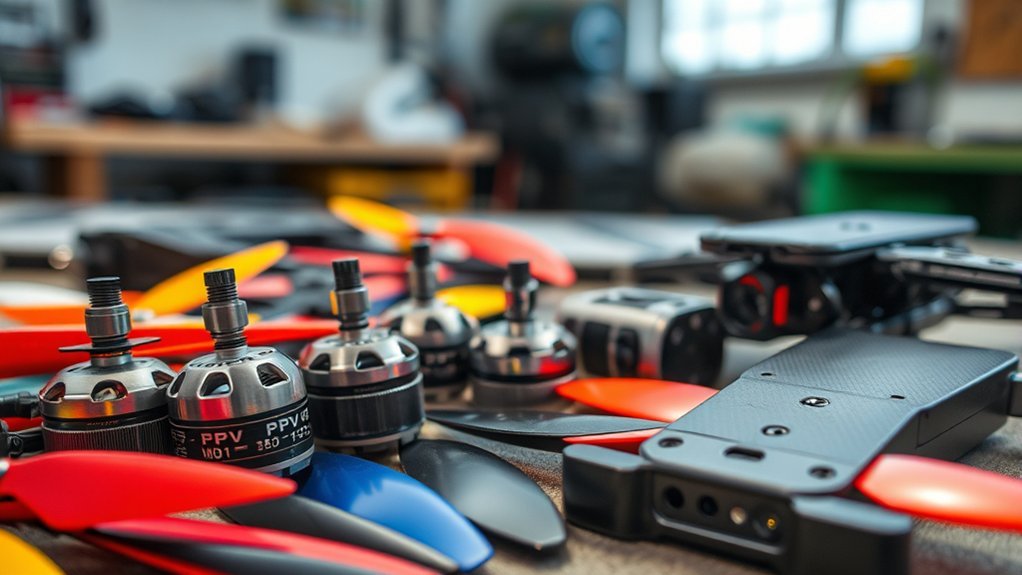
To choose FPV motors, treat the motor, propeller, battery, ESC, and drone weight as one system. Start with the frame and propeller size, estimate the finished all-up weight, choose the battery cell count, then select a stator size and KV range that fit that load. KV describes unloaded motor speed per volt; it does not directly measure power or torque. Before buying, verify the exact motor-and-prop test data for thrust, current draw, efficiency, supported voltage, mounting pattern, and shaft or prop fit.
Last updated: September 21, 2026 — motor/KV guidance, thrust terminology, manufacturer test-data guidance, and Betaflight safety references rechecked.
Quick Answer
Choose FPV motors in this order: frame and prop size → all-up weight → battery voltage → motor stator size and KV → thrust/current data → physical fit. Higher KV gives more unloaded RPM per volt, while lower KV is commonly paired with higher voltage or larger props. Do not choose by KV alone; confirm the exact motor, propeller, battery, and ESC combination before flying.
Key Takeaways
- Start with frame size and propeller size before choosing motor KV.
- KV is unloaded RPM per volt, not a direct measure of motor power or torque.
- About 2:1 maximum thrust-to-weight is a useful minimum planning baseline; performance FPV builds commonly use substantially more headroom.
- Check the exact propeller, battery voltage, thrust, current draw, ESC rating, mounting pattern, and screw length before buying.
At a Glance
| Time Required | 20 to 45 minutes for planning and checking motor data |
| Difficulty | Beginner to intermediate |
| Tools Needed | Frame specs, prop size, motor thrust table, battery specs, ESC rating, small scale, screwdriver, soldering tools |
| Cost | Varies by motor size, brand, build type, and quantity needed |
How to Choose FPV Motors Step by Step
Use the same selection order for almost every custom FPV build. It prevents you from choosing an attractive KV number first and trying to force the rest of the components around it.
- Set the frame and propeller size. The frame determines the prop diameter you can physically run.
- Estimate all-up weight. Include the battery, camera, GPS, straps, wiring, hardware, and any action camera or payload.
- Choose the battery cell count. Higher voltage usually calls for lower KV when the prop and motor size stay similar.
- Choose a stator-size and KV range. The stator must have enough torque capacity for the propeller load, while KV must suit the intended battery voltage.
- Verify the exact combination. Check the manufacturer’s thrust table for the exact prop, voltage, thrust, current, watts, and efficiency. Then confirm ESC capacity, motor mount, shaft/prop attachment, arm thickness, and screw length.
A manufacturer’s test table is more useful than KV alone. For example, T-Motor’s V2207 V3 data lists different supported voltages, current draw, thrust, RPM, power, and efficiency for individual KV and propeller combinations.
Understanding Motor Types: Brushless vs. Brushed
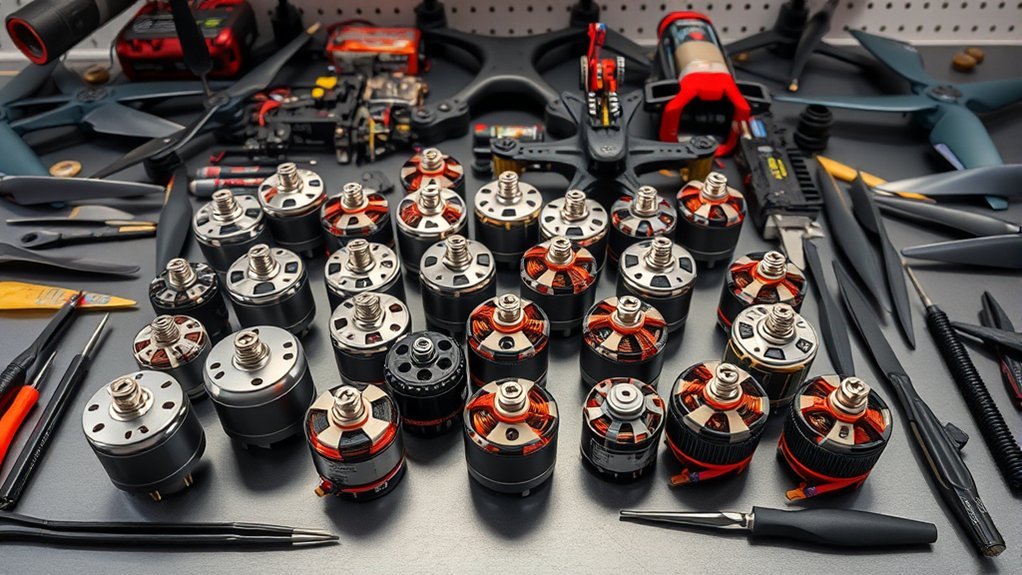
Brushless motors are the standard choice for modern custom FPV builds because they offer high power-to-weight performance, good efficiency, long service life, and fast electronic control through an ESC. They do not use physical brushes rubbing against a commutator, which reduces mechanical wear.
Brushed motors are simpler and cheaper but wear faster and are normally limited to small toy-grade or older micro drones. For most 3-inch, 5-inch, 7-inch, racing, freestyle, long-range, cinewhoop, and payload-focused FPV builds, brushless motors are the practical choice.
Brushless motors also let you match different stator sizes, KV ratings, propellers, and battery voltages. The important point is that these values must be selected together rather than treating any one motor specification as a performance score.
What Does KV Mean on an FPV Motor?
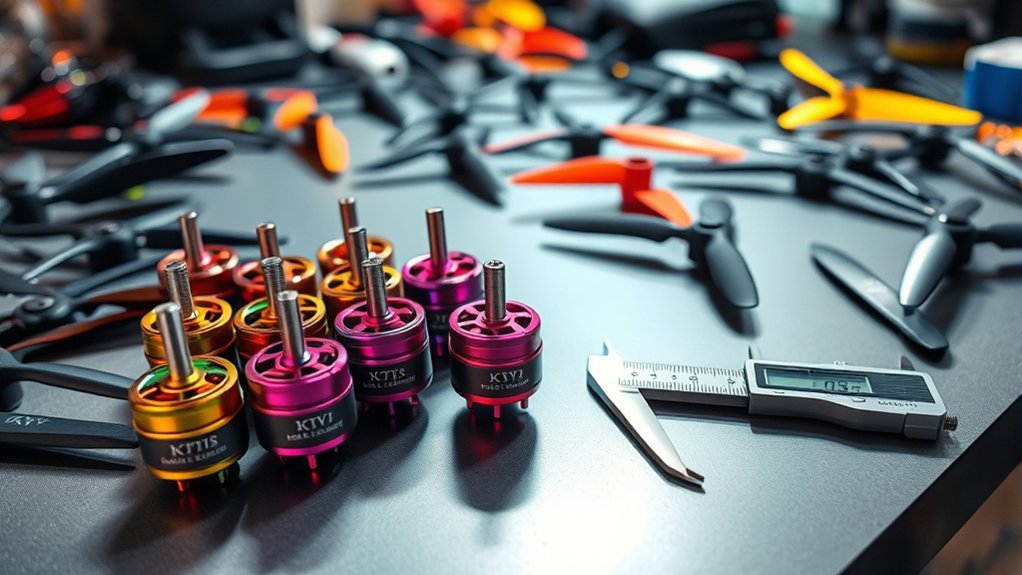
KV describes a motor’s approximate unloaded RPM per volt. A 2300KV motor theoretically attempts about 2,300 RPM for each volt applied when no propeller is attached. Once a propeller loads the motor, actual RPM is lower.
KV is not a direct power or torque rating. A small high-KV motor may spin quickly but still be unsuitable for a large propeller. A larger motor with lower KV can have much more stator volume and greater ability to control a heavy prop. Always evaluate KV with stator size, propeller load, battery voltage, current draw, ESC capacity, and all-up weight.
What Changes When KV Goes Higher?
Higher KV increases unloaded RPM potential at the same voltage. When the full system is matched correctly, that can create a more aggressive top end and is common on smaller props or lower-voltage performance builds. For example, a 2300KV motor has a theoretical no-load speed of about 34,040 RPM at 14.8V nominal and 38,640 RPM at 16.8V fully charged. Loaded RPM will be lower.
Higher KV is not a guarantee of faster acceleration. Throttle response also depends on stator design, torque reserve, propeller diameter, pitch, blade count, rotating mass, voltage, and tuning. Increasing KV or prop load can also increase current and motor temperature, so check the exact manufacturer’s test data rather than assuming a higher number is automatically better.
How Does Battery Voltage Change the KV You Need?
Battery voltage is one of the strongest constraints on KV. For a conventional 5-inch build, a common starting region is roughly 2300KV to 2800KV on 4S and 1600KV to 2100KV on 6S, with the exact choice depending on motor size, propeller, weight, and flying style. Current manufacturer options show the same pattern: T-Motor offers its V2207 V3 in 2550KV for 4S and lower-KV versions such as 1750KV, 1950KV, and 2050KV for 6S.
Smaller props often use substantially higher KV, while long-range 7-inch builds generally use lower KV than 5-inch quads. For a 7-inch 6S long-range build, around 1300KV is a common starting direction, but there is no universal KV for every 7-inch motor. Cinelifters and larger payload aircraft vary even more, so check the exact motor-and-prop test data instead of applying one broad “large drone” range.
Note: KV is only one part of motor selection. Always check thrust data, recommended prop size, battery voltage, maximum current, and motor temperature guidance before choosing a motor.
How Do You Estimate Drone Weight and Frame Size?
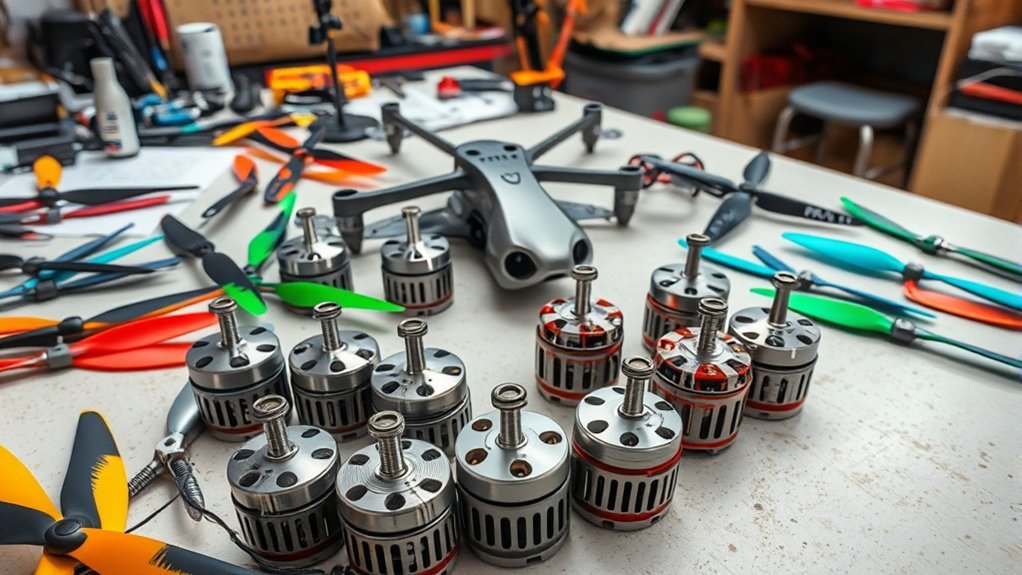
Estimate all-up weight (AUW) by adding the frame, four motors, ESC, flight controller, propellers, battery, camera, video transmitter, receiver, antenna, GPS module if used, screws, wiring, straps, action camera, and any payload. If you have not bought every part yet, use listed component weights and include a conservative allowance for wiring and hardware rather than assuming a fixed number of grams for every build.
Next, confirm what propeller diameter the frame supports. A conventional 5-inch frame is designed around roughly 5-inch props, while 3-inch and 7-inch frames target their respective prop classes. Larger props generally require more motor torque and often more stator volume.
Also verify the motor mounting pattern, mounting screw diameter, arm thickness, shaft or prop-mount type, and available clearance. A correct electrical combination is still unusable if the motor does not physically fit the frame or propeller.
How Much Thrust Does an FPV Drone Need?

A multirotor can theoretically hover once total available thrust exceeds its weight, but operating that close to 1:1 leaves almost no reserve for climbing or correcting disturbances. About 2:1 maximum thrust-to-weight is a useful minimum planning baseline because it leaves meaningful control headroom. Performance FPV builds normally use substantially more.
For example, if a quad weighs 1 kg and you use a 2:1 planning ratio, target at least 2 kg of combined maximum thrust, or about 500 grams per motor. For freestyle, a ratio around 4:1 to 5:1 or higher provides much stronger acceleration and recovery. Racing builds can go significantly beyond that. The right ratio depends on whether you prioritize efficiency, payload, smooth video, freestyle response, or maximum acceleration.
| Weight (kg) | 2:1 Planning Thrust (kg) |
|---|---|
| 0.5 | 1.0 |
| 1.0 | 2.0 |
| 1.5 | 3.0 |
| 2.0 | 4.0 |
| 2.5 | 5.0 |
When reading a motor thrust table, match the exact propeller and battery voltage. Compare thrust, current, power, and efficiency rather than looking only at the highest thrust number. A motor can produce excellent peak thrust with an aggressive prop while pulling too much current for your ESC or battery.
A motor choice is only good if the full system works together: motor, prop, battery, ESC, frame weight, cooling, and flying style.
How Do You Choose the Right FPV Motor Size?

FPV motor size usually appears as a four-digit number such as 2207, 2306, or 2806. The first two digits describe stator diameter in millimeters and the last two describe stator height. A 2306 motor therefore has a stator about 23 mm wide and 6 mm tall.
Increasing stator volume generally increases a motor’s ability to produce torque and control a heavier propeller, but it also adds motor mass. Stator shape matters too. Taller and narrower motors and wider, shorter motors can have different rotational inertia, cooling, bearing size, and response characteristics even when their overall stator volumes are similar.
For conventional 5-inch FPV, 2207 and 2306 are common modern sizes, although other sizes can work. Larger 6-inch and 7-inch props usually call for more stator volume. The correct size still depends on AUW, prop pitch and blade count, battery voltage, and the manufacturer’s test data.
Common Motor and Prop Size Pairings
Use propeller diameter to narrow the motor-size range, then verify the exact combination. Propeller pitch, blade count, and mass also affect load: an aggressive tri-blade can draw far more current than a light low-pitch prop of the same diameter.
| Drone / Prop Size | Common Motor Size | Typical Use |
| 2-inch to 2.5-inch | 1103 to 1404 | Tiny freestyle, toothpick, indoor/outdoor micro builds |
| 3-inch | 1404 to 1507 for many open-prop builds | Compact freestyle, light cinematic, fast park flying |
| 4-inch | 1804 to 2004 | Sub-250g builds, cruising, efficient freestyle |
| 5-inch | 2207, 2306, and similar 22xx/23xx sizes | Freestyle, racing, general FPV |
| 6-inch to 7-inch | 2507, 2806, 2807, and similar | Long range, smooth cruising, heavier freestyle |
| 8-inch and larger | Application-specific larger low-KV motors | Cinelifters, payload drones, endurance builds |
Cinewhoop exception: a ducted 3-inch build can place more load on its motors than a light open-prop 3-inch quad, so cinewhoops may use more stator volume than the basic 3-inch row suggests.
[Amazon Products Picked for You]

brute force motor, XSPEED 2207.5 brushless motor,Fine workmanship, high quality materials, strong explosive force

1. SUNFUN2207 brushless motor is the upgraded FPV Motor, 12N 14P high torque motor design, which is smooth, reliable and powerful.
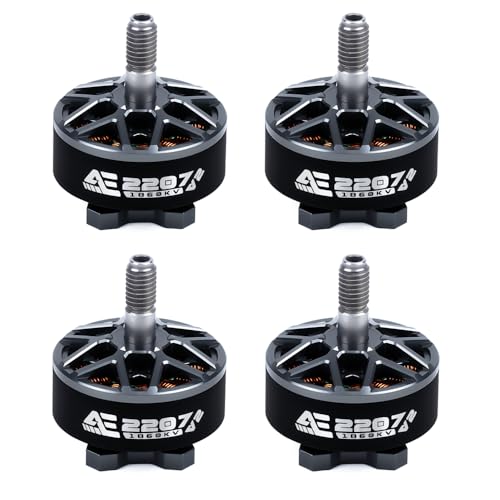
IP53 rating dustproof and waterproof bearing placement design.
What Controls Motor Torque and Responsiveness?
Torque is the motor’s ability to control the propeller under load. Responsiveness describes how quickly the motor-prop system can change RPM after a throttle command or flight-controller correction.
- Stator volume: More stator volume generally increases torque capability but also adds weight.
- Motor geometry: Stator diameter and height affect rotational inertia, cooling, magnet dimensions, bearings, and response.
- Propeller load: Diameter, pitch, blade count, and prop mass determine how hard the motor must work.
- Motor construction: Magnets, windings, air gap, bearings, laminations, and manufacturing quality affect real performance.
For freestyle, prioritize enough torque reserve for recovery and prop-wash control without unnecessary motor weight. Racing builds often prioritize sharp response and low rotating mass. Long-range builds normally put cruise efficiency and sustained temperature ahead of maximum punch.
How Do Battery Voltage and Discharge Rate Affect Motor Choice?
LiPo cell count determines battery voltage. A 4S battery is 14.8V nominal and 16.8V fully charged. A 6S battery is 22.2V nominal and 25.2V fully charged. Because 6S applies more voltage, a comparable 5-inch setup normally uses lower KV than a 4S setup.
Battery discharge capability must also support the motor system. C rating multiplied by capacity in amp-hours gives the pack’s stated theoretical current figure. For example, 1.3Ah × 30C = 39A. Treat this as a specification to compare against the battery maker’s guidance, not as proof that every pack will maintain that current under all conditions. Battery condition, temperature, voltage sag, connectors, and wiring affect real performance.
Battery weight belongs in AUW. Choose a capacity appropriate for the intended cell count and flight goal, then recalculate AUW and verify thrust/current with that exact battery weight. Adding a larger pack can extend usable energy but eventually makes the aircraft heavier, less agile, and harder for the propulsion system to carry efficiently.
Warning: Do not pair high KV, high battery voltage, and an aggressive propeller without checking test data. The combination can sharply increase current and heat, overstress the ESC or battery, and cause an in-flight failure.
What ESC Rating Does an FPV Motor Need?
The ESC must support both the battery voltage and the current demanded by the exact motor-and-prop combination. Read the motor test table and compare maximum current with the ESC’s per-channel continuous and burst ratings. On a 4-in-1 ESC, also follow the manufacturer’s total-board limitations and cooling requirements.
For example, if a tested motor/prop combination reaches 35A per motor, an ESC channel rated only for 35A continuously leaves little margin for changing conditions or transient load. A higher-rated ESC may be appropriate, but the correct margin depends on the manufacturer’s ratings, airflow, burst duration, and build.
Voltage support is separate from amperage. Do not connect a 6S pack to an ESC that is not rated for 6S. Inspect solder joints, capacitor installation, motor-wire clearance, and firmware configuration before the first powered test.
[Amazon Products Picked for You]

High-Performance ESC: Supports input voltage range of 6V to 28V and delivers continuous 60A current per channel for optimal power and responsiveness.
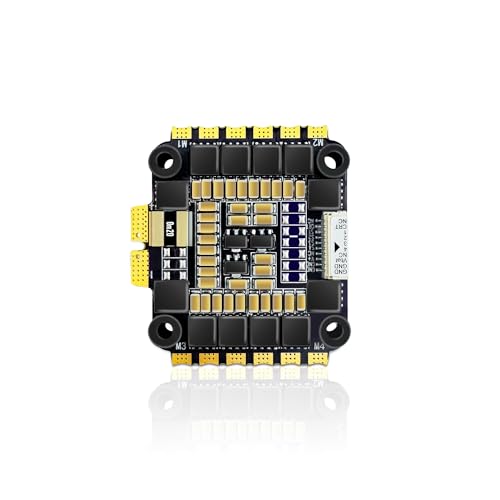
Powerful 55A 4-IN-1 ESC: 55A continuous current, 65A peak current, ready for your 3S-6S battery.
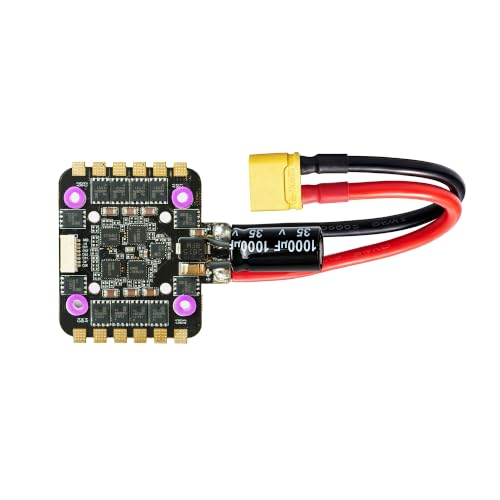
Stable 70A Power Output – Supports 2‑6S LiPo batteries, delivering 70A continuous current (80A peak for 5 seconds). Provides reliable power for both racing drones and heavy‑lift platforms.
How Do You Connect and Mount FPV Motors Safely?
Verify the motor’s mounting pattern, screw diameter, arm thickness, and screw length before installation. A screw that reaches into the windings can permanently damage the motor. Route the three motor wires so they cannot contact the propellers or a sharp carbon edge.
Motor Installation Techniques
Use this installation sequence:
- Align the motor mounting holes with the frame. Common patterns vary by motor class, so confirm the motor drawing instead of assuming one pattern.
- Use the specified M2 or M3 screws and confirm that the threaded section cannot reach the windings.
- Connect the three motor wires to the ESC. Swapping any two wires reverses a conventional brushless motor, while supported ESC firmware can also change motor direction electronically.
- Insulate and secure wiring where needed so vibration or a crash cannot move it into a propeller.
Before installing propellers, verify motor order and direction in your flight-controller software. Betaflight’s official Motors Tab documentation specifically instructs users to remove the props before motor testing.
Secure Wiring Practices
Solder each motor wire cleanly to the ESC and route it along the frame away from propellers and sharp edges. Zip ties, cloth tape, or other suitable restraints can stop wiring from moving during vibration or a crash.
After a crash, inspect the motor bell, shaft, bearings, screws, windings, wiring, and propeller before flying again. A damaged prop or bearing can create vibration and heat even when the motor still spins.
Pro Tip: Before installing props, use a current-limiting smoke stopper during first power-up when appropriate and test motor order and direction in your configurator. Never bench-test motor rotation with propellers installed.
What Specs Matter Most When Comparing FPV Motors?
- Stator size: It helps indicate the motor’s torque capacity and suitability for the intended prop load.
- KV: Match unloaded speed potential to battery voltage and propeller load rather than comparing KV in isolation.
- Manufacturer test data: Compare thrust, current, watts, and efficiency using the exact propeller and voltage you plan to run.
- Physical compatibility: Confirm mounting pattern, screw size, shaft or prop attachment, motor weight, and available frame clearance.
Secondary construction details such as bearings, magnets, windings, shaft design, bell construction, and spare-parts availability can help distinguish two otherwise similar motors. They should not replace verified thrust/current data for the intended setup.
[Amazon Products Picked for You]

IP53 rating dustproof and waterproof bearing placement design.

This motor can support 3-4s lipo battery, more powerful and better faster.

Item name: 2204 2300KV Brushless Motor CCW CW
Example Motor Directions by Flying Style
Use these as starting directions rather than fixed prescriptions:
- 5-inch freestyle: 2207 or 2306 is common. Roughly 2300–2800KV is common territory on 4S, while roughly 1600–2100KV is common on 6S.
- 5-inch racing: Prioritize low motor weight, strong response, and enough current/thermal headroom for the intended racing prop.
- 3-inch open-prop freestyle: Motors around the 1404–1507 class are common, but KV varies greatly with battery voltage.
- 7-inch long range: Larger stator volume and lower KV help manage the larger prop efficiently; around 1300KV is a common 6S starting direction for many 7-inch builds.
- Cinewhoop: Ducted props can create substantial load, so torque capacity, temperature, and smoothness matter more than chasing maximum unloaded RPM.
Common FPV Motor Selection Mistakes
- Choosing KV first: Start with frame, propeller, AUW, and battery voltage.
- Treating KV as torque or power: KV is primarily an unloaded speed constant.
- Ignoring prop pitch and blade count: Two props with the same diameter can load a motor very differently.
- Ignoring ESC limits: Check cell count plus continuous and burst current ratings.
- Using screws that are too long: A screw that reaches the windings can destroy the motor.
- Forgetting battery and payload weight: Calculate ready-to-fly AUW, not just dry frame weight.
- Reading only maximum thrust: Compare current, efficiency, and the exact test prop and voltage.
- Testing with props installed: Remove propellers during bench motor tests.
How Do You Troubleshoot Hot or Weak FPV Motors?
If the quad feels weak, twitchy, unusually hot, or unstable, inspect the complete propulsion system before replacing motors. Common causes include excessive prop load, bent or damaged props, excessive AUW, damaged bearings, bent bells or shafts, loose hardware, vibration, poor solder joints, filtering problems, or an unsuitable tune.
If one motor runs noticeably hotter than the other three, inspect that arm for mechanical damage, wiring problems, a damaged prop, bearing play, or frame vibration. If all four motors heat abnormally after gentle flying, recheck prop load, motor/voltage compatibility, filtering, and PID settings.
Touch can reveal an obvious heat problem, but it is not a calibrated temperature test. Use ESC temperature telemetry where available or an infrared thermometer, and follow the motor manufacturer’s temperature limits. Betaflight’s PID tuning documentation also provides motor-output and tuning controls relevant to high-KV or higher-cell-count setups.
Related Guides
Frequently Asked Questions
What KV motor should I get for my FPV?
For many conventional 5-inch FPV drones, roughly 2300KV to 2800KV is common on 4S and roughly 1600KV to 2100KV on 6S. Smaller props may use much higher KV. Always match KV with stator size, propeller load, battery voltage, thrust requirements, and ESC limits.
How do I choose the right KV motor?
Start with frame and prop size, estimate ready-to-fly weight, and choose the battery cell count. Then select a stator size and KV range that fit the load. Finish by checking manufacturer thrust/current data for the exact propeller and voltage you plan to use.
How much thrust should my FPV motors produce?
A multirotor can theoretically hover once thrust exceeds its weight, but about 2:1 maximum thrust-to-weight is a useful minimum planning baseline because it leaves control and climb headroom. Freestyle commonly benefits from roughly 4:1 to 5:1 or more, while racing builds can use substantially higher ratios.
What is the difference between 4S high KV and 6S low KV?
A typical 4S setup uses lower battery voltage and therefore a higher motor KV than a comparable 6S setup. A 6S build uses higher voltage with lower KV to keep usable RPM and prop load in the intended range. Efficiency, current, and throttle feel depend on the exact motor, propeller, and tune rather than cell count alone.
What is the best KV for 6S freestyle?
For many 5-inch 6S freestyle builds, roughly 1700KV to 2050KV is a common starting region. Lower values can favor a calmer or more efficient setup, while higher values can provide a more aggressive top end. Verify the exact motor and propeller test data before choosing.
Can I use 4S motors on a 6S battery?
Do not assume a motor normally used on 4S is automatically safe on 6S. Betaflight can limit motor output for some higher-cell-count combinations, but every component must still support the battery voltage and the motor/prop combination must stay within safe current and temperature limits. Using a motor KV intended for the chosen battery is the simpler approach.
How do I know if my FPV motor is too hot?
Unexpectedly high motor temperature after a gentle hover or normal flight is a warning sign. Check the propeller, motor bearings, screws, frame vibration, motor/voltage match, filtering, and PID tune. Use ESC temperature telemetry or an infrared thermometer when available and follow the motor manufacturer’s temperature guidance.
Conclusion
Choose FPV motors by working from the aircraft outward: frame and propeller size first, then all-up weight, battery voltage, stator size, and KV. After narrowing the options, use manufacturer test data to compare thrust, current, watts, efficiency, and temperature behavior with the exact propeller and voltage you intend to run.
Before installation, verify the motor mount, prop attachment, screw length, ESC cell-count support, and per-channel current rating. Test motor order and direction with the propellers removed. A motor that fits this complete system will be safer, easier to tune, and more predictable than one chosen from KV or peak-thrust numbers alone.
