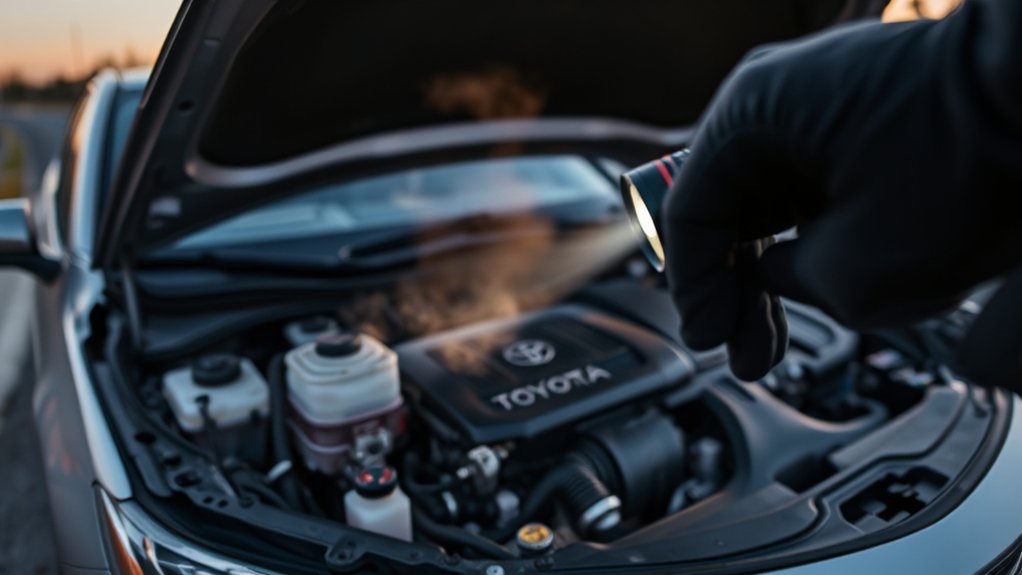
If your Toyota Camry is overheating at idle but cools down once you start moving, the symptom pattern points first to inadequate low-speed airflow through the radiator. A failed cooling fan or fan-control problem is a leading possibility because road speed can provide airflow that is missing while the car is stopped. However, the pattern is a diagnostic clue, not proof of a bad fan: low coolant, trapped air, radiator restrictions, thermostat trouble, water-pump problems, or an internal engine leak can produce similar symptoms.
Last updated: September 11, 2026
Quick Answer
A Toyota Camry that overheats only while idling most often has too little airflow through the radiator, usually because the cooling-fan motor, fuse, relay, wiring, temperature input, fan controller, or surrounding airflow path is not working correctly. If the temperature drops after the vehicle starts moving, treat that as an airflow clue rather than proof of one failed part. Low coolant, trapped air, a restricted radiator, thermostat trouble, weak coolant circulation, or an internal leak can cause similar symptoms.
Key Takeaways
- Overheating mainly at idle strongly points toward a cooling-fan or low-speed airflow problem, but it does not identify the failed component by itself.
- Never remove a radiator or pressurized coolant-reservoir cap while the engine is hot.
- Check the coolant level only after the engine has cooled completely, and investigate any repeated coolant loss.
- Do not rely on universal water-pump, thermostat, fan-temperature, or coolant-flush specifications. Follow the information for your exact Camry year and powertrain.
- Stop driving and follow the model-specific owner’s manual if the high-temperature warning remains on, steam appears, or coolant is escaping rapidly.
At a Glance
| Time Required | About 10–20 minutes for safe cold-engine visual checks; professional diagnosis may take longer |
| Difficulty | Beginner for visual checks; intermediate to advanced for electrical and pressure testing |
| Tools Needed | Gloves, flashlight, clean rag, and the model-year owner’s manual; scan tool and pressure tester are optional |
| Cost | Visual inspection may cost nothing; repair cost depends on the model year and failed component |
Warning: If the temperature gauge enters the hot zone, a high-temperature warning appears, or steam comes from under the hood, move to a safe location and follow the emergency procedure in the owner’s manual for your exact Camry. Do not open a hot radiator or pressurized reservoir cap. Hot coolant and steam can cause severe burns.
Why Does a Toyota Camry Overheat at Idle?
Your Camry’s cooling system must circulate coolant through the engine and move air through the radiator. When the car is moving, outside air naturally passes through the grille. At idle, the electric cooling fan becomes much more important because vehicle movement is no longer providing the same airflow.
Common causes of overheating at idle include:
- Cooling-fan failure: A worn fan motor, blown fuse, failed relay, damaged connector, wiring fault, faulty temperature input, fan-control module, or other control problem may stop the fan from operating correctly. The exact fan-control design varies by model year and powertrain.
- Low coolant: A leak can leave too little coolant in the system to absorb and transfer engine heat.
- Trapped air: Air left after a coolant change or repair can interrupt circulation and cause unstable temperature readings.
- Radiator airflow restriction: Leaves, dirt, damaged fins, or debris trapped between the A/C condenser and radiator can reduce heat transfer.
- Internal radiator restriction: Contamination or deposits may limit coolant flow through the radiator.
- Thermostat failure: A thermostat that does not open correctly can restrict coolant flow to the radiator.
- Water-pump trouble: Leakage, bearing damage, a damaged impeller, or a drive or control-system problem can reduce circulation.
- Pressure loss: A damaged cap, cracked hose, weak clamp, or leaking component can lower system pressure and coolant level.
- Internal engine leak: A damaged head gasket, cracked cylinder head, or another internal fault may force combustion gas into the cooling system or allow coolant to escape internally.
Pro Tip: If the temperature rises while stopped but falls at normal road speed, inspect the cooling-fan system and radiator airflow before assuming the engine needs major internal repairs. The symptom changes the diagnostic order, but it does not prove which component failed.
What Should You Do Immediately if Your Camry Overheats?
- Turn off the air conditioning. This can reduce additional heat load, but it is not a permanent repair.
- Move to a safe location. Pull off the road as soon as conditions allow.
- Follow the model-specific overheating procedure. Camry generations and powertrains differ, so use the owner’s manual for the exact vehicle rather than one universal shutdown routine.
- Stay clear of steam. If hot steam or coolant is escaping heavily, do not open the hood until the steam has subsided and it is safe to approach.
- Do not open the hot cooling system. Never remove a radiator or pressurized reservoir cap while the system is hot.
- Allow the vehicle to cool completely before cold-engine checks. Cooling time varies, so do not rely on a fixed number of minutes.
- Check the reservoir only when safe. Inspect the coolant level after the engine is fully cold and follow the instructions for your specific model year.
- Arrange a tow when necessary. Tow the vehicle if coolant is pouring out, the fan is damaged, the warning remains or returns, or you cannot identify a safe temporary cause.
Turning the cabin heater to maximum may remove a small amount of heat on some vehicles, but use it only while reaching a safe stopping point if conditions allow. Do not use the heater as a reason to continue driving an overheating Camry.
How Do You Troubleshoot a Camry That Overheats at Idle?
Begin with checks that do not require opening the hot cooling system or touching moving electrical components. The symptom pattern helps decide what belongs near the top of the list: cooling-fan and airflow faults move higher when road speed lowers the temperature; coolant-flow, leak, thermostat, radiator, and internal-engine problems move higher when the Camry overheats at every speed; and trapped air or an incorrect fill procedure moves higher when the problem begins immediately after cooling-system work.
Compare When the Overheating Happens
| Symptom Pattern | Areas to Inspect First |
|---|---|
| Overheats at idle but cools while driving | Cooling fan, fan fuse or relay where applicable, wiring, fan control, shroud, condenser and radiator airflow |
| Overheats at idle and highway speed | Low coolant, severe leak, thermostat, radiator restriction, water pump, pressure loss, internal engine leak |
| Temperature changes after recent cooling-system work | Trapped air, incorrect filling procedure, loose connection, wrong coolant mixture or specification |
| Overheats mainly with the A/C running | Cooling fan operation, condenser airflow, fan-control strategy, radiator condition |
| Coolant repeatedly disappears | External leak, cap, heater core, water pump, pressure loss, or internal engine leak |
If your Camry overheats mainly at highway speed rather than at idle, see Toyota Camry overheating at highway speeds. If repeated coolant loss is the main symptom, use the Toyota Camry coolant-leak guide instead of treating every loss as an idle-airflow problem.
Check the Coolant When the Engine Is Cold
After the engine has cooled completely, inspect the level in the coolant reservoir according to the owner’s manual. A low level supports the possibility of a leak, but simply topping it off does not solve the cause of the loss.
Use only the coolant specification and filling method listed for your exact model year and powertrain. Do not select coolant only by its color, because different coolant chemistries may have similar colors.
Inspect for Visible Leaks
Use a flashlight to inspect the reservoir, radiator area, hoses, hose connections, thermostat housing, water-pump area, and the ground under the vehicle. Look for wet areas, dried crusty residue, staining, or a sweet odor.
If the coolant level continues to fall without an obvious external leak, the system may require pressure testing and an internal-leak inspection.
Inspect the Cooling Fan Safely
Warning: An electric cooling fan can start unexpectedly. Keep your hands, tools, clothing, and hair away from the fan and belts whenever you are inspecting the engine compartment.
A fan that never runs when the vehicle commands cooling may have a failed motor, fuse, relay on systems that use one, connector, wire, temperature-sensor input, fan controller, or electronic control problem. A fan that spins slowly, makes grinding noises, or stops intermittently may have a worn motor or damaged blade assembly.
Do not deliberately let the engine enter the hot zone just to see whether the fan starts. On applicable Camrys, a technician can use Toyota-compatible diagnostic equipment to review temperature data and command or evaluate fan operation without intentionally overheating the engine.
Scan for Trouble Codes and Live Data
An OBD-II scan tool may reveal cooling-fan circuit codes, coolant-temperature sensor problems, thermostat-performance codes, or engine-misfire information. Live coolant-temperature data can also help determine whether the dashboard reading agrees with the engine-control system’s reported temperature.
A stored code identifies a circuit or operating condition, not necessarily the exact failed part. Complete the appropriate model-specific tests before replacing components.
What Are the Signs of a Malfunctioning Thermostat?
The thermostat controls coolant flow through the radiator as the engine warms. A thermostat that remains closed or opens too little can cause rapid temperature increases and poor radiator circulation.
Possible signs include:
- The engine temperature rises above normal soon after warm-up.
- Temperature measurements show poor heat transfer to the radiator even though the engine temperature is climbing.
- The temperature changes sharply instead of remaining stable.
- Cabin heat becomes inconsistent because coolant circulation is poor.
- A thermostat-related diagnostic code appears on an applicable model.
A thermostat stuck open usually causes slow warm-up, reduced heater performance, or an engine that runs cooler than intended. It is not the most likely explanation for overheating only at idle.
Temperature fluctuations alone cannot prove the thermostat has failed. Low coolant, trapped air, sensor faults, fan problems, and internal leaks can create similar symptoms. Do not rely on one universal thermostat opening temperature for every Camry.
How Does the Water Pump Affect Camry Overheating?
The water pump circulates coolant through the engine, heater circuit, and radiator. Depending on the Camry’s model year and powertrain, the vehicle may use different pump designs, drive methods, controls, and cooling loops.
| Possible Water-Pump Sign | What It May Mean | Recommended Action |
|---|---|---|
| Coolant residue or wetness near the pump | Pump seal, gasket, housing, or nearby connection may be leaking | Pressure-test and inspect the source |
| Grinding, rumbling, or bearing noise on a mechanical pump system | Pump bearing or drive component may be damaged | Stop and arrange an inspection |
| Overheating at several vehicle speeds | Coolant circulation may be inadequate | Test circulation, thermostat operation, and radiator flow |
| Pump-related diagnostic code on an applicable model | Electrical or commanded pump operation may be abnormal | Follow the model-specific diagnostic procedure |
Do not replace a Camry water pump solely because the vehicle has reached a generic mileage. Toyota service requirements and pump designs vary by year and powertrain. Replace or repair the pump when inspection and testing confirm a fault. For a separate discussion of replacement timing, see Toyota Camry water-pump lifespan and symptoms.
How Do You Spot Coolant Leaks That Cause Overheating?
A puddle beneath your Camry may be coolant, but air-conditioning condensation can also leave clear water under the vehicle. Coolant may be colored, may feel slippery, and can leave pale or crusty residue after drying. Do not taste an unknown fluid or touch it with bare skin.
After the engine is fully cold, inspect these areas:
- Upper and lower radiator hoses
- Hose clamps and plastic connectors
- Radiator seams and end tanks
- Coolant reservoir and cap area
- Thermostat housing
- Water-pump area
- Heater hoses near the firewall
- Passenger-side carpet for possible heater-core leakage
A pressure test can reveal a slow external leak that does not appear while the engine is cold. The tester must use the pressure specified for the vehicle. Excessive test pressure can damage the cooling system.
Milky residue under an oil cap, persistent white exhaust vapor after the engine is fully warm, repeated bubbles in the reservoir, unexplained coolant loss, or unusually rapid pressure buildup after a cold start may justify testing for an internal combustion-gas leak. None of these clues proves a failed head gasket by itself.
Why Do Radiator Maintenance and Airflow Matter?
The radiator must have both unrestricted coolant flow inside and adequate airflow outside. A restriction on either side can reduce cooling capacity.
Regular Radiator Inspections Needed
- Inspect the front of the condenser and radiator for leaves, plastic bags, insects, and packed dirt.
- Look for large areas of bent or corroded fins.
- Check whether the fan shroud, lower air guides, and seals are present and secure.
- Inspect radiator seams and plastic end tanks for staining or cracks.
- Check hoses and connections for swelling, softness, brittleness, or leakage.
- Follow the coolant-replacement schedule in the maintenance guide for your exact model year.
If cleaning is necessary, use gentle airflow or low-pressure water when the vehicle is cool. High-pressure water can flatten delicate fins or damage electrical components.
Signs of Radiator Issues
Possible radiator problems include:
- Overheating despite confirmed fan operation and correct coolant level
- Abnormal temperature patterns across the radiator during professional temperature testing
- Visible leakage or dried coolant around seams
- Damaged or heavily blocked fins
- Coolant contamination or recurring deposits
- A pressure cap that cannot maintain the vehicle’s specified pressure
An electric fan running frequently is not enough to diagnose a clogged radiator. Hot weather, air-conditioning use, coolant temperature, vehicle speed, refrigerant pressure, and normal control strategy can all influence fan operation depending on the Camry generation.
Can Air Pockets Make a Camry Overheat at Idle?
Yes. Air can enter the cooling system after a leak, coolant replacement, hose repair, thermostat replacement, radiator replacement, water-pump service, or another cooling-system repair. A trapped pocket can interrupt coolant circulation or interfere with a temperature sensor’s contact with liquid coolant.
Possible symptoms include:
- A temperature gauge that rises and falls unexpectedly
- Gurgling behind the dashboard
- Cabin heat that changes between hot and cool
- A coolant level that drops after the first heat cycles following service
- Overheating that began immediately after cooling-system work
Bleeding procedures vary by model year and powertrain. Some systems may require specific fill equipment, scan-tool commands, pump activation, or separate procedures for different cooling loops. Follow the applicable Toyota repair information rather than using a universal bleeding method.
Note: Hybrid Camrys can contain separate engine and power-electronics cooling components. Do not touch orange high-voltage cables or attempt to service high-voltage equipment.
Does Heavy Traffic Cause a Toyota Camry to Overheat?

A healthy Camry should be able to manage normal traffic without overheating. Heavy traffic usually exposes an existing weakness rather than creating the cooling-system fault itself. When road speed falls, the vehicle loses much of the natural airflow that normally passes through the grille, condenser, and radiator.
Why Can Road Speed Cool the Engine Down?
At road speed, outside air passes through the grille, condenser, and radiator. At idle, the cooling fan must provide much more of that airflow. If the fan does not start, runs too slowly, operates incorrectly after a repair, or cannot move air through blocked fins, the temperature can climb while the vehicle remains stopped and then fall again after the vehicle starts moving.
That road-speed recovery is one of the most useful clues in an idle-overheating diagnosis, but it is not conclusive. Low coolant, marginal circulation, trapped air, or a partially restricted radiator can overlap with the same pattern.
Overheating may become more noticeable during hot weather because the cooling system has less temperature margin. However, no fixed amount of idling time predicts when a faulty vehicle will overheat.
How Does Air Conditioning Affect Idle Overheating?
The air-conditioning condenser releases heat in front of the radiator. The compressor can also add load on applicable gasoline-engine systems. Cooling-fan control is designed to account for operating conditions, but the exact fan strategy varies by Camry year and powertrain.
If the temperature rises mainly when the A/C is operating at idle, inspect:
- Whether all required cooling fans operate as commanded
- Fan speed and direction where applicable
- Condenser and radiator airflow
- Debris trapped between the condenser and radiator
- Fan fuses, relays, wiring, modules, and control commands as applicable to the vehicle
- Refrigerant-system pressures if a technician suspects an A/C fault
Turning off the A/C may temporarily reduce heat load, but it does not repair the underlying problem. Likewise, a fan that operates during one A/C condition does not by itself prove that every temperature-related fan command and control circuit is working correctly.
Step-by-Step Diagnostic Order for Idle Overheating
- Document the symptom. Note whether overheating happens only at idle, with the A/C on, after recent repairs, or at every speed.
- Stop safely and use the owner’s manual. Do not continue driving with a persistent high-temperature condition, steam, or rapid coolant loss.
- Let the cooling system become fully cold. Never open a hot pressurized cooling system.
- Check the cold coolant level. Use the specified coolant and investigate repeated loss.
- Look for leaks. Inspect hoses, connections, radiator seams, reservoir, thermostat housing, and water-pump area.
- Inspect external airflow. Check the condenser, radiator fins, fan shroud, air guides, and seals.
- Evaluate the cooling fan. Keep clear of the blades and test the appropriate fuse, relay, motor, wiring, sensor input, controller, and command circuit for the exact model.
- Scan for codes. Review coolant-temperature data, fan commands where available, thermostat-related codes, and misfire information.
- Test system pressure. A technician can test the cap and cooling system for hidden leaks using the specified pressure.
- Check thermostat and circulation. Use temperature measurements and factory procedures rather than replacing parts based on symptoms alone.
- Test for internal leakage. If coolant disappears, the system repeatedly bubbles, or no external cause explains the overheating, consider appropriate combustion-gas, leak-down, compression, or related testing.
- Bleed the system correctly. Follow the exact procedure for the Camry’s model year and powertrain.
- Confirm the repair. Verify stable temperature at idle and during normal driving under appropriate operating conditions without deliberately allowing the engine to overheat.
Overheating only while stopped is an airflow clue, not proof that the radiator itself—or any single component—has failed.
When Should You Get Professional Help?
Arrange professional diagnosis if the Camry repeatedly overheats, loses coolant, produces steam, shows signs of coolant and oil contamination, or has a fan or electrical problem you cannot test safely.
| Condition | Recommended Action |
|---|---|
| Temperature warning stays on or returns | Stop driving and arrange a diagnostic inspection |
| Steam or rapid coolant loss | Move to safety, stay clear of escaping steam or coolant, and arrange a tow |
| Cooling fan does not operate correctly | Test the model-specific fan circuit and control command |
| Overheating began after a repair | Verify installation, coolant specification, filling, and bleeding procedure |
| Coolant disappears without a visible leak | Pressure-test and check for hidden external or internal leakage |
| Hybrid cooling or high-voltage concern | Use a Toyota-qualified or appropriately hybrid-trained technician |
Ask the technician to describe the test results rather than replacing several components based only on the symptom. Useful evidence may include fan-command data, electrical measurements, pressure-test results, temperature readings, coolant-flow findings, or combustion-gas test results.
You can also check your VIN for open Toyota safety recalls and service campaigns. A recall lookup does not replace diagnosis, because a particular overheating complaint may have no applicable recall and some non-recall technical information is distributed through other Toyota service resources.
Frequently Asked Questions
What causes a Toyota Camry to overheat only when idling?
The first category to investigate is insufficient radiator airflow. Check the cooling-fan motor, applicable fuse or relay, wiring, connector, temperature input, fan controller, fan shroud, condenser, and radiator fins. Low coolant, trapped air, thermostat trouble, radiator restrictions, weak circulation, pressure loss, and internal leaks can cause similar symptoms.
Why does my Toyota Camry cool down when I start driving?
Vehicle movement pushes air through the condenser and radiator. If the temperature falls at road speed, natural airflow may be compensating for a fan or low-speed airflow problem. The pattern is a strong diagnostic clue, but it does not identify the exact failed component.
How can I tell whether the thermostat or water pump is bad?
A thermostat problem may cause incorrect warm-up or restricted radiator flow. A water-pump problem may produce leakage, mechanical noise on applicable pump designs, a pump-related code, or inadequate circulation. Because low coolant and trapped air can mimic both failures, use model-specific pressure, temperature, scan-data, and circulation tests before replacing parts.
What three things should I check first after the engine cools?
Check the cold coolant level according to the owner’s manual, look for visible leaks or dried residue, and inspect the fan and radiator-airflow area without placing your hands near the fan. If the high-temperature warning returns, stop driving and have the cooling system diagnosed.
Can I drive a short distance with an overheating Camry?
Continuing to drive an overheating vehicle can turn a cooling-system fault into serious engine damage. Move to a safe location and follow the exact owner’s-manual instructions when the temperature warning appears, the gauge enters the hot zone, steam appears, or coolant escapes. Arrange a tow when the cause is unknown, coolant is being lost rapidly, or the symptom returns.
Should I replace the water pump at a specific mileage?
Do not use one universal replacement interval for every Toyota Camry. Pump design and service requirements vary by model year and powertrain. Follow the applicable Toyota maintenance and repair information, and replace the pump when inspection, testing, or an engine-specific service procedure calls for it.
Can trapped air make a Toyota Camry overheat at idle?
Yes. Air left after a leak or cooling-system repair can interrupt coolant circulation, contribute to erratic temperature readings, and cause changing heater output. If the overheating began immediately after cooling-system work, verify the coolant level and use the filling or bleeding procedure specified for the exact Camry model and powertrain.
Why does my Camry keep overheating after I add coolant?
Adding coolant restores lost volume but does not repair the reason it became low. Repeated overheating can indicate an external leak, pressure-cap problem, trapped air, fan or airflow fault, thermostat or circulation problem, radiator restriction, or internal coolant loss. If the level falls again, diagnose the cause instead of repeatedly topping it off.
Conclusion
A Toyota Camry that overheats at idle needs prompt attention. When the temperature improves at road speed, begin with the cooling fan and radiator airflow because vehicle movement may be temporarily replacing the airflow missing at a stop. Then check the cold coolant level, leaks, trapped air, thermostat operation, radiator flow, pressure control, and water-pump circulation.
Do not open a hot cooling system or ignore a persistent high-temperature warning. Camry generations, engines, hybrids, fan controls, pump designs, coolant procedures, and emergency instructions differ, so use the correct Toyota manual and factory procedure for the exact vehicle. Professional pressure, electrical, scan-data, circulation, and internal-leak tests can prevent unnecessary parts replacement.
Sources
- Toyota Manuals and Warranties — model-year owner’s manuals, maintenance information, and vehicle-specific instructions
- Toyota Technical Information System — factory repair manuals, wiring diagrams, service bulletins, and diagnostic information
- Toyota Warning Lights — model-specific warning-indicator guidance and owner-manual access
- Toyota Safety Recall and Service Campaign Lookup — VIN-based Toyota campaign information
- National Highway Traffic Safety Administration Recall Lookup — recalls, investigations, complaints, and manufacturer communications
