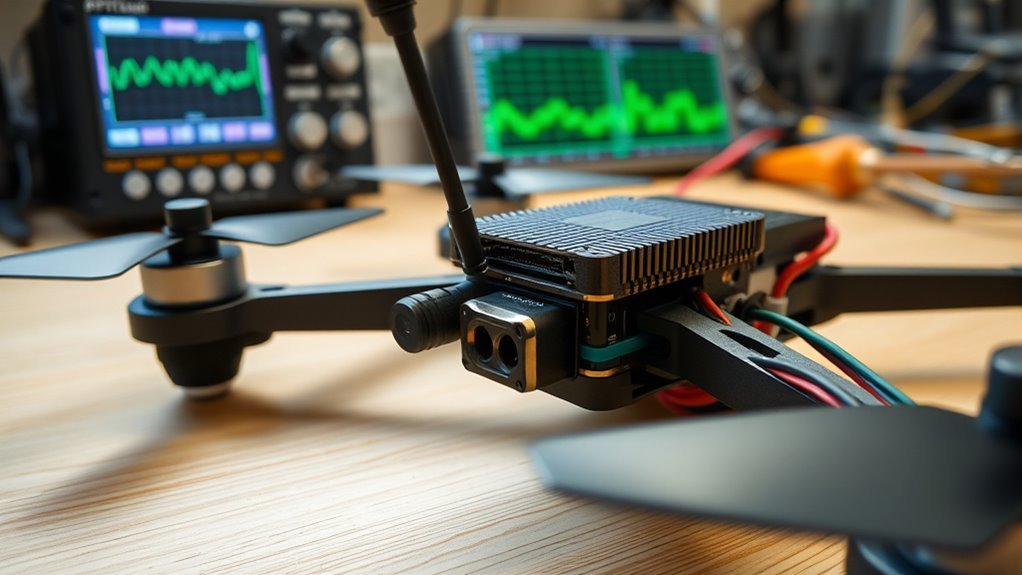
FPV video transmitters, or VTX units, carry live drone footage to the pilot’s goggles or monitor over 5.8 GHz. Their output power, channel choice, and band selection shape range, clarity, and interference. Legal limits also vary sharply by region, which can complicate setup. A simple mismatch in settings can weaken the entire link, and the next step is understanding why.
What Is an FPV VTX?
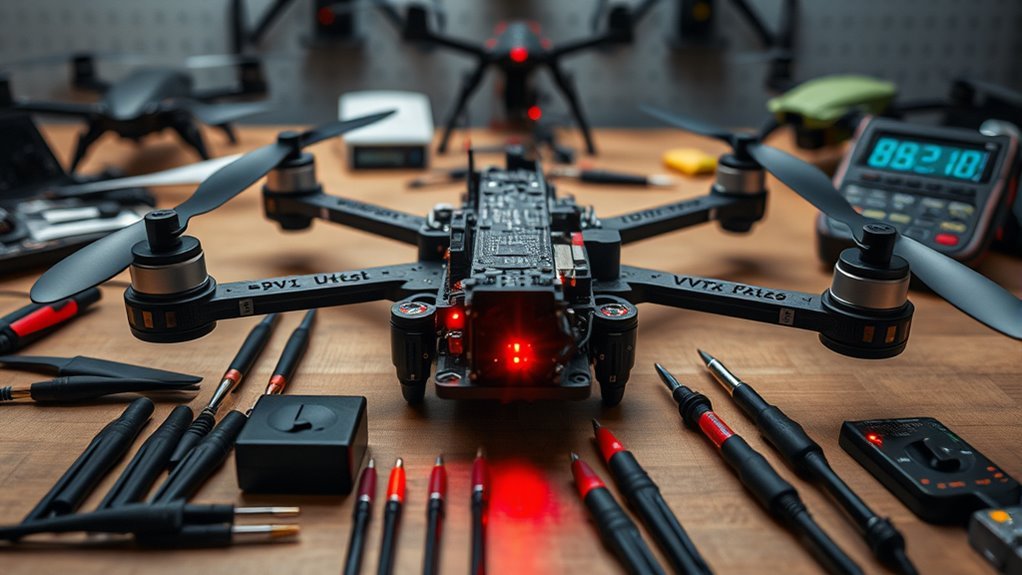
An FPV video transmitter, or VTX, takes the camera’s video signal, modulates it, and broadcasts it wirelessly to the pilot’s goggles or receiver, most commonly on the 5.8 GHz band to reduce interference.
In FPV systems, the VTX is the onboard video transmitter that turns live camera output into a usable RF stream. Its power output typically spans 25mW to 1W, but higher settings can increase interference and must remain within legal limits set by local authorities.
VTX channels are arranged into bands such as Raceband, allowing pilots to select frequencies with less overlap during shared flight sessions. Proper antenna choice also matters; circularly polarized antennas can reduce multipath interference and improve signal clarity.
VTX channels like Raceband reduce overlap, while circularly polarized antennas help improve clarity and cut multipath interference.
For pilots seeking autonomous, unblocked flight, the VTX is a core link between machine and vision. Clear channel selection, compliant power output, and respect for legal limits keep FPV communication efficient, stable, and accessible.
How FPV VTX Power Affects Range
FPV VTX power output directly influences range, with typical systems spanning from 25mW to 1W as transmit power increases.
Higher power can improve signal penetration and distance, but it also raises interference risk and may be constrained by regional regulations.
Antenna quality and placement further shape real-world performance, so usable range depends on both output power and system setup.
Power vs Range
Although higher VTX output generally extends usable range and improves penetration through obstacles, the relationship is not linear and depends heavily on antenna performance, frequency conditions, and local regulations. VTX power shapes range, but freedom also comes from clean RF. A 25mW transmitter may reach short distances; a 200mW unit can push farther under ideal conditions.
| Power | Typical reach |
|---|---|
| 25mW | Up to 500 m |
| 200mW | 1–2 km |
Interference rises as output increases in crowded bands, so antenna placement and design matter greatly. Properly mounted antennas can reveal extra distance without changing hardware. Regulatory limits, such as the 25mW cap in many regions, define legal operation and reduce spectrum conflict.
Tradeoffs And Limits
Higher VTX output can extend usable FPV range, but the gains come with clear limits: more power increases interference potential, adds heat load, and can overload the receiver if pushed too far.
VTX power usually spans 25mW to 1W, yet practical transmission range depends on terrain, antennas, and the receiving setup. At 25mW, close-range flight under 500 meters is typical; around 200mW, open-area range may reach 1 to 2 kilometers.
However, legal limits often cap 25mW without licensing, so higher power levels require local compliance. Excess output can create signal distortion, reducing image quality.
Effective thermal management matters because sustained high power generates more heat and can damage components. Choosing the right level preserves performance and freedom.
FPV VTX Channels and Bands
FPV VTX units typically operate in the 5.8 GHz band, where multiple channels are available to reduce interference between pilots.
Channel selection must match the receiver’s band compatibility to guarantee a usable video link.
Proper coordination of channels and bands is essential, especially during group flying or events.
Channel Selection
Channel selection on an FPV video transmitter is centered on matching the 5.8 GHz band to the correct channel and band grouping to reduce interference and preserve a clean video link.
A VTX should be set to one of the common channels, such as Fat Shark, RaceBand, or A/B bands, so pilots can coordinate frequency use and protect video feeds in shared airspace.
Power output also affects selection: low settings limit range, while higher levels improve coverage but raise interference risk and draw regulatory scrutiny.
Many regions impose regulatory limits near 200mW, so compliance matters as much as signal clarity.
Careful channel choice helps maintain reliable control, fair event spacing, and an unobstructed transmission path for liberated flight.
Band Compatibility
Most FPV video transmitters operate in the 5.8 GHz band, where compatibility depends on matching the VTX to the correct channel set and band grouping. VTX channels are arranged across RaceBand, FatShark, and other sets for disciplined video transmission and reduced interference.
| Band | Notes |
|---|---|
| 5.8 GHz | Primary FPV band |
| 40 channels | Common U.S. spacing |
| RaceBand | Fast pilot coordination |
| FatShark | Broad legacy support |
| 25mW-1W | Regional output power limits |
Each channel is typically spaced 20 MHz apart, aiding frequency management. However, output power must respect legal limits, since regulations vary by region. Careful channel coordination lets multiple pilots fly with liberated clarity, preserving a clean feed and minimizing cross-talk.
How to Set FPV VTX Power and Channel
Setting the VTX power and channel correctly is essential for maintaining a clear video link and avoiding interference. In an FPV system, VTX power usually ranges from 25mW to 1W, while the VTX channel must match the receiver band in the 5.8 GHz plan. Smart Audio or IRC Tramp lets pilots adjust settings from the flight controller, reducing field-side dependence and preserving operational freedom.
- Select a VTX power level that balances range, heat, and battery load.
- Choose a VTX channel within A, B, E, or F bands to protect the video signal.
- Confirm the setting before flight and verify compliance with regulatory guidelines.
Incorrect combinations can create signal interference, degrading image quality and control confidence. A disciplined setup procedure supports cleaner transmission, more reliable links, and safer flying.
Using matched channels and sensible power settings allows the pilot to operate with greater autonomy while keeping the system efficient and predictable.
FPV VTX Power Limits by Region
Regional FPV VTX power limits vary by jurisdiction, and compliance depends on both output level and operating band. A pilot’s FPV Video Link must match local regulations, because VTX output above authorized thresholds can trigger interference and legal penalties. In the U.S., 200mW is commonly the ceiling, though some bands require less. In Europe, 25mW is often the rule for 5.8 GHz. Other countries may restrict use to specific frequency bands or require frequency hopping to improve spectrum efficiency.
| Region | Typical VTX limit |
|---|---|
| United States | 200mW |
| Europe | 25mW |
| 5.8 GHz use | Band-specific |
| Some countries | Hopping/digital rules |
| All regions | Check local law |
These power limits preserve shared spectrum and protect nearby users. A liberated FPV practice remains lawful only when the VTX is configured within regional regulations, avoiding unnecessary interference and preserving access for everyone.
Analog vs Digital FPV VTX Systems
Analog FPV VTX systems prioritize ultra-low latency, typically around 1–2 ms, with standard-definition video near 576–720 lines, while digital systems trade added delay, often 28–50 ms, for HD output from 720p to 1080p60.
In practice, analog FPV favors immediate control response, while digital systems prioritize image clarity. Both use similar VTX power output ranges, often 25 mW to 1 W, yet legal limits vary by region and may tighten above 200 mW.
- analog FPV: lighter VTX hardware, often 3–8 g, supports agile builds and faster response.
- digital systems: heavier modules, such as DJI O3-class units, add mass but deliver a cleaner video feed.
- Signal behavior differs: analog degrades with artifacts, preserving orientation, while digital may freeze or cut to black.
For pilots seeking liberation through precision, the choice rests on whether latency or image fidelity matters most within legal limits.
Common FPV VTX Setup Mistakes
Even when video problems appear to originate from the VTX power supply, many faults are caused instead by poor signal routing, ground loops, interference, or weak mechanical connections.
In FPV builds, the video transmitter is often blamed before the antenna system is inspected. Linear antennas perform poorly in multipath interference, so circular polarization usually provides cleaner reception and less fading.
Mounting antennas against carbon arms or other conductive parts can further attenuate output.
Another common error is loading the flight controller 5V regulator with both camera and VTX current; separate power paths reduce stress and prevent unstable behavior.
Loose or low-grade SMA connectors also create avoidable signal loss, even when the transmitter itself is healthy.
Careful placement, solid grounding, and high-quality hardware preserve link integrity and keep the system reliable.
How to Fix Weak FPV Video
Weak FPV video is usually corrected by tracing the signal path from the source to the receiver and eliminating the most common points of loss. The VTX, camera, antennas, and power supply should be checked in sequence, because weak video signal often comes from small faults rather than one major failure.
- Confirm channel selection matches the receiver and avoids interference from other pilots; overlapping bands can crush clarity.
- Inspect connectors and cables for looseness, corrosion, or damage, then reroute the camera lead away from power wires or use twisted pairs to reduce noise.
- Fit circularly polarized antennas on both the VTX and receiver, and verify stable power supply voltage to prevent dropout and multipath fade.
A disciplined inspection restores usable video faster than random part swapping. When every link is clean, the pilot gains a freer, more reliable view of the flight path.
Frequently Asked Questions
How to Choose a VTX Antenna?
A VTX antenna should be chosen by matching antenna types to the craft’s use case, then checking gain factors, frequency ranges, and polarization options.
Circular polarized models usually resist multipath better, while linear units can suit simpler setups. Careful attention to compatibility issues, connector fit, and mounting positions prevents losses.
Light weight matters for agile flight. Final selection should rely on performance testing to confirm signal quality and range.
Why Was DJI FPV Discontinued?
DJI FPV was discontinued because DJI history met an FPV market shifting toward modularity, openness, and lower latency.
Product evolution favored systems like ExpressLRS, HDZero, Walksnail, and analog, while customer feedback criticized the proprietary ecosystem.
Competition analysis showed demand for flexible, mix-and-match hardware.
Technological advancements accelerated this change, narrowing future prospects for closed platforms.
The result was a market that increasingly preferred liberation over locked integration and limited customization.
Is Long Range FPV Legal?
Long range FPV can be legal, but only within long range regulations, frequency limitations, and country specific laws.
Compliance often depends on drone licensing requirements, equipment certification, and maintaining visual line-of-sight where mandated.
Public safety concerns shape most rules, especially around altitude, airspace, and interference.
Responsible flying means verifying local authority guidance before each flight.
Freedom exists, yet it is bounded by legal structure, not by technical capability alone.
How to Improve VTX Signal?
Improving VTX signal starts with signal interference solutions: use circularly polarized antennas, maintain clear line of sight, and keep antennas away from carbon fiber.
Strong antenna placement tips include tightening SMA connectors and avoiding obstruction.
Proper VTX power settings, preferably from VBAT, support video clarity enhancement.
Careful channel selection strategies reduce overlap.
Range extension techniques improve reach, while heat management methods preserve transmitter output and empower reliable, liberated flight.
Conclusion
In FPV, the VTX is the quiet link between a drone and its pilot, and its settings decide everything. Power can extend range, but only until noise, heat, and legal limits close in. Channels must match cleanly, or interference can erase the feed without warning. Analog and digital systems each bring strengths and tradeoffs. The final challenge remains the same: configure carefully, or the next flight may reveal the weak point too late.
