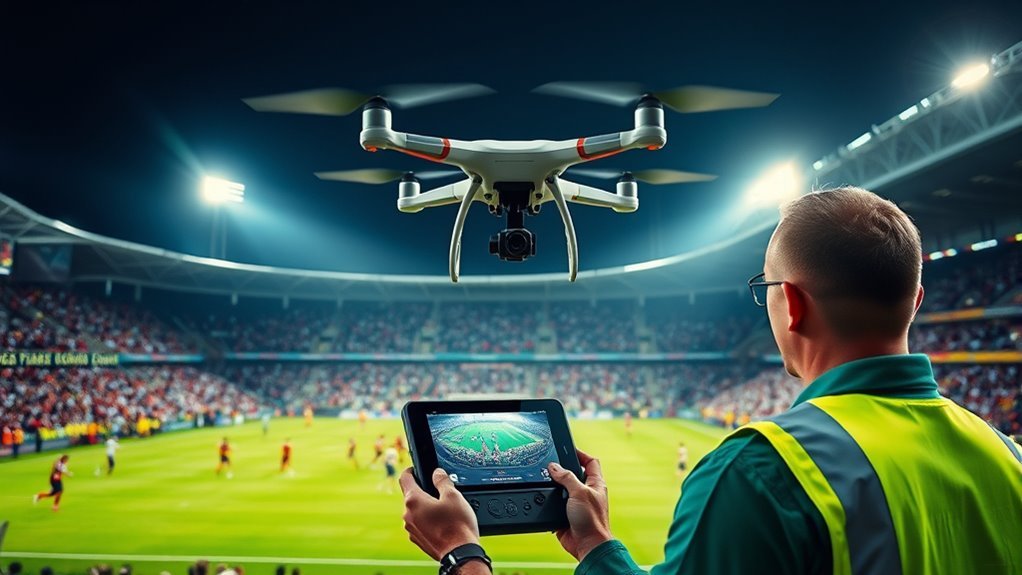
Filming sports events with a drone demands more than a clear view of the field. It requires written permission, venue-specific approval, and strict compliance with airspace limits and stadium policies. Altitude caps, restricted zones, and crowd safety can reshape the entire flight plan. Even before takeoff, the operator must confirm settings, backup procedures, and legal boundaries. The question is not only what can be filmed, but what can be done safely and lawfully.
Drone Permissions for Sports Events
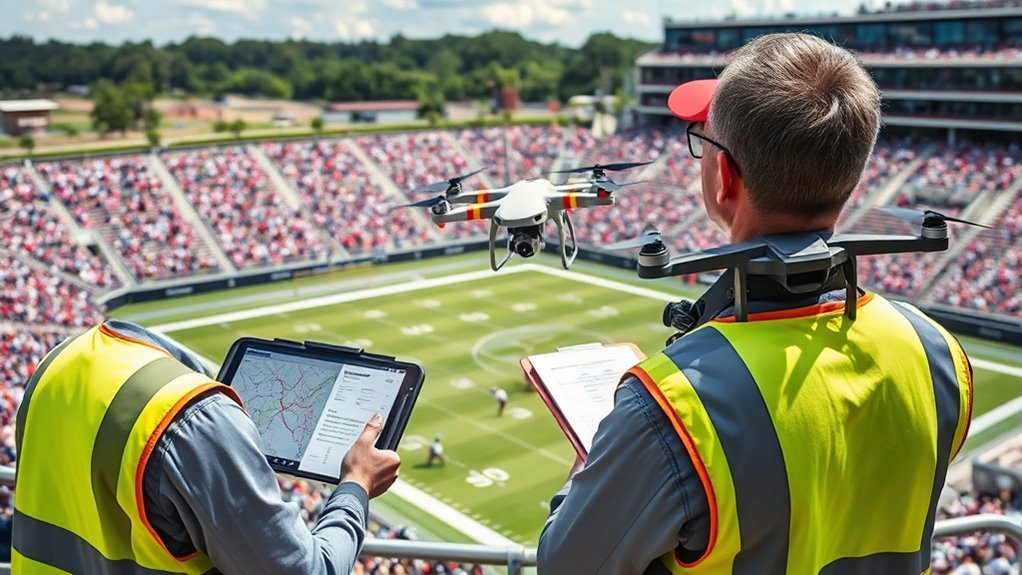
Before any drone is flown at a sports event, local regulations and permit requirements should be verified, since many venues fall within controlled airspace or impose additional operational limits.
Drone pilots should confirm whether the site requires special authorization, as many stadiums and arenas restrict flight times, altitudes, and designated zones. Venue management or event organizers should be contacted in advance to clarify conditions and secure written permission.
Confirm special authorization first, since many stadiums and arenas restrict flight times, altitudes, and zones.
Under FAA rules, operations over crowds or stadiums are generally prohibited without a waiver, so compliance is not optional; it is the minimum safeguard for lawful freedom of movement.
Operators who wish to use a drone must also avoid restricted airspace and document all approvals, agreements, and waivers in writing. That record helps define responsibility, reduce dispute, and protect against enforcement action.
Careful preparation permits responsible aerial access while preserving safety, legality, and the operator’s ability to work without unnecessary interference or delay.
How Stadium Rules Change Your Flight Plan
Once permission is confirmed, stadium rules can still reshape the flight plan in ways that affect altitude, route, and camera position. Most venues cap altitude near 80 feet, so the operator must use drones with disciplined flight modes that respect the ceiling while preserving usable framing.
Some stadium rules create no-fly zones above spectator areas, forcing lateral paths and tighter angles instead of direct overhead passes. Such limits are not merely procedural; they define the safe perimeter of creative freedom.
Coordination with security personnel is essential, because on-site protocols may further narrow launch points, transit corridors, or hover positions. Early confirmation of venue-specific permits also reduces the risk of delays when the event begins.
Local regulations remain controlling and violations can lead to fines or future bans. A compliant flight plan thus balances access, precision, and restraint, allowing the drone to operate within boundaries while still capturing the scale and energy of the match.
Drone Safety Checks Before Game Day
Before game day, a thorough pre-flight inspection should confirm that the drone, batteries, camera, and gimbal are operating correctly and show no signs of damage or wear.
Weather conditions and airspace restrictions must also be reviewed in advance, as changing wind, visibility, or nearby flight activity can increase operational risk.
Compliance with stadium rules and local permissions should be verified before launch to reduce the likelihood of interference, collision, or regulatory violation.
Pre-Flight Equipment Check
A thorough pre-flight equipment check is essential to reduce operational risk on game day. The operator verifies battery charge, capacity, and health so the aircraft can complete the assignment without mid-flight loss of power.
Camera parameters, including shutter speed, ISO, and aperture, are set for expected venue lighting to preserve image quality. Propellers are inspected for chips, cracks, or wear, because intact blades support stable flight and controlled maneuvering during fast action.
Firmware updates for the drone and camera are confirmed before launch, as current software may improve performance and add functions. Emergency procedures and fail-safe settings are reviewed in advance, enabling immediate response if anomalies arise.
A free account on the control platform may aid planning, and drones help capture liberated perspectives.
Weather And Airspace Review
Weather conditions should be verified against local forecasts before game day to confirm that wind, rain, or other precipitation will not compromise flight stability or visibility.
Weather impacts on lift, battery endurance, and camera control should be treated as operational limits, not suggestions. For safe airspace navigation, the operator should review stadium-area restrictions through B4UFLY and confirm any Temporary Flight Restrictions.
- Check wind, rain, and lightning risk.
- Confirm TFRs and adjacent no-fly zones.
- Verify permits under applicable drone regulations.
- Map obstacles, crowd density, and escape routes.
This review preserves lawful access while reducing exposure to spectators, property, and equipment.
Freedom in this situation depends on disciplined compliance: only within approved airspace can the drone move with confidence and purpose.
Best Drone Settings for Sharp Sports Footage
Sharp sports footage depends first on shutter speed, which should generally be set between 1/500 and 1/1000 seconds, with 1/500 as the minimum for clear fast-action capture.
ISO should remain near 400 to preserve exposure without adding avoidable noise, while aperture around f/2.7 can help isolate the athlete from the background.
In bright conditions, ND filters may be required to hold the target shutter speed and limit motion blur, especially when shooting video at 60FPS with a corresponding 1/200-second shutter.
Shutter Speed Basics
When filming fast-moving sports action from a drone, shutter speed should be kept at least between 1/500 and 1/1000 seconds to reduce motion blur and preserve subject detail.
These shutter speed techniques support motion blur prevention during fast action, especially where athletes change direction without warning. A higher setting near 1/1000 seconds is generally preferred for critical moments, because it improves edge clarity and keeps decisive plays readable from above.
- Maintain 1/500 seconds as a practical floor.
- Use 1/1000 seconds for rapid pivots and sprints.
- Monitor exposure to avoid underexposed frames.
- Use ND filters in bright conditions to hold the chosen shutter speed.
Such control enables sharper, freer visual coverage while limiting avoidable capture risk.
ISO And Aperture Balance
With shutter speed established for motion control, the next exposure variables are ISO and aperture, which must be balanced to preserve detail without introducing noise or softness.
For sports coverage, ISO adjustments should generally remain near 400, a level that supports exposure in changing light while limiting grain. Aperture settings around f/2.7 help maintain a usable depth of field, keeping fast-moving athletes clear as the drone tracks action.
This exposure balance becomes more critical in bright stadium conditions, where ND filters may be required to prevent overexposure without forcing unsafe shutter changes.
Operators seeking freedom in movement should keep settings disciplined: preserve sharpness, protect highlights, and avoid excessive digital compensation.
When conditions shift, the camera should be tuned conservatively, not aggressively.
Drone Shot Ideas for Game Day
A well-planned drone shot list helps organize game day coverage while reducing the risk of missed moments or unsafe flight decisions. The operator should sequence shots to match venue access, weather, and airspace limits, then apply orbit mode techniques, aerial panorama tips, and follow me strategies only when conditions remain controlled and permitted.
- Establishing frames: record the stadium exterior, arriving fans, and pre-game activity to define context before play begins.
- Orbit shots: circle players or focal areas at a safe radius, using smooth motion to emphasize decisive moments without intruding on the field.
- High-angle views: position above the action to reveal play development and spacing that ground cameras cannot document.
- Tracking sequences: use follow-me mode sparingly to follow fast movement, maintaining obstacle clearance, signal stability, and compliance.
Each movement should preserve public freedom to enjoy the event while respecting safety, privacy, and venue restrictions.
Capture Crowds, Formations, and Reactions
Crowds can be documented from the air to convey the scale and energy of the event, with wide-angle stadium views establishing context and showing spectator density. Such coverage should remain controlled and above approved zones, preserving sightlines while avoiding disruption.
Careful passes can reveal crowd dynamics, including waves of movement, clustered cheering, and the spatial rhythm of the stands. When gameplay allows, aerial framing may isolate strategic formations, giving clear evidence of positioning, spacing, and tactical shifts that ground cameras often miss.
Reaction shots should be timed to key moments, capturing emotional reactions without lingering over individuals in ways that raise privacy or safety concerns. Circular flight paths around cheering fans can add motion and intensity, but only if altitude, speed, and separation standards are maintained.
The result is liberated visual coverage: expansive, disciplined, and responsive to the living energy of the event.
Review and Share Sports Drone Footage
Before any footage is reviewed or distributed, the operator should verify that all required permissions were obtained from event organizers and stadium authorities, and that local drone regulations were followed throughout the flight.
A disciplined footage review should then confirm compliance with altitude limits, flying zones, and safety conditions.
- Check every clip for restricted views, identifiable spectators, and copyrighted signage.
- Select dynamic shots only if they were captured without interference to play or crowd movement.
- Edit slow-motion sequences and highlight reels to present decisive moments with accuracy and restraint.
- Use sharing platforms that support sports content while honoring event policies and copyright law.
Distribution should remain limited to authorized channels until all legal and contractual risks are cleared.
A careful release strategy preserves the operator’s freedom to create, while reducing the chance of fines, bans, or takedown demands.
Frequently Asked Questions
What Are Some Creative Ideas for Drone Video Shoots?
Creative drone shoots may include aerial perspectives of the full field, dynamic angles that orbit key subjects, and follow-me tracking for fast action.
Broad sweeps can reveal crowd interactions and stadium energy, while altitude changes offer low, intimate views or higher contextual frames.
Each movement should remain controlled, permissioned, and situationally aware to reduce risk.
Used precisely, these techniques can create liberated, cinematic coverage without sacrificing safety or compliance.
Is It Legal to Fly a Drone Over a Stadium?
Usually not, and the line is not to be crossed lightly. A drone regulations overview shows that flying over a stadium during an event is generally barred without special authorization, while a stadium policies analysis often adds stricter limits.
Event safety considerations and temporary flight restrictions can shut the door entirely. Anyone seeking liberation through flight should secure permits, waivers, and local approval first, or face enforcement, fines, and potential liability.
Who Can Use Drones for Filming Events?
Qualified operators with the right certifications can use drones for filming events, subject to drone regulations, event permits, and operator qualifications.
In the U.S., commercial filming generally requires FAA Part 107 licensure, plus any venue approval, insurance, and access restrictions. Accredited media may receive priority, while hobbyists are often barred.
Each event can set altitude, route, and safety limits, so compliance remains essential for lawful, low-risk aerial work.
What Is the 1:1 Rule for Drones?
The 1:1 rule for drones requires the pilot to keep the aircraft at a distance from themselves that matches its altitude, so a drone at 100 feet should remain within 100 feet of the operator.
This supports visual line of sight, aligns with drone regulations, and reduces risk in crowded areas.
It also preserves safe aerial perspectives and controlled filming techniques while allowing greater operational freedom within compliant limits.
Conclusion
In the arena of the sky, the drone is a careful messenger, admitted only after the gatekeeper’s consent and the rulebook’s blessing. It must circle like a courteous hawk, never straying into forbidden winds or crowded stands. When it obeys the stadium’s lines, it can gather the drama of play, the pulse of the crowd, and the stillness between moments, returning with footage earned not by speed, but by discipline.
