Last updated: September 16, 2026
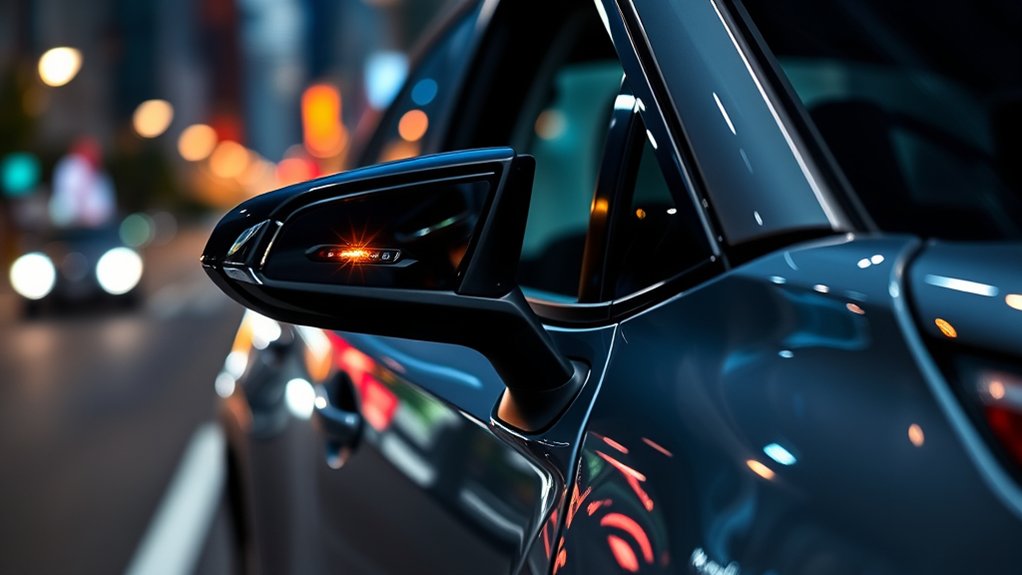
The Toyota RAV4’s Blind Spot Monitor (BSM) uses rear-side radar sensors behind the rear bumper to help detect traffic beside the vehicle or approaching from behind. On many 2019–2025 U.S.-market RAV4s, a detected vehicle turns on the indicator in the corresponding side mirror; if you signal toward that side, the indicator flashes. The redesigned 2026 RAV4 uses updated BSM behavior, so alert sounds and controls should always be checked against the exact model-year manual.
BSM operation has changed across RAV4 generations. Older models may use a physical BSM switch, recent fifth-generation models generally use the multi-information display, and newer systems use updated driver-assistance settings. For the exact procedure for your vehicle, use Toyota’s official Manuals & Warranties lookup.
Scope: This guide focuses on U.S.-market RAV4 models. Equipment, alerts, menus, and operating conditions can vary by model year, powertrain, trim, production date, and market.
Quick Answer
- The RAV4 BSM uses radar sensors hidden behind the left and right rear bumper areas; the side mirrors contain the warning indicators, not the radar sensors.
- When BSM detects qualifying traffic, the indicator in the mirror on that side illuminates. If you signal toward the detected side, the indicator flashes.
- Do not assume every RAV4 BSM produces a lane-change chime. Many 2019–2025 U.S. RAV4s primarily use the mirror indicator for BSM, while RCTA has the reverse-traffic buzzer. The redesigned 2026 system uses updated alert behavior.
- Activation varies by model year. Older RAV4s may have a physical BSM switch; newer models generally use an instrument-cluster or driver-assistance settings menu.
- Older RAV4s can use a shared BSM/RCTA control. On many newer models, BSM and RCTA have separate settings.
- Snow, ice, mud, bumper damage, sensor misalignment, accessories, certain road layouts, and some weather conditions can reduce detection performance.
Understanding the Toyota RAV4’s Blind Spot Monitor

The Blind Spot Monitor is a driver-assistance system for lane-change awareness. Rear-side radar modules monitor areas beside and behind the RAV4. When the system detects qualifying traffic, the indicator in the corresponding outside mirror illuminates. Signaling toward that side makes the warning more prominent.
The most important point is that RAV4 BSM behavior is model-year dependent. Toyota has changed the controls, alert logic, detection capabilities, and relationship between BSM and Rear Cross-Traffic Alert over time.
| Model-Year Group | Typical BSM Control | Important Difference |
|---|---|---|
| 2013–2018 | Physical BSM main switch on equipped models | BSM and RCTA can share the same main switch; mirror indicators provide the driving warning. |
| 2019–2025 | Multi-information display/settings on many models | Recent models can provide separate BSM and RCTA settings; BSM lane-change warnings are primarily visual on many U.S. configurations. |
| 2026 | Updated driver-assistance/customization interface | Redesigned BSM logic adds updated alerts and detection capabilities; Toyota lists BSM with RCTA as standard on the 2026 U.S. RAV4 lineup. |
BSM is a supplemental warning system. It cannot decide whether a lane change is safe, so use the mirrors, turn signal, and a direct shoulder check before moving into another lane.
How the Blind Spot Monitor Works
RAV4 BSM uses rear-side radar sensors mounted behind the left and right sides of the rear bumper. These modules look for qualifying traffic in adjacent lanes and for traffic approaching rapidly from behind. They are different from the round parking-assist sensors that may be visible in the bumper, the backup camera, and the forward radar used by other driver-assistance functions.
The exact speed, shift-position, and system-status conditions required for BSM operation vary by generation. That is another reason not to apply one model year’s specifications to every RAV4.
How Do You Turn On RAV4 BSM?
The correct activation method depends on your RAV4:
- Many 2013–2018 models: Use the physical BSM main switch. On these implementations the switch can control both BSM and RCTA.
- Many 2019–2025 models: Use the steering-wheel meter controls to open the multi-information display settings, find BSM, and switch it on. Recent versions can also provide a separate RCTA setting.
- 2026 redesign: Use the current driver-assistance/customization controls shown in the manual for your exact configuration.
Make setting changes while safely parked rather than searching through menus while driving.
Does the Toyota RAV4 Blind Spot Monitor Beep?
It depends on model year. On many 2019–2025 U.S.-market RAV4s, the normal BSM warning while driving is visual: the outside-mirror indicator illuminates for detected traffic and flashes if the turn signal is operated toward that side. The audible reverse-traffic warning belongs to RCTA.
The redesigned 2026 RAV4 uses updated BSM warning behavior and can add an audible warning when the turn signal is used toward detected traffic. Because Toyota has changed this behavior over time, hearing or not hearing a BSM chime is not enough by itself to diagnose a fault.
When Does BSM Monitor Traffic?
Once BSM is enabled and its operating conditions are met, it monitors the relevant areas beside and behind the vehicle. It does not mean that every object beside the RAV4 will trigger a warning.
| Situation | Typical BSM Response |
|---|---|
| Qualifying vehicle in monitored blind-spot area | Indicator on the detected side illuminates. |
| Turn signal operated toward detected traffic | Mirror indicator flashes; additional alerts depend on model year. |
| System switched off | A BSM OFF or driving-assist status indication may appear, depending on model year. |
| Sensor blocked or system fault detected | The multi-information display may show an unavailable or malfunction warning. |
Understanding Blind Spot Monitor Alerts and Indicators
The mirror warning is the most consistent RAV4 BSM cue across generations. A steady indicator generally means the system has detected qualifying traffic on that side. If you signal toward the detected side, the indicator flashes to draw more attention to the potential lane-change conflict.
What Does the Mirror BSM Light Mean?
A solid BSM indicator means the system has detected traffic that meets its warning criteria in or approaching the monitored area. A flashing indicator means you are signaling toward the side where traffic has been detected.
Bright sunlight can make the mirror indicator harder to see. Some recent RAV4s also allow the indicator brightness or detection timing to be adjusted through vehicle settings.
When Does a Warning Chime Sound?
Do not use the presence of a chime as a universal BSM test. On many fifth-generation RAV4s, RCTA is the function that provides the configurable buzzer while reversing. Older shared BSM/RCTA systems may also sound a confirmation buzzer when their main switch is operated. The redesigned 2026 BSM adds different audible-warning behavior.
If you are troubleshooting a missing sound, first determine whether you are testing BSM while driving or RCTA while reversing, then check the manual for that exact model year.
How Can You Check BSM System Status?
Start by confirming that BSM is enabled in the correct menu or switch for your RAV4 and that no unavailable or malfunction message is displayed. Do not deliberately create a dangerous lane-change situation just to test the warning.
If you suspect a fault, inspect the exterior surface of the rear bumper around both radar areas for snow, ice, mud, accessories, stickers, or damage. A Toyota dealer or properly equipped repair facility can diagnose sensor faults or alignment problems without relying on a road-side guess.
The Safety Benefits of the Blind Spot Monitor
BSM can provide useful extra information when another road user is difficult to see in the mirrors during a lane change. It is most valuable as a supplement to normal visual checks rather than as permission to change lanes.
Independent evidence supports the general benefit of this technology. Insurance Institute for Highway Safety research found that police-reported lane-change crash involvement rates were 14% lower among vehicles equipped with blind-spot monitoring than comparable vehicles without it. That population-level result does not mean BSM will detect every conflict or prevent every crash.
Rear Cross-Traffic Alert extends the rear-side radar’s usefulness to reversing situations, but it is a separate function with different operating conditions and warning logic.
Activating and Deactivating the Blind Spot Monitor

Before looking for a dashboard button, identify your model year. A physical BSM switch is normal on some older RAV4s, while recent models generally place the control in a settings menu.
- Older shared-switch systems: Turning off the BSM main switch can also disable RCTA.
- Recent systems: BSM and RCTA may appear as separate settings, so switching one off does not necessarily switch off the other.
- After changing a setting: Check the cluster for an OFF indicator or warning message appropriate to that model year.
- If the menu does not contain BSM: Confirm that the vehicle is actually equipped with the feature before treating it as a fault.
What Is Rear Cross-Traffic Alert (RCTA)?
Rear Cross-Traffic Alert uses the rear-side radar sensors while the RAV4 is reversing. When qualifying cross traffic approaches from either side, RCTA can flash the outside-mirror indicators, sound a buzzer, and, on applicable models, display an alert on the multimedia screen.
RCTA operating speeds have changed over time. Older RAV4 manuals include examples with the RAV4 below about 5 mph and approaching traffic around 5–18 mph. Later fifth-generation manuals expanded the example range; 2025 documentation lists the RAV4 below about 9 mph and approaching traffic around 5–34 mph. Do not use an older speed range to diagnose a newer RAV4.
For model-year-specific RCTA settings, speed ranges, warning messages, and troubleshooting, see our Toyota RAV4 Rear Cross-Traffic Alert guide.
How RCTA Works With the Blind Spot Monitor
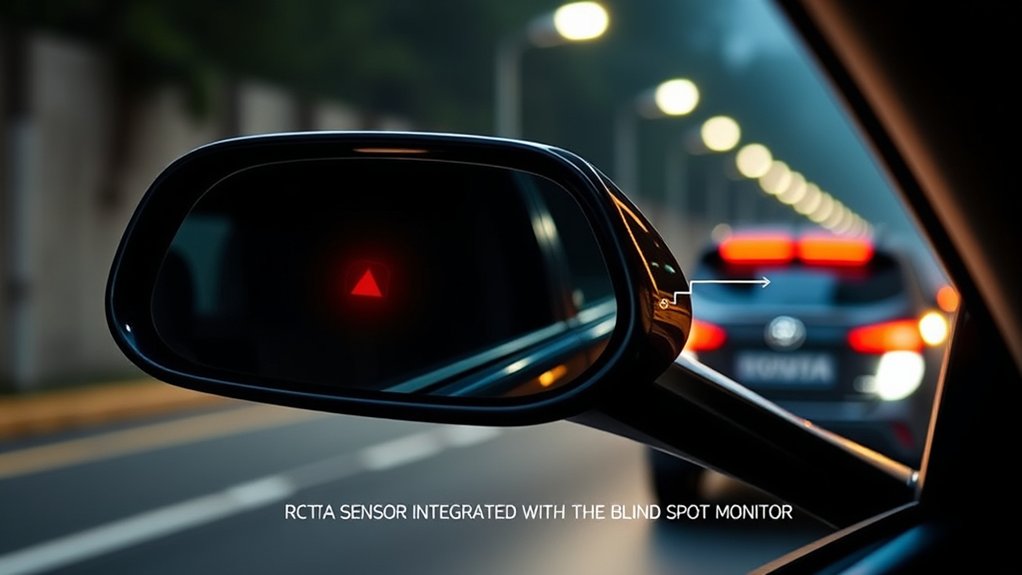
BSM and RCTA commonly use the same rear-side radar hardware but perform different jobs. BSM supports lane-change awareness while driving forward. RCTA looks for qualifying cross traffic while the vehicle is reversing.
- BSM: Primarily warns through the corresponding outside-mirror indicator.
- RCTA: Typically flashes mirror indicators and sounds a buzzer when qualifying cross traffic is detected.
- Recent models: RCTA may also show a directional warning on the multimedia display.
- Control relationship: Older systems may share one switch; many newer systems provide separate settings.
Neither feature replaces a direct check of the lane, driveway, parking aisle, pedestrians, cyclists, or other surroundings.
Key Limitations of the Blind Spot Monitor and RCTA
BSM and RCTA rely on radar interpretation, sensor alignment, and specific operating conditions. A system that is switched on can still miss traffic or produce an unnecessary warning.
| Condition | Why It Matters | What to Do |
|---|---|---|
| Snow, ice, mud, or heavy contamination on rear bumper | Can obstruct or degrade radar operation. | Clean the exterior bumper surface around both rear-corner sensor areas. |
| Rear-bumper impact or sensor misalignment | A radar module can be physically shifted even when damage looks minor. | Have the mounting and system checked after significant impact. |
| Bumper repainting, stickers, accessories, or repairs | Material or incorrect repair around the radar path can interfere with detection. | Follow Toyota repair guidance and have the system checked after relevant body work. |
| Heavy rain, snow, standing water, sharp curves, steep grades, or unusual lane geometry | Radar detection can become less reliable or generate unnecessary alerts. | Increase visual checks and do not rely on BSM/RCTA alone. |
| Motorcycles, bicycles, pedestrians, or unusual objects | Detection capability differs by model year; many earlier manuals specifically warn about smaller road users. | Always perform a direct visual check before changing lanes or reversing. |
| Bike racks, trailers, or other rear-mounted equipment | Accessories can interfere with radar or alter system behavior. | Follow the manual’s towing/accessory instructions for your model year. |
| Strong sunlight | The mirror indicator may be more difficult to see. | Rely on normal visual checks rather than the warning light alone. |
Troubleshooting Your Blind Spot Monitor
If BSM stops working, start with the rear bumper rather than the mirror. The radar modules sit behind the bumper corners, so contamination, impact, body repairs, accessories, or sensor misalignment can affect the system.
Common BSM Error Messages
Exact wording varies by year, but these are the two main categories to understand:
- “Blind Spot Monitor Unavailable”: Usually means the system cannot operate normally at that moment. Check the rear bumper sensor areas for snow, ice, mud, contamination, or other obstruction. Extreme environmental conditions can also affect operation.
- “Blind Spot Monitor Malfunction Visit Your Dealer”: Points toward a detected system fault or possible sensor/alignment problem that should be diagnosed rather than treated as simple dirt on the bumper.
- RCTA unavailable or malfunction message: RCTA uses related rear-side radar hardware, so obstruction or sensor problems can affect both features even though their settings may be separate.
- BSM OFF or driving-assist OFF indicator: This may simply mean the feature is intentionally disabled rather than malfunctioning.
What Should You Check if BSM Is Not Working?
- Confirm equipment: Make sure your exact RAV4 trim and option package includes BSM.
- Confirm the setting: Check the physical switch on older models or the appropriate vehicle settings menu on newer models.
- Read the displayed message: “Unavailable” and “Malfunction” do not mean the same thing.
- Clean the rear bumper corners: Remove snow, ice, mud, or heavy dirt from the exterior surface around the radar areas.
- Check recent history: A warning that started after a rear impact, bumper removal, repainting, body repair, trailer installation, or rear accessory deserves closer inspection.
- Use model-specific instructions: Some manuals tell you to drive with the system’s operating conditions satisfied after removing an obstruction. Follow the procedure for your exact year rather than using a generic reset.
- Get the system diagnosed if the warning persists: Radar alignment and internal faults require proper diagnostic equipment.
For a closer look at the hardware and why bumper work matters, see our RAV4 rear radar sensor guide.
Tips for Getting the Most Out of Your Blind Spot Monitor
- Keep the rear bumper sensor areas clean: The radar modules are behind the bumper, so keeping the exterior corners clear matters more than cleaning the mirror for sensor performance.
- Do not cover the radar areas: Stickers, certain accessories, repairs, or unsuitable paint work can interfere with operation.
- Use your turn signal: The system can provide its stronger lane-change warning when you signal toward detected traffic.
- Know your model year’s alert behavior: Do not expect an older RAV4 and a redesigned 2026 RAV4 to use identical sounds, menus, or detection logic.
- Check BSM after rear-body work: A bumper that looks cosmetically correct can still leave a radar sensor misaligned.
- Keep using mirrors and shoulder checks: BSM is an additional source of information, not confirmation that a lane is clear.
Related Guides
Frequently Asked Questions
Does the Toyota RAV4 Blind Spot Monitor Beep?
It depends on model year. On many 2019–2025 U.S.-market RAV4s, BSM primarily warns through the outside-mirror indicator, while the audible reverse-traffic buzzer belongs to RCTA. The redesigned 2026 RAV4 uses updated BSM alert behavior that can include an audible warning.
How Do I Turn On the RAV4 Blind Spot Monitor?
Older RAV4s may use a physical BSM main switch, while many 2019–2025 models use the multi-information display settings. The redesigned 2026 model uses its updated driver-assistance/customization interface. Check the manual for your exact model year before assuming a switch or menu is missing.
Where Are the RAV4 Blind Spot Monitor Sensors?
The BSM radar sensors are installed behind the left and right rear bumper areas. The warning lights are in the outside mirrors, but the radar sensors themselves are not located in the mirrors.
Why Does My RAV4 Say Blind Spot Monitor Unavailable?
Snow, ice, mud, contamination, extreme conditions, or another condition preventing normal radar operation can trigger an unavailable message. Clean the rear bumper sensor areas and follow the recovery procedure in your exact owner’s manual. If the warning persists, have the system inspected.
Can the System Detect Motorcycles or Bicycles in the Blind Spot?
Detection capability depends on model year. Many pre-2026 RAV4 manuals warn that BSM is not designed to reliably detect small motorcycles, bicycles, or pedestrians. Redesigned 2026 documentation adds bicycle detection, but you should still make a direct visual check before changing lanes.
Is the Blind Spot Monitor Covered Under Toyota’s Warranty?
A BSM defect may be covered while the applicable Toyota new-vehicle warranty is active, but coverage depends on the vehicle, warranty period, cause, and exclusions. Collision damage, modifications, and some bumper or sensor repairs may be treated differently, so check the warranty guide for your VIN and model year.
Can the Blind Spot Monitor Be Retrofitted to Older RAV4 Models?
Aftermarket blind-spot systems can be installed on older vehicles, but a factory-equivalent retrofit is not automatically plug-and-play. Sensor placement, wiring, mirror indicators, control modules, calibration, and exact vehicle compatibility must all be considered before installation.
Conclusion
The Toyota RAV4 Blind Spot Monitor is most useful when you understand the version fitted to your exact model year. The basic idea stays the same: rear-side radar detects qualifying traffic and the outside-mirror indicator warns you about a possible lane-change conflict. The controls, audible alerts, RCTA relationship, operating limits, and detection capabilities have changed over time.
If BSM becomes unavailable, check the rear bumper sensor areas first. If the problem began after impact or body work, or a malfunction warning remains, have the system properly diagnosed. Keep using your mirrors, turn signal, and shoulder checks even when BSM is operating normally.
