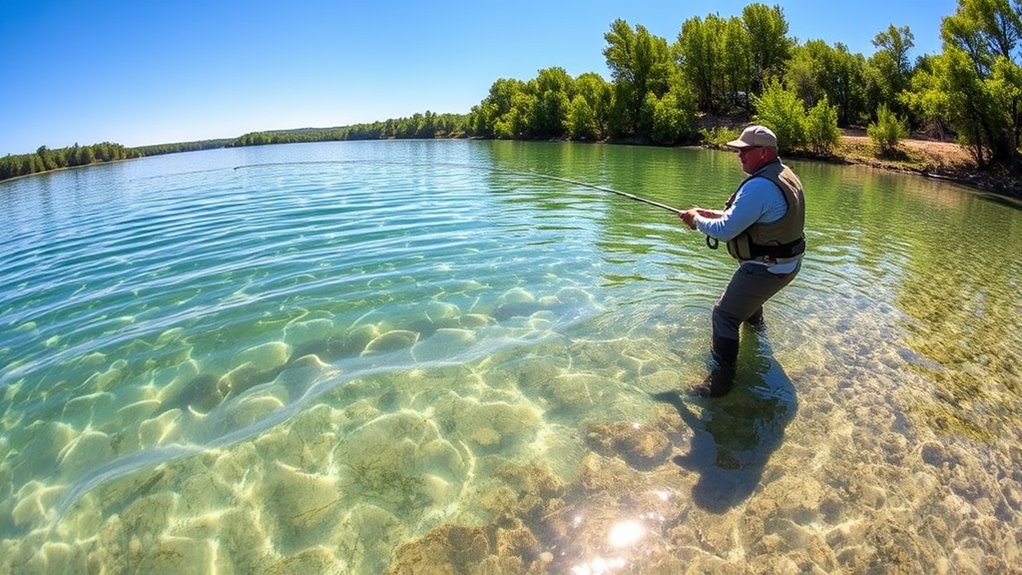
Water clarity affects fishing because it changes how far bass can detect, inspect, and react to your lure. In clear water, start with natural colors, realistic profiles, quiet presentations, and longer casts. As visibility falls, add contrast, flash, vibration, sound, or bulk, and put the lure closer to cover. Use clarity as your starting point, then fine-tune for forage, water temperature, weather, depth, and fishing pressure.
Last updated: September 11, 2026 — reviewed for water-clarity measurement, bass sensory research, lure-selection guidance, and fishing-app references.
Quick Answer
Water clarity affects fishing by changing how easily bass can find and inspect a lure. Clear water usually favors subtle natural presentations. Lightly stained water lets you add flash and vibration. Stained or dirty water calls for stronger contrast, more water movement, and accurate casts closer to fish-holding cover.
Key Takeaways
- Clear water usually calls for natural colors, smaller profiles, longer casts, and subtle presentations.
- Lightly stained water lets you mix natural looks with flash, vibration, and moderate retrieve speeds.
- Stained and dirty water often reward stronger contrast, vibration, sound, and close casts to cover.
- Bass can still feed in muddy water, although heavy turbidity can reduce the distance at which they react to prey.
- Water temperature, forage, sky conditions, wind, depth, cover, and fishing pressure should fine-tune your lure choice.
At a Glance
| Clear Water roughly 8+ ft visibility |
Natural colors, quiet baits, lighter line where appropriate, long casts, and finesse rigs. |
| Lightly Stained Water roughly 4–8 ft visibility |
Natural colors with flash, vibration, spinnerbaits, swim jigs, and moving baits. |
| Stained Water roughly 2–4 ft visibility |
Contrasting colors, rattles, square bills, bladed jigs, and stronger vibration. |
| Dirty Water roughly 0–2 ft visibility |
Bulky dark or bright lures, deliberate retrieves, heavy vibration, and tight casts to cover. |
Important: These are practical angler visibility bands used in this guide, not universal scientific definitions. What matters most is measuring visibility consistently and noticing when it changes.
How Do You Measure Water Clarity for Fishing?
The most consistent scientific-style visual method is a Secchi disk. The U.S. Environmental Protection Agency describes Secchi depth as the depth at which a black-and-white disk disappears from view. It is a measure of general water transparency.
For everyday fishing, you can make a faster field check. Lower the same white lure, light-colored jig, or spinnerbait blade beside the boat or bank and note the depth where you can no longer see it. Repeat the test when you move into a creek, pocket, windblown bank, or runoff area.
Your lure-disappearance depth is not the same measurement as an official Secchi depth, so do not compare the two as if they were interchangeable. The fishing test is simply a repeatable way to tell whether the water in front of you is clearer or dirtier than the water you fished earlier.
Understanding Water Clarity and Its Impact on Fishing Success

Understanding water clarity is essential when you target bass because visibility affects how far a fish can detect and inspect prey. Anglers usually describe what they see as clear, stained, or muddy water, while scientific monitoring may use Secchi depth or an instrument-based turbidity measurement.
Research supports the basic idea that reduced visibility changes predator behavior. In a 2009 study published in the Transactions of the American Fisheries Society, Daniel Shoup and David Wahl found that turbidity affected prey selection in largemouth bass, and the overall foraging rate was lower at the highest turbidity tested.
In clear water, bass have more opportunity to visually inspect a bait. Natural colors, realistic shapes, restrained action, and presentations that keep the angler farther from the fish can therefore be useful starting points.
As visibility drops, vibration becomes more important as one of several sensory cues. A scientific review by Horst Bleckmann and Randy Zelick describes the fish lateral line as a sensory system capable of detecting weak water motions and pressure gradients. That helps explain why spinnerbaits, bladed jigs, crankbaits, and other water-moving lures can remain effective when visual range is reduced.
In dirty water, contrast, silhouette, vibration, deflection, and accurate placement can make a lure easier to locate. Dark colors can form a strong silhouette, while bright colors can create a visible target under some light and water conditions.
Water clarity can also change within the same lake. Wind, rain, boat traffic, algae, inflowing creeks, and disturbed banks may create clearer or dirtier pockets. Check the water at each area instead of assuming the whole lake has the same visibility.
Use clarity to choose your starting presentation, then fine-tune it with water temperature, forage, depth, cover, light, and fish activity.
The dirtier the water gets, the more important it becomes to give bass an easy-to-locate target through contrast, vibration, sound, water displacement, or precise close-range placement.
60-Second Water Clarity Decision Rule
Instead of choosing a lure from color alone, use this order every time you reach a new spot:
- Measure visibility. Use the same lure or blade each time so your clear, stained, and dirty comparisons stay consistent.
- Identify the likely forage. Shad, bluegill, crawfish, and other prey should influence your lure shape and base color.
- Choose the signal level. Clear water starts subtle. Add flash and vibration as visibility drops. In dirty water, emphasize silhouette, water movement, sound, or close placement.
- Choose your casting distance. Stay farther from fish in clear water. In dirty water, accurate short casts to cover can become more important than maximum distance.
- Adjust one variable when fish respond poorly. Change color, size, sound, retrieve, or target distance instead of replacing your entire approach at once.
This sequence makes water clarity a decision tool rather than a rigid rule. For a broader look at lure selection beyond clarity, see the bait selection for fishing guide.
Selecting Baits Based on Water Visibility
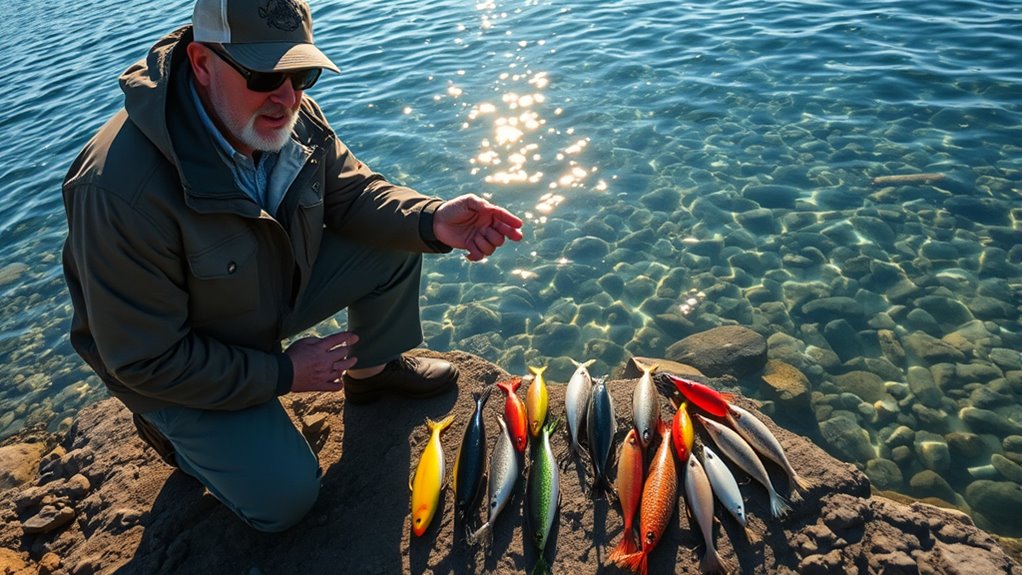
Water clarity influences which lure signals bass can detect most easily. You do not need a separate tackle box for every condition, but you should know when to emphasize realism and when to emphasize contrast or vibration.
Using the practical visibility bands in this guide, clear water around 8 feet or more is a good place to start with natural soft plastics in colors like green pumpkin, watermelon, smoke, shad, and translucent baitfish patterns. Silent crankbaits, small swimbaits, finesse jigs, drop shots, Ned rigs, and shaky heads can also fit the situation.
Clear water often rewards realism. Use thinner profiles when bass are pressured, and match the local forage when you can. If bass are chasing shad, try pearl, silver, smoke, or natural baitfish colors. Around bluegill, green pumpkin, watermelon, amber, or subtle bluegill tones can look more natural.
For lightly stained water around 4 to 8 feet of visibility, baits that add some flash or vibration can remain visible without becoming excessively aggressive. Spinnerbaits, swim jigs, underspins, small bladed jigs, and crankbaits all fit this middle range.
In stained water around 2 to 4 feet of visibility, choose stronger contrast. Square bills, lipless crankbaits with rattles, bladed jigs, spinnerbaits, and darker soft plastics give bass additional visual or mechanical cues.
In dirty water around 0 to 2 feet of visibility, dark colors like black, black-blue, and junebug can create a strong silhouette. Bright colors like chartreuse, white, orange, and firetiger can also provide useful contrast under the right light conditions.
Bulkier baits can move more water. A Colorado-blade spinnerbait, vibrating jig with a full trailer, bulky jig, creature bait, ribbon-tail worm, or square bill that deflects off cover can give fish a stronger close-range target.
Treat these choices as starting points rather than fixed rules. Forage, light, depth, season, and bass behavior can override a simple color chart.
Note: “Bright” does not always mean better. In muddy water, a black-and-blue jig may outperform chartreuse because its dark body creates a strong silhouette against available light.
Techniques for Fishing in Varying Water Conditions
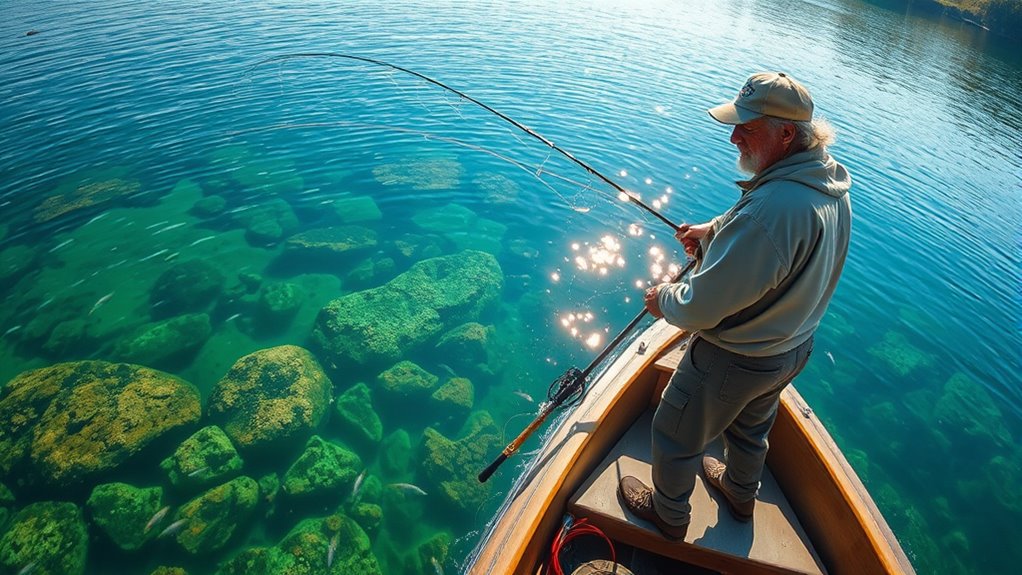
The same lure can produce very different results when you change cast angle, retrieve speed, pause length, distance from the fish, or contact with cover. Clarity should influence those presentation choices as much as it influences color.
In clear water, natural soft plastics in colors such as green pumpkin or watermelon are useful starting points. Finesse techniques such as shaky heads, drop shots, Ned rigs, wacky rigs, and weightless stick baits can help when bass are cautious.
Long casts can be valuable in clear water because they increase the distance between the fish and the angler, boat, or shoreline movement. Keep unnecessary noise low and use line strength that still safely matches the cover. For a deeper treatment of these conditions, see the clear-water fishing tactics guide.
For moving baits in clear water, try steady retrieves, subtle twitches, and natural pauses before increasing sound or vibration. A silent crankbait or soft swimbait can be a better starting point than an aggressively rattling bait when fish are pressured.
For lightly stained water, baits that combine a natural profile with flash or vibration include spinnerbaits, swim jigs, underspins, and small bladed jigs.
In stained water, use stronger contrast with square bills, lipless crankbaits, bladed jigs, or spinnerbaits. Target visible cover, grass edges, docks, laydowns, riprap, points, and current seams where a bass can intercept prey.
When faced with dirty water, choose a strong silhouette or visible contrast and put the lure close to likely fish-holding cover. Pitching, flipping, short roll casts, and repeated casts from different angles can give fish more chances to detect the bait.
Use contact in low visibility. Bump a square bill into wood, tick a spinnerbait over grass, drag a jig through cover, or crawl a bulky worm along the bottom. Contact changes the lure’s speed, vibration, and direction and can make it easier for a nearby bass to detect.
Adjust retrieval speed with temperature and fish activity as well as clarity. Cold conditions often favor more deliberate presentations, while warm water and active fish may let you cover water more quickly.
Pro Tip: In muddy water, make several accurate casts to the same high-percentage piece of cover from different angles. Reduced visual range can mean a lure has to pass closer to a fish before it gets noticed.
Essential Tackle for Different Clarity Levels
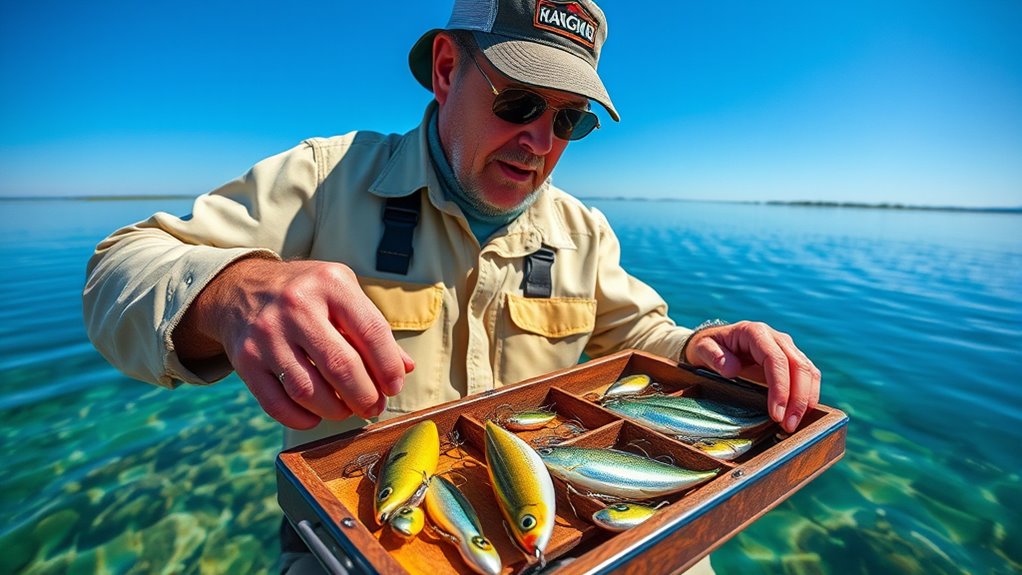
Choosing tackle for different water clarity levels is not only about lure color. Your line, rod power, lure weight, hook, and trailer affect how naturally the presentation moves and how effectively you can fish the available cover.
In clear conditions, natural soft plastics such as green pumpkin, watermelon, smoke, and shad colors are dependable starting points, along with quiet crankbaits and subtle swimbaits.
Fluorocarbon is commonly used for many clear-water and bottom-contact presentations because it is less visible underwater than many line alternatives and it sinks. It is not literally invisible, and it is not the best choice for every technique, especially presentations where a sinking line works against the lure. Use the lightest line that still safely matches the cover, lure, and fish size.
For lightly stained water, spinnerbaits, swim jigs, underspins, bladed jigs, and crankbaits can combine a visible profile with movement or flash.
In stained water, try stronger contrast and a lure that gives off a detectable signal, such as a square bill, lipless crankbait, spinnerbait, or bladed jig.
For dirty water, focus on strong silhouettes or bold contrast plus bulk, vibration, sound, deflection, or close placement. Pitching and flipping are useful when fish hold near shallow cover.
Use a rod with enough backbone when fishing stained or dirty water around wood, grass, docks, reeds, or rocks. Close-range strikes around cover may require you to set the hook and move a fish away from the obstruction quickly.
Fish attractant or scent is optional. Treat it as a secondary cue rather than a substitute for finding fish, choosing a detectable presentation, and putting the lure in the right place.
Keep your tackle box simple but complete. A few natural soft plastics, a finesse rig, spinnerbait, bladed jig, square bill, lipless crankbait, dark jig, and high-contrast dirty-water option can cover most visibility changes without forcing you to carry dozens of nearly identical colors.
Best Lure Colors by Water Clarity
Color choice should start with visibility, but it should not end there. Match the water first, then consider forage, sunlight, depth, bottom color, and fishing pressure.
- Clear water: Green pumpkin, watermelon, smoke, pearl, silver, shad, translucent baitfish, and natural bluegill shades.
- Lightly stained water: Green pumpkin with blue or purple flake, white, pearl, gold, bluegill, subtle chartreuse, and natural craw colors.
- Stained water: Chartreuse-white, black-blue, red craw, firetiger, orange belly, gold blade combinations, and darker soft plastics.
- Dirty water: Black, black-blue, junebug, chartreuse, white, orange, firetiger, and bold two-tone colors with strong contrast.
On bright days, extra flash can help in some stained-water situations but may look excessive when clear-water fish have time to inspect the bait. Under dimmer conditions, a solid or dark silhouette can become easier to distinguish.
Red, orange, and craw patterns are common choices around crawfish-oriented cover, while shad and pearl colors fit baitfish patterns. Bluegill colors can be useful around grass, docks, shallow cover, and other areas where sunfish are present.
How Weather and Season Change Water Clarity
Water clarity rarely stays identical all season. Rainfall, runoff, wind, suspended sediment, algae, water level, and current can change how far light penetrates and how far an angler can see into the water.
Heavy rain can carry sediment and debris into creeks, pockets, and shallow banks. After runoff, look for transition areas where dirtier water meets clearer water, as well as protected pockets or cleaner inflows.
Wind can reduce clarity on shallow banks by stirring sediment. It can also break up the surface and reduce visibility from above, so a windblown, lightly stained bank may fish differently from a calm clear bank nearby.
Algae can also reduce water transparency. When visibility drops, increase the lure’s detectable signal gradually and keep searching for areas with active baitfish and fish-holding cover rather than assuming color alone will solve the problem.
Cold fronts can change activity regardless of clarity. When fish stop chasing, slow the presentation, tighten your target area, and keep the lure in productive water longer.
Warning: Do not assume muddy water is unsafe to fish, but stay alert after storms. Fast current, floating debris, slick banks, changing water levels, and poor visibility can create serious hazards from shore or boat.
Where to Fish When Water Clarity Changes
Water clarity can affect location as well as lure choice. When visibility changes, bass may reposition relative to depth, shade, current, structure, and cover.
In clear water, bass may use deeper structure, shade, vegetation edges, brush, rock transitions, or other areas that let them feed without staying exposed in shallow open water.
In lightly stained water, bass may be comfortable feeding shallower, making spinnerbaits, swim jigs, crankbaits, and bladed jigs useful search baits around grass, docks, wood, and riprap.
In stained water, target obvious ambush features such as laydowns, dock corners, grass holes, stump fields, bridge pilings, creek bends, current breaks, and rocky banks.
In dirty water, shorten the distance between your lure and likely fish-holding cover. Hard cover, bank irregularities, shallow targets, current breaks, and clarity-transition edges give you defined places to cast.
If an entire creek turns muddy after rain, compare it with nearby water before leaving. A protected pocket, main-lake edge of the stain, cleaner inflow, or wind-protected bank may provide better visibility. For a full condition-specific approach, see the muddy-water bass fishing guide.
Common Misconceptions About Water Clarity

Several common water-clarity rules are useful starting points, but they become misleading when treated as absolutes.
One misconception is that clear water is always preferable. Clear water can produce excellent fishing, but greater visibility also gives bass more opportunity to inspect lures, line, and unnatural movement.
Murky or muddy water can still produce good fishing. Bass retain non-visual sensory tools such as the lateral line, but that does not mean turbidity has no cost. Research on largemouth bass shows that sufficiently high turbidity can alter prey selection and reduce overall foraging rate.
Another myth is that bright colors are automatically best whenever visibility drops. Dark baits can create a strong silhouette, while bright colors can create contrast under other conditions. Black-blue, junebug, chartreuse, white, orange, and firetiger all have roles, but no one color wins in every stained lake.
Fish are also not automatically inactive just because water is murky. Their activity still depends on temperature, forage, current, weather, season, dissolved oxygen, and other conditions.
Another mistake is using the same retrieve all day. If bass miss a moving bait in stained water, slow down or change the angle. If fish follow in clear water without committing, downsize, reduce sound, change color, or increase casting distance.
Use clarity as a starting filter, then let actual fish response determine the next adjustment.
Water Clarity Troubleshooting
If you are not getting bites, clarity can help you decide which variable to test first. Change one or two things at a time so you learn what actually improved the presentation.
- Fish follow but do not bite in clear water: Downsize your lure, use a more natural or translucent color, reduce unnecessary sound, or make longer casts.
- Fish miss a moving bait in stained water: Slow the retrieve, change your casting angle, add a pause, or choose a lure with a more consistent vibration.
- You get no bites in muddy water: Move closer to high-percentage shallow cover, use a stronger silhouette or bulkier bait, and make accurate repeat casts.
- Your lure disappears almost immediately: Increase contrast, vibration, water displacement, or sound before assuming the fish are not present.
- The water clears during the day: Move toward quieter presentations, more natural colors, and greater casting distance.
- The water muddies after wind or rain: Look for cleaner-water edges, protected pockets, current breaks, and defined cover.
Sources Behind These Water-Clarity Guidelines
- U.S. Environmental Protection Agency: Water-clarity guidance describes Secchi depth as a measure of general transparency and explains how suspended particles and algae affect light penetration.
- Shoup & Wahl, 2009, Transactions of the American Fisheries Society: Experimental work on largemouth bass found that changing turbidity affected prey selection and that overall foraging rate was lower at the highest tested turbidity.
- Bleckmann & Zelick, 2009, Integrative Zoology: Review of the fish lateral-line system describes its ability to detect weak water motions and pressure gradients.
- Fishbrain and Fishidy: Current product and waterbody pages were reviewed on September 11, 2026 for the fishing-app FAQ below.
Related Guides
Frequently Asked Questions
Does water clarity affect fishing?
Yes. Water clarity changes how far bass can visually detect and inspect prey, which affects lure presentation, color, casting distance, retrieve, and location. Clear water usually favors subtle natural presentations, while stained or dirty water often calls for stronger contrast, vibration, sound, water displacement, or closer placement.
How do you measure water clarity for fishing?
For a quick fishing check, lower the same white lure, jig, or spinnerbait blade into the water and note the depth where it disappears. For standardized water-transparency monitoring, a Secchi disk is lowered until it is no longer visible. A lure-visibility test is useful for comparing fishing spots, but it is not the same measurement as official Secchi depth.
What fishing app shows water clarity?
Fishbrain’s BiteGuide lets anglers select water clarity as a condition and uses it when generating lure and color recommendations. Fishidy lists water-clarity classifications on some waterbody pages. Treat app information as a planning aid rather than a live instrument reading, and check the water when you arrive because rain, wind, runoff, and algae can change clarity quickly.
What color lure should you use for water clarity?
Start with natural or translucent colors such as green pumpkin, watermelon, smoke, pearl, and shad in clear water. Add flash or moderate contrast as the water stains. In dirty water, black-blue, junebug, chartreuse, white, orange, firetiger, and other high-contrast colors are useful starting points. Forage and light conditions should still influence the final choice.
Is clear water always better for bass fishing?
No. Clear water gives bass more visual range, but it also gives them more opportunity to inspect a lure and detect unnatural movement. Lightly stained water can still provide enough visibility for feeding while giving the angler more room to use flash, vibration, and moving baits.
How do you fish muddy water after rain?
Compare the muddy inflow with nearby water and look for clearer edges, protected pockets, current breaks, and shallow cover. Use a lure with strong contrast, vibration, sound, or water displacement, and cast accurately to likely fish-holding targets. Fish may need the lure to pass closer before they detect it.
Can bass find lures in muddy water?
Yes. Bass are not limited to vision. Their lateral-line system detects local water movement, so vibration and water displacement provide additional cues when visibility is poor. Heavy turbidity can still shorten visual reaction distance and reduce feeding efficiency, which is why close lure placement becomes more important.
Conclusion
Water clarity is one of the fastest observations you can use to organize your bass-fishing decisions. Clear water generally pushes you toward stealth, realism, and distance. As visibility drops, contrast, vibration, sound, water displacement, and accurate placement become more important.
Do not treat clarity as a color chart by itself. Measure the water, identify the likely forage, choose the amount of lure signal the conditions call for, and then adjust your retrieve and target distance based on how fish respond.
Check visibility again when you change areas or when wind, rain, runoff, or sunlight changes the water. That simple habit gives you a repeatable reason for changing lures instead of guessing.