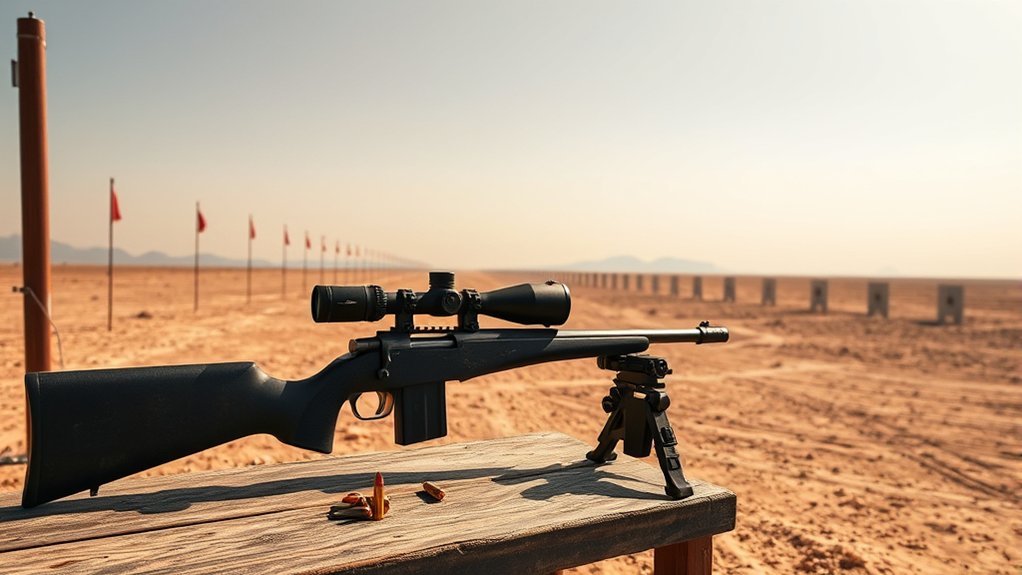
The maximum effective range for small arms fire varies widely based on firearm type, ammunition caliber, and shooter proficiency. Generally, rifles achieve ranges of 400 to 800 yards, with specialized ammunition exceeding 1,500 yards. Handguns possess effective ranges of about 50 to 100 yards, while shotguns range from 35 to 150 yards. Factors such as shooter skill and environmental conditions further influence these ranges. Understanding these variables can enhance shooting performance and optimize engagement distance.
What Is Maximum Effective Range?
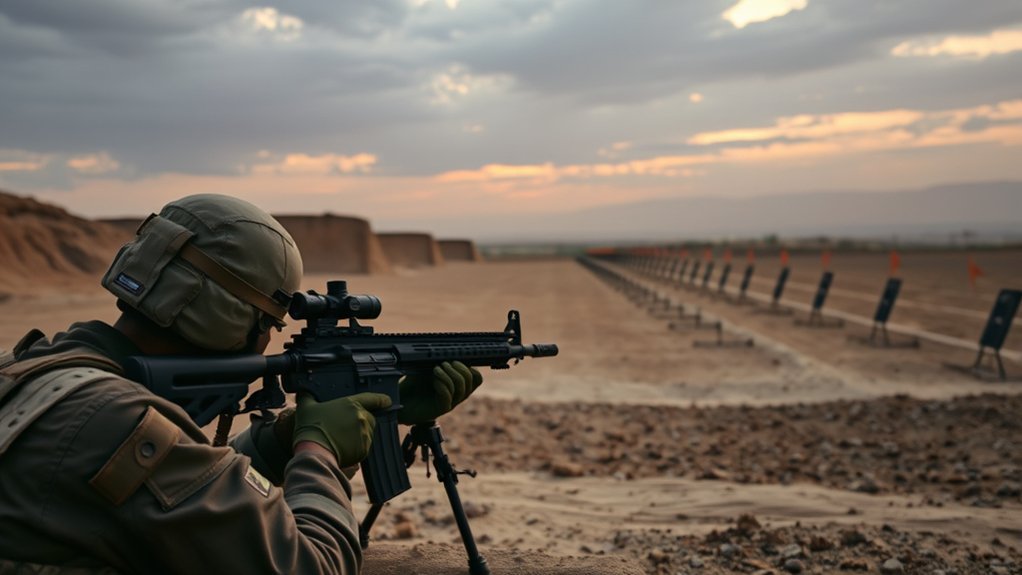
The concept of maximum effective range serves as a critical benchmark in the field of marksmanship and ballistics. It is defined as the farthest distance at which a shooter can consistently hit targets with accuracy, influenced by various factors such as ammunition type and shooter skill.
For rifles, the maximum effective range typically ranges from 400 to 800 yards, contingent on caliber and environmental factors. Specialized rounds, like the .338 Lapua Magnum, can extend this range beyond 1,500 yards.
In contrast, handguns generally possess a maximum effective range of approximately 50 yards, though skilled shooters can achieve up to 100 yards with magnum calibers. Shotguns are ideal for close engagements, with effective ranges of 35 to 150 yards depending on the load.
Environmental factors, including wind and temperature, necessitate adjustments in aim, underscoring the complexity of achieving precision at long ranges.
Key Factors Influencing Effective Range in Small Arms
Understanding maximum effective range requires an examination of various key factors that influence small arms fire.
The caliber of ammunition plays a significant role; larger calibers typically offer greater effective ranges due to enhanced energy and velocity.
Shooter skill is equally important; experienced marksmen can maintain accuracy and consistency at extended distances, thereby extending the effective range compared to novices.
Environmental conditions, such as wind speed, temperature, and humidity, can adversely affect ballistic performance, necessitating precise adjustments in aim.
Additionally, the design of the weapon system, including barrel length and sighting mechanisms, directly impacts bullet velocity and accuracy, influencing maximum effective range.
Finally, the type of ammunition—like hollow point versus full metal jacket—determines terminal performance and penetration, further establishing how effective a shot will be at specific ranges.
Collectively, these factors shape the parameters of effective ranges for small arms fire.
Effective Ranges for Firearms and Ammunition
Effective ranges for firearms and ammunition vary widely across different calibers and types of weapons, influenced by design characteristics and intended use.
Standard pistol calibers, such as 9mm, have an effective range of approximately 50 yards, extendable to 100 yards by skilled shooters using magnum calibers and optics.
In contrast, rifles exhibit more significant variability; for example, the effective range of the 5.56×45 mm NATO can reach 600 yards, while the .338 Lapua Magnum can exceed 1,500 yards.
Shotguns are optimized for closer engagements, with birdshot effective up to 50 yards and slugs achieving up to 150 yards.
The AR-15 demonstrates practical effective ranges of 400 to 600 yards for point targets, with a maximum range reaching about 3,000 yards.
Environmental factors such as wind and temperature further influence effective range and accuracy, requiring adjustments to maximize kinetic energy and achieve precision at longer ranges.
How Does Shooter Skill Affect Effective Range?
Shooter skill plays a critical role in determining effective range, as consistent practice enhances a shooter’s ability to maintain accuracy across various positions.
Additionally, the ability to manage stress factors, such as heart rate and breathing control, further influences precision under pressure.
Accurate range estimation techniques are essential, as misjudging distances can greatly compromise engagement success.
Importance of Practice Consistency
Mastering the nuances of small arms fire requires consistent practice, as proficiency directly impacts a shooter’s effective range. Experienced shooters can reliably hit targets beyond 400 yards with rifle rounds, while novices may falter even at 100 yards.
- Regular practice develops essential muscle memory.
- Enhanced accuracy leads to tighter groupings, extending effective range.
- Breathing control and trigger discipline are critical for precision.
- Utilizing various shooting positions simulates real-world scenarios.
- Performance tracking identifies improvement areas, guiding targeted practice.
These factors underscore the importance of practice consistency in achieving peak shooting performance. Without disciplined training, a shooter’s ability to engage effectively diminishes, limiting their potential in varied conditions and distances.
Impact of Stress Factors
Stress factors play a critical role in determining a shooter’s effective range, as they can greatly impair performance under pressure. Experienced shooters possess the skills necessary to shoot accurately at distances exceeding 600 yards, while novices may falter at shorter ranges.
Key elements like field marksmanship, which encompasses estimating range and adjusting for wind drift, are crucial; even minor miscalculations can drastically affect accuracy. Additionally, environmental distractions and elevated heart rates can expand shot group sizes, diminishing a shooter’s precision.
Regular training and engaging in realistic practice scenarios are essential for mastering these challenges, fostering an understanding of one’s firearm, and ultimately enhancing effective range. By mitigating stress factors, shooters can better adapt to real-world conditions and improve their overall performance.
Techniques for Range Estimation
Effective range estimation is an essential skill that directly influences shooting accuracy, particularly as distances increase. Shooter skill greatly impacts effective range; experienced marksmen consistently hit targets at greater distances, while novices struggle beyond 100 yards.
Techniques for range estimation can enhance accuracy, including:
- Utilizing a rangefinder for precise distance measurement.
- Estimating distances based on known landmarks and measurements.
- Practicing various shooting positions to understand stability’s effect on precision.
- Adapting techniques to environmental factors like wind and lighting.
- Regularly measuring group sizes during practice to assess how distance affects accuracy.
These techniques collectively empower shooters to optimize their effective range, ultimately enhancing performance in diverse shooting scenarios.
Impact of Environmental Conditions on Effective Range
Environmental conditions play a critical role in determining the effective range of small arms fire. Factors such as wind speed and direction necessitate precise adjustments to account for trajectory deviations.
Meanwhile, temperature and humidity affect air density, influencing bullet velocity and stability. Understanding these elements is essential for optimizing shooting performance under varying atmospheric scenarios.
Wind Speed Effects
Although often overlooked, wind speed plays an essential role in determining the effective range of small arms fire. A 10 mph crosswind can deflect a bullet several inches at 100 yards, necessitating windage adjustments for accurate shooting.
Lighter calibers, such as the 5.56×45 mm NATO, are particularly susceptible to drift from even mild winds, impacting their maximum effective range. Additionally, environmental factors like wind gusts create unpredictable shooting conditions, complicating accuracy.
Shooters must also consider the Coriolis effect at distances exceeding 1,000 yards.
- Wind speed can shift bullet trajectory considerably.
- Light winds affect lighter calibers more severely.
- Wind gusts complicate marksmanship.
- Accurate shooting requires wind condition assessment.
- Training is essential for compensating for wind effects.
Temperature Influence
Temperature greatly influences the performance of small arms fire by altering air density, which affects bullet dynamics. In colder conditions, denser air increases bullet drag, often resulting in a reduced maximum effective range.
Conversely, higher temperatures decrease air density, which can lessen drag and potentially extend effective range. While humidity also impacts air density, its effects are similar to those of higher temperatures, allowing for slight improvements in effective range.
Additionally, temperature variations influence wind patterns, which can considerably alter bullet trajectory, necessitating adjustments for accuracy.
Extensive training across varied temperatures enables shooters to understand these factors, enhancing their adaptability and proficiency in the field, ultimately optimizing their effectiveness in diverse environmental conditions.
Humidity Considerations
Humidity plays a critical role in determining the effective range of small arms fire, as it influences air density and bullet performance. High humidity can drastically impact various factors affecting accuracy and range.
- Increased air resistance reduces bullet velocity, leading to decreased maximum effective range.
- Moisture absorption in ammunition can compromise powder consistency, affecting reliability.
- Trajectory changes occur due to altered air density, resulting in increased bullet drop over distances.
- Visibility issues arise from haze created by humidity, complicating target engagement.
- Shooters must adjust aim to account for bullet drop, necessitating practice in varying conditions.
Understanding these factors is essential for maximizing effectiveness and ensuring precision in diverse environments.
Choosing the Right Ammunition for Maximum Effective Range?
When selecting ammunition for maximum effective range, one must consider several critical factors that influence performance. The choice of ammunition directly affects effective range; for instance, 5.56×45 mm NATO cartridges are tailored for up to 600 yards, whereas .50 BMG cartridges can exceed 1,600 yards.
High-velocity ammunition, such as bonded bullets, requires a minimum velocity of approximately 1,800 fps to retain effectiveness over long distances. Understanding projectile design is essential; conventional bullets need around 1,600 fps for proper expansion, while mono-metal bullets excel at velocities exceeding 2,000 fps.
Additionally, bullet weight plays a significant role; heavier bullets generally maintain effectiveness better than lighter counterparts at extended ranges. Utilizing ballistics calculators will aid in evaluating performance across various ranges, enabling shooters to make informed decisions about suitable ammunition selection tailored to specific shooting scenarios.
Maximize Your Effective Range in the Field
Maximizing effective range in the field necessitates a thorough understanding of various factors that influence shooting performance. To achieve the desired accuracy, shooters must consider the unique capabilities of their rifle and the environmental conditions that can affect trajectory.
- Recognize the impact of bullet drop at various distances.
- Practice shooting from diverse field positions for practical application.
- Utilize high-quality optics and appropriate ammunition.
- Regularly document shooting performance to analyze patterns.
- Understand that environmental factors, such as wind, can make shots susceptible to deviation.
Frequently Asked Questions
What Is the 333 Rule for Guns?
The 333 Rule for guns outlines proficiency at three distances: 3 yards, 30 yards, and 300 yards. This approach enhances marksmanship techniques while considering ballistic performance, ammunition types, and environmental factors affecting effective range.
What Gun Will Shoot 1000 Yards?
Long-range rifles, such as the .338 Lapua Magnum, excel at 1,000 yards when paired with appropriate caliber selection. Mastering shooting techniques and utilizing high-quality optics are essential for compensating bullet drop and achieving accuracy.
What Counts as Small Arms Fire?
Small arms fire encompasses firearms classified for individual use, including handguns and rifles, characterized by varied effective ranges. Key factors include ammunition types, shooting techniques, and military applications, influencing performance and tactical effectiveness in combat scenarios.
How Effective Is 9mm at 100 Yards?
At 100 yards, 9mm exhibits diminishing ballistic performance, influenced by accuracy factors such as shooter skill, environmental influences, and ammunition types. Effective engagements require precision, with hollow points outperforming full metal jackets in terminal performance.
Conclusion
In conclusion, the maximum effective range of small arms fire is influenced by various factors, including the type of firearm, ammunition, shooter skill, and environmental conditions. While some may argue that effective range is primarily determined by the weapon itself, it is evident that a combination of these elements plays a vital role. Understanding and optimizing each factor enables shooters to enhance their performance, making informed choices essential for achieving precision and efficacy in diverse scenarios.
